22 August 2010

Victoria Cross: A. C. Mynarski

ANDREW CHARLES MYNARSKI

Pilot Officer, Royal Canadian Air Force; 419 (RCAF) Squadron

Born: 14 October 1916, Winnipeg, Manitoba, Canada
Died: 13 June 1944, France

Citation: Pilot Officer Mynarski was the mid-upper gunner of a Lancaster aircraft, detailed to attack a target at Cambrai in France, on the night of 12th June, 1944. The aircraft was attacked from below and astern by an enemy fighter and ultimately came down in flames.
As an immediate result of the attack, both port engines failed. Fire broke out between the mid-upper turret and the rear turret, as well as in the port wing. The flames soon became fierce and the captain ordered the crew to abandon the aircraft.
Pilot Officer Mynarski left his turret and went towards the escape hatch. He then saw that the rear gunner was still in his turret and apparently unable to leave it. The turret was, in fact, immovable, since the hydraulic gear had been put out of action when the port engines failed, and the manual gear had been broken by the gunner in his attempts to escape.
Without hesitation, Pilot Officer Mynarski made his way through the flames in an endeavour to reach the rear turret and release the gunner. Whilst so doing, his parachute and his clothing, up to the waist, were set on fire. All his efforts to move the turret and free the gunner were in vain. Eventually the rear gunner clearly indicated to him that there was nothing more he could do and that he should try to save his own life. Pilot Officer Mynarski reluctantly went back through the flames to the escape hatch. There, as a last gesture to the trapped gunner, he turned towards him, stood to attention in his flaming clothing and saluted, before he jumped out of the aircraft. Pilot Officer Mynarski's descent was seen by French people on the ground. Both his parachute and clothing were on fire. He was found eventually by the French, but was so severely burnt that he died from his injuries.
The rear gunner had a miraculous escape when the aircraft crashed. He subsequently testified that, had Pilot Officer Mynarski not attempted to save his comrade's life, he could have left the aircraft in safety and would, doubtless, have escaped death.
Pilot Officer Mynarski must have been fully aware that in trying to free the rear gunner he was almost certain to lose his own life. Despite this, with outstanding courage and complete disregard for his own safety, he went to the rescue. Willingly accepting the danger, Pilot Officer Mynarski lost his life by a most conspicuous act of heroism which called for valour of the highest order.

[London Gazette issue 37754 dtd 11 Oct 1946, published 8 Oct 1946.]

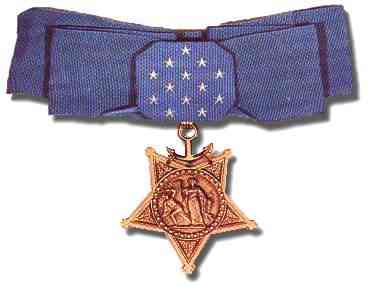
Medal of Honor: J. W. Covington

JESSE WHITFIELD COVINGTON

Ship's Cook Third Class, US Navy; USS Stewart (DD 13)

Born: 16 September 1889, Haywood, Tennessee
Died: 21 November 1966, Virginia(?)

Citation: For extraordinary heroism following internal explosion of the Florence H [on 17 April 1918]. The sea in the vicinity of wreckage was covered by a mass of boxes of smokeless powder, which were repeatedly exploding. Jesse W. Covington, of the U.S.S. Stewart, plunged overboard to rescue a survivor who was surrounded by powder boxes and too exhausted to help himself, fully realizing that similar powder boxes in the vicinity were continually exploding and that he was thereby risking his life in saving the life of this man.

20 August 2010

Velociraptor zombies

For those of you who didn't have enough to worry about.....

19 August 2010

RIP: Bill Millin


Bill Millin (right, closest to camera) prepares to wade ashore in Normandy, 6 Jun 1944.


Bill Millin
14 July 1922 - 17 Aug 2010


ZUI this article from the New York Times:
Bill Millin, a Scottish bagpiper who played highland tunes as his fellow commandos landed on a Normandy beach on D-Day and lived to see his bravado immortalized in the 1962 film “The Longest Day,” died on Wednesday in a hospital in the western England county of Devon. He was 88.

Mr. Millin was a 21-year-old private in Britain’s First Special Service Brigade when his unit landed on the strip of coast the Allies code-named Sword Beach, near the French city of Caen at the eastern end of the invasion front chosen by the Allies for the landings on June 6, 1944.

*******

The young piper was approached shortly before the landings by the brigade’s commanding officer, Brig. Simon Fraser, who as the 15th Lord Lovat was the hereditary chief of the Clan Fraser and one of Scotland’s most celebrated aristocrats. Against orders from World War I that forbade playing bagpipes on the battlefield because of the high risk of attracting enemy fire, Lord Lovat, then 32, asked Private Millin to play on the beachhead to raise morale.

When Private Millin demurred, citing the regulations, he recalled later, Lord Lovat replied: “Ah, but that’s the English War Office. You and I are both Scottish, and that doesn’t apply.”

After wading ashore in waist-high water that he said caused his kilt to float, Private Millin reached the beach, then marched up and down, unarmed, playing the tunes Lord Lovat had requested, including “Highland Laddie” and “Road to the Isles.”

*******

After the war, he worked on Lord Lovat’s estate near Inverness, but found the life too quiet and took a job as a piper with a traveling theater company. In the late 1950s, he trained in Glasgow as a psychiatric nurse and eventually settled in Devon, retiring in 1988. He visited the United States several times, lecturing on his D-Day experiences.

In 1954 he married Margaret Mary Dowdel. A widower, he is survived by their son, John.
(Links in original.)

15 August 2010

Victoria Cross: R. C. Travis

RICHARD CHARLES TRAVIS, DCM MM

Serjeant, 2nd Battalion the Otago Infantry Regiment, New Zealand Forces

Born: 6 April 1884, Otara, Opotiki, Southland, New Zealand
Died: 25 July 1918, France

Citation: For most conspicuous bravery and devotion to duty.
During "surprise" operations [on 24 July 1918, at Rossignol Wood, north of Hebuterne, France,] it was necessary to destroy an impassable wire block. Sjt. Travis, regardless of all personal danger, volunteered for this duty. Before zero hour, in broad daylight, and in close proximity to enemy posts, he crawled out and successfully destroyed the block with bombs, thus enabling the attacking parties to pass through.
A few minutes later a bombing party on the right of the attack was held up by two enemy machine guns, and the success of the whole operation was in danger. Perceiving this, Sjt. Travis, with great gallantry and utter disregard of danger, rushed the position, killed the crew, and captured the guns. An enemy officer and three men immediately rushed at him from a bend in the trench and attempted to retake the guns. These four he killed single-handed, thus allowing the bombing party, on which much depended, to advance.
The success of the operation was almost entirely due to the heroic work of this gallant N.C.O., and to the vigour with which he made and used opportunities for inflicting casualties on the enemy.
He was killed twenty-four hours later, when, under a most intense bombardment prior to an enemy counter-attack, he was going from post to post, encouraging the men.

(London Gazette Issue 30922 dated 27 Sep 1918, published 24 Sep 1918.)

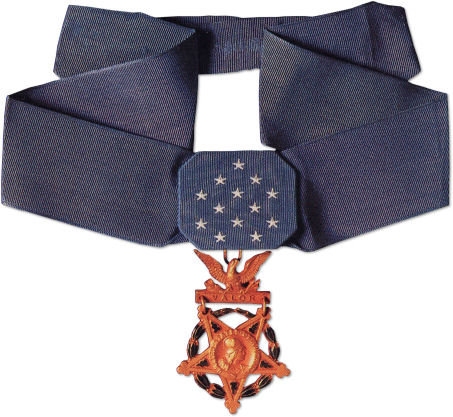
Medal of Honor: J. L. Day

JAMES LEWIS DAY

Corporal, US Marine Corps; 2nd Battalion, 22nd Marine Regiment, 6th Marine Division

Born: 5 October 1925, East St Louis, Illinois
Died: 18 October 1998, Cathedral City, California

Citation: For conspicuous gallantry and intrepidity at the risk of his life above and beyond the call of duty as a squad leader serving with the Second Battalion, Twenty-Second Marines, Sixth Marine Division, in sustained combat operations against Japanese forces on Okinawa, Ryukya Islands from 14 to 17 May 1945. On the first day, Corporal Day rallied his squad and the remnants of another unit and led them to a critical position forward of the front lines of Sugar Loaf Hill. Soon thereafter, they came under an intense mortar and artillery barrage that was quickly followed by a ferocious ground attack by some forty Japanese soldiers. Despite the loss of one-half of his men, Corporal Day remained at the forefront, shouting encouragement, hurling hand grenades, and directing deadly fire, thereby repelling the determined enemy. Reinforced by six men, he led his squad in repelling three fierce night attacks but suffered five additional Marines killed and one wounded, whom he assisted to safety. Upon hearing nearby calls for corpsman assistance, Corporal Day braved heavy enemy fire to escort four seriously wounded Marines, one at a time, to safety. Corporal Day then manned a light machine gun, assisted by a wounded Marine, and halted another night attack. In the ferocious action, his machine gun was destroyed, and he suffered multiple white phosphorous and fragmentation wounds. He reorganized his defensive position in time to halt a fifth enemy attack with devastating small arms fire. On three separated occasions, Japanese soldiers closed to within a few feet of his foxhole, but were killed by Corporal Day. During the second day, the enemy conducted numerous unsuccessful swarming attacks against his exposed position. When the attacks momentarily subsided, over 70 enemy dead were counted around his position. On the third day, a wounded and exhausted Corporal Day repulsed the enemy's final attack, killing a dozen enemy soldiers at close range. Having yielded no ground and with more than 100 enemy dead around his position, Corporal Day preserved the lives of his fellow Marines and made a significant contribution to the success of the Okinawa campaign. By his extraordinary heroism, repeated acts of valor, and quintessential battlefield leadership, Corporal Day inspired the efforts of his outnumbered Marines to defeat a much larger enemy force, reflecting great credit upon himself and upholding the highest traditions of the Marine Corps and the United States Naval Service.


Note: Major General Day was presented with the Medal of Honor by President Clinton on 20 January 1998. The paperwork for the medal had been lost; it resurfaced in 1980 but then took 18 more years to work its way through the system.

13 August 2010

FY11 MCPO and SCPO selectees


Posting the CPO results reminded me that while I had seen this year's MCPO list, I hadn't commented on it, and I hadn't seen the new SCPO list. So....

The MCPO list is here. I see one name I recognise - a QM nav ET from Providence.

The SCPO list is here. I see two on this list - both A-gangers, both from Prov.

Belated congratulations to all selectees!

FY11 CPO selectees

The list is out.

I recognised four names this time, an SK LS from Jax, and a mechanic and two sonar girls from Prov. My congratulations to them, and to all the other selectees.

11 August 2010

Living Medal of Honor recipients


In yesterday's post about David Dolby, the Congressional Medal of Honor Society (CMOHS) was quoted as saying that there are now 87 surviving MoH recipients. The complete list, with links to individual pages, can be found at the CMOHS site here; below is a simplified list.

World War II

Van T Barfoot, Second Lieutenant, US Army
Melvin E Biddle, Private First Class, US Army
Mike Colalillo, Private First Class, US Army
Charles H Coolidge, Technical Sergeant, US Army
Francis S Currey, Sergeant, US Army
Walter D Ehlers, Staff Sergeant, US Army
Barney F Hajiro, Private, US Army
John D Hawk, Sergeant, US Army
Daniel K Inouye, Second Lieutenant, US Army
Arthur J Jackson, Private First Class, US Marine Corps
Robert D Maxwell, Technician Fifth Grade, US Army
Vernon McGarity, Technical Sergeant, US Army
Charles P Murray Jr, First Lieutenant, US Army
Nicholas Oresko, Master Sergeant, US Army
Wilburn K Ross, Private, US Army
George T Sakato, Private, US Army
Paul J Wiedorfer, Staff Sergeant, US Army
Hershel W Williams, Corporal, US Marine Corps

Korean War

Hector A Cafferata Jr, Private, US Marine Corps
William R Charette, Hospital Corpsman Third Class, US Navy
Duane E Dewey, Corporal, US Marine Corps
Rodolfo P Hernandez, Corporal, US Army
Thomas J Hudner Jr, Lieutenant, US Navy
Einar H Ingman Jr, Sergeant, US Army
Hiroshi H Miyamura, Corporal, US Army
Ola L Mize, Master Sergeant, US Army
Ronald E Rosser, Corporal, US Army
Tibor Rubin, Corporal, US Army
Robert E Simanek, Private First Class, US Marine Corps
James L Stone, First Lieutenant, US Army
Ernest E West, Private First Class, US Army

Vietnam War

John P Baca, Specialist Fourth Class, US Army
John F Baker Jr, Sergeant, US Army
Donald E Ballard, Hospital Corpsman Second Class, US Navy
Harvey C Barnum Jr, Captain, US Marine Corps
Gary B Beikirch, Sergeant, US Army
Patrick H Brady, Major, US Army
Paul W Bucha, Captain, US Army
Jon R Cavaiani, Staff Sergeant, US Army
Bruce P Crandall, Major, US Army
Sammy L Davis, Sergeant, US Army
George E Day, Colonel, US Air Force
Drew D Dix, Staff Sergeant, US Army
Roger H C Donlon, Captain, US Army
Frederick E Ferguson, Chief Warrant Officer, US Army
Bernard F Fisher, Major, US Air Force
Michael J Fitzmaurice, Specialist Fourth Class, US Army
James P Fleming, Captain, US Air Force
Robert F Foley, Captain, US Army
Wesley L Fox, Captain, US Marine Corps
Harold A Fritz, Captain, US Army
Charles C Hagemeister, Specialist Fifth Class, US Army
Frank A Herda, Specialist Fourth Class, US Army
Robert R Ingram, Hospital Corpsman Third Class, US Navy
Joe M Jackson, Lieutenant Colonel, US Air Force
Jack H Jacobs, Captain, US Army
Don J Jenkins, Staff Sergeant, US Army
Thomas G Kelley, Lieutenant Commander, US Navy
Allan J Kellogg Jr, Gunnery Sergeant, US Marine Corps
Joseph R Kerrey, Lieutenant (Junior Grade), US Navy
Thomas J Kinsman, Specialist Fourth Class, US Army
Howard V Lee, Major, US Marine Corps
Peter C Lemon, Sergeant, US Army
Angelo J Liteky, Captain, US Army
Gary L Littrell, Sergeant First Class, US Army
James E Livingston, Captain, US Marine Corps
Allen J Lynch, Sergeant, US Army
Walter J Marm Jr, First Lieutenant, US Army
John J McGinty III, Second Lieutenant, US Marine Corps
David H McNerney, First Sergeant, US Army
Robert J Modrzejewski, Major, US Marine Corps
Thomas R Norris, Lieutenant, US Navy
Robert E O'Malley, Sergeant, US Marine Corps
Robert M Patterson, Sergeant, US Army
Richard A Pittman, Sergeant, US Marine Corps
Alfred V Rascon, Specialist Fourth Class, US Army
Ronald E Ray, Captain, US Army
Gordon R Roberts, Sergeant, US Army
Clarence E Sasser, Specialist Fifth Class, US Army
James M Sprayberry, Captain, US Army
Kenneth E Stumpf, Specialist Fourth Class, US Army
James A Taylor, Captain, US Army
Brian M Thacker, First Lieutenant, US Army
Michael E Thornton, Engineman Second Class, US Navy
Leo K Thorsness, Lieutenant, US Air Force
Jay R Vargas, Major, US Marine Corps
Gary G Wetzel, Specialist Fourth Class, US Army

That breaks down to:
18 World War II (16 Army, 2 Marine Corps)
13 Korean War (8 Army, 2 Navy and 3 Marine Corps)
56 Vietnam War (35 Army, 6 Navy, 10 Marine Corps and 5 Air Force)

(All MoH awards since the end of the Vietnam War have been posthumous.)
59 Army
8 Navy
15 Marine Corps
5 Air Force

(The only Coast Guardsman ever to be awarded the Medal, Signalman First Class Douglas A Munro, received it posthumously after his death at Guadalcanal in 1942.)

10 August 2010

RIP: David Dolby

David Charles Dolby
14 May 1946 – 6 August 2010


ZUI this article from the Chester County (PA) Daily Local News:
David C. Dolby, a Medal of Honor recipient and a fixture at local veteran events in recent years, died Friday morning in Spirit Lake, Idaho. He was 64.

Dolby, who lived in Royersford, was in Idaho for a veterans' gathering, according to friends.

The announcement of his death was made by the Congressional Medal of Honor Society. The cause was not announced.

*******

A Norristown native, Dolby was in a platoon of the 1st Cavalry Division during an attack as six of its members were killed instantly and others were wounded. In four hours of combat, he retrieved wounded men, stopped the enemy attack, reorganized his platoon and kept them covered during a counterattack. He was credited with saving the lives of many of his fellow soldiers while leaving himself continually in an exposed position, contributing to the overall success of the Army assault.

In all, Dolby served five tours in Vietnam.

*******

The Medal of Honor Society said there are 87 surviving Medal of Honor recipients.

************* *** *************

DAVID CHARLES DOLBY

Sergeant (then Specialist 4th Class), US Army; Company B, 1st Battalion (Airborne), 8th Cavalry, 1st Cavalry Division (Airmobile)

Born: 14 May 1946, Norristown, Pennsylvania
Died: 6 August 2010, Spirit Lake, Idaho

Citation: For conspicuous gallantry and intrepidity at the risk of life above and beyond the call of duty [on 21 May 1966, in the Republic of Vietnam], when his platoon, while advancing tactically, suddenly came under intense fire from the enemy located on a ridge immediately to the front. Six members of the platoon were killed instantly and a number were wounded, including the platoon leader. Sgt. Dolby's every move brought fire from the enemy. However, aware that the platoon leader was critically wounded, and that the platoon was in a precarious situation, Sgt. Dolby moved the wounded men to safety and deployed the remainder of the platoon to engage the enemy. Subsequently, his dying platoon leader ordered Sgt. Dolby to withdraw the forward elements to rejoin the platoon. Despite the continuing intense enemy fire and with utter disregard for his own safety, Sgt. Dolby positioned able-bodied men to cover the withdrawal of the forward elements, assisted the wounded to the new position, and he, alone, attacked enemy positions until his ammunition was expended. Replenishing his ammunition, he returned to the area of most intense action, single-handedly killed 3 enemy machine gunners and neutralized the enemy fire, thus enabling friendly elements on the flank to advance on the enemy redoubt. He defied the enemy fire to personally carry a seriously wounded soldier to safety where he could be treated and, returning to the forward area, he crawled through withering fire to within 50 meters of the enemy bunkers and threw smoke grenades to mark them for air strikes. Although repeatedly under fire at close range from enemy snipers and automatic weapons, Sgt. Dolby directed artillery fire on the enemy and succeeded in silencing several enemy weapons. He remained in his exposed location until his comrades had displaced to more secure positions. His actions of unsurpassed valor during 4 hours of intense combat were a source of inspiration to his entire company, contributed significantly to the success of the overall assault on the enemy position, and were directly responsible for saving the lives of a number of his fellow soldiers. Sgt. Dolby's heroism was in the highest tradition of the U.S. Army.

Bamboo People (Mitali Perkins)

Burma (officially, since 1989, the Union of Myanmar) is in southeast Asia, between India and Thailand. It was an independent kingdom for several hundred years, but after a series of three wars with Britain, the Konbaung dynasty fell and Burma was annexed into the British Empire in 1885. The country was occupied by the Japanese from 1942 until 1945 (one of their accomplishments being the construction of a railroad from Bangkok, Thailand, to the Burmese capital at Rangoon), after which the country reverted to British rule.

Independence was granted in 1948. In 1962, General Ne Win - former Chief of Staff of the Armed Forces and interim Prime Minister - led a successful coup. The military has retained control of Burma since then, ignoring the results of elections and viciously suppressing protests. The junta which seized power in 1988 has been accused of many human-rights violations, including murder, brutal military offensives against ethnic minorities (such as the Karen), forced labour, and the use of child soldiers.

Chiko is a 15-year-old Burmese boy, living alone with his mother in Yangon (the former Rangoon) since his father was arrested for treason four months ago. The father was a doctor, and Chiko learned much from him, including reading and writing (both Burmese and English). Since the arrest there has been no money coming in, and Chiko's mother has been selling off household goods in order to buy food. Chiko wants to become a teacher, and when he spots an ad in the paper he talks his mother into letting him apply for the job and take the examination. It turns out to be a trap, though; boys who have shown up for the exam are grabbed by soldiers and forced into the Army. Their training camp is a former Karenni school near the Thai border.

Tu Reh is a 16-year-old Karenni boy. After his village was burned by Burmese soldiers, he fled with his parents and sister to a refugee camp just across the border in Thailand. Since then, he and his best friend, Sa Reh, have been looking forward to getting revenge. Now, for the first time, he is accompanying his father and other men from the camp on a mission to deliver medical supplies and food to Karenni hiding in the jungle. They are unarmed, but he is at least accomplishing something.

And now, somewhere out in the jungle, Chiko and Tu Reh are about to meet....

The good: First-person present-tense narratives normally annoy me, but after the first couple of pages I didn't even notice that the book was written this way (with the first section narrated by Chiko and the second by Tu Reh).

I really hadn't read much about Burma (other than in books about World War II) before this book came along, and I'm sure most American readers will know less than I did. Perkins manages to provide background information without resorting to info dumps such as my first two paragraphs above; details are worked in as the story progresses.
I lift the cover off the plate and see ngapi, the dried and fermented shrimp paste we eat with every meal; rice; and a few chunks of chicken floating in a pale, weak curry. [Chiko, p 8]

*******

Sidewalk vendors are beginning to set up wares for the afternoon. The rickshaw veers to avoid children playing in the streets. These little ones should be inschool, but they don't have a choice. Schools have been closed so many times that nobody can learn much. [Chiko, p 25]

*******

"Home" in the camp is a bamboo hut on stilts. Looks a bit like our house in the village, but it's much smaller. ... I put my bamboo pole where it belongs, against the wall near my sleeping mat. Afternoon sunshine filters through the walls. Sand is piled in one corner of the room, and a pot of rice steams there on a small fire. [Tu Reh, p 195]

I read Perkins's previous book, Secret Keeper, last year, and was left wondering how, should UFOs ever land and disgorge their crews, we could possibly understand them; the people in Secret Keeper are every bit as human as I am, but I couldn't understand the way their minds worked at all - the cultural differences were just too great. Maybe it's just a guy thing, but I didn't have that problem at all with Bamboo People; the themes of war, hate and revenge were much simpler.

A couple of back-of-the-book notes give background on Burma and its history, and on the author's interest therein.

The bad: The Burmese and Karenni names are a little confusing, especially the latter. For instance, all of the male Karenni are named Reh (Tu Reh, Sa Reh, Bu Reh) and all of the females are named Meh (Oo Meh, Ree Meh, Nya Meh). Since Oo Meh is Tu Reh's sister, and Oo Reh is their father, I'm assuming that "Meh" and "Reh" are actually sex* markers, not names; in fact, I'm going to slide a little farther out on my limb here and guess that they actually mean "daughter" and "son." It really would have been nice to have another note, concerning names, at the back of the book.

And I'm sorry, but "Chiko" is just too much like "Chico" - I kept snickering as I pictured a Mexican boy lost in the Burmese jungles....


Bamboo People: A Novel, by Mitali Perkins. Charlesbridge, 2010. Young adult. Available from Amazon and Barnes & Noble, of course - though buying through IndieBound or from your local independent bookseller is highly recommended!

Other reviews can be found here (A Chair, A Fireplace and a Tea Cozy) and here (Semicolon). Perkins's blog (Mitali's Fire Escape) can be found here, and she has a page about Bamboo People here.


* People have sexes; genders are for nouns.

08 August 2010

Victoria Cross: J. A. Liddell

JOHN AIDAN LIDDELL

Captain, 3d Battalion Princess Louise's (Argyll and Sutherland Highlanders); Royal Flying Corps

Born: 3 August 1888, Newcastle-upon-Tyne, Northumberland
Died: 31 August 1915, La Panne, Belgium

Citation: For most conspicuous bravery and devotion to duty [in Belgium] on 31st July, 1915.
When on a flying reconnaissance over Ostend-Bruges-Ghent he was severely wounded (his right thigh being broken), which caused momentary unconsciousness, but by a great effort he recovered partial control after his machine had dropped nearly 3,000 feet, and notwithstanding his collapsed state succeeded, although continuously fired at, in completing his course, and brought the aeroplane into our lines - half an hour after he had been wounded.
The difficulties experienced by this Officer in saving his machine, and the life of his observer, cannot be readily expressed, but as the control wheel and throttle control were smashed, and also one of the undercarriage struts, it would seem incredible that he could have accomplished his task.

(London Gazette issue 29272 dtd 23 Aug 1915, published 20 Aug 1915.)


Note: Liddell's death was due to wounds received during this action. Although it is not mentioned in the VC citation, he had been awarded the Military Cross earlier in 1915 for his services as commander of an Argyll and Sutherlands machine gun section.

Medal of Honor: M. E. Crain

MORRIS E CRAIN

Technical Sergeant, US Army; Company E, 141st Infantry, 36th Infantry Division

Born: 7 October 1924, Bandana, Kentucky
Died: 13 March 1945, Haguenau, France

Citation: He led his platoon against powerful German forces during the struggle to enlarge the bridgehead across the Moder River [at Haguenau, France, on 13 March 1945]. With great daring and aggressiveness he spearheaded the platoon in killing 10 enemy soldiers, capturing 12 more and securing its objective near an important road junction. Although heavy concentrations of artillery, mortar, and self-propelled gunfire raked the area, he moved about among his men during the day, exhorting them to great efforts and encouraging them to stand firm. He carried ammunition and maintained contact with the company command post, exposing himself to deadly enemy fire. At nightfall the enemy barrage became more intense and tanks entered the fray to cover foot troops while they bombarded our positions with grenades and rockets. As buildings were blasted by the Germans, the Americans fell back from house to house. T/Sgt. Crain deployed another platoon which had been sent to his support and then rushed through murderous tank and small-arms fire to the foremost house, which was being defended by 5 of his men. With the enemy attacking from an adjoining room and a tank firing pointblank at the house, he ordered the men to withdraw while he remained in the face of almost certain death to hold the position. Although shells were crashing through the walls and bullets were hitting all around him, he held his ground and with accurate fire from his submachinegun killed 3 Germans. He was killed when the building was destroyed by the enemy. T/Sgt. Crain's outstanding valor and intrepid leadership enabled his platoon to organize a new defense, repel the attack and preserve the hard-won bridgehead.


Note: USAT Sgt Morris E Crain (later USNS Sgt Morris E Crain T-AK 244) was named in his honour.

01 August 2010

Book list - Jul 10

The Great Explosion - SF, by Eric Frank Russell
A Sporting Chance: Unusual Methods of Hunting - hunting, by Daniel P Mannix *
Enchanted Glass - YA modern fantasy, by Diana Wynne Jones
Tell Me a Secret - YA, by Holly Cupala
The Face on the Milk Carton - YA, by Caroline B Cooney
A Tale of Time City - YA time travel, by Diana Wynne Jones


Only six books last month, with one reread (marked by an asterisk). To reach my goal of 210 books this year, I have to average 17.5 per month, so I've now fallen behind, but I'll catch up. I did also read parts of a few other books, but found some of the stories therein to be boring enough that I didn't finish the books:
The First Heroes: New Tales of the Bronze Age - historical fiction (short stories), edited by Noreen Mary Doyle
Dreamwish Beasts and Snarks - SF (short stories), by Michael D Resnick
Isaac Asimov's Near Futures and Far - SF (short stories), edited by George Scithers

No Carnegie Medal winners last month, so I'm still at 39 of 71.

Victoria Cross: Bradbury, Dorrell and Nelson

EDWARD KINDER BRADBURY

Captain, L Battery Royal Horse Artillery

Born: 16 August 1881, Altringham, Cheshire
Died: 1 September 1914, Néry, France

Citation: For gallantry and ability in organising the defence of "L" Battery against heavy odds at Nery on 1st September [1914].

[London Gazette issue 28985 dtd 25 Nov 1914, published 24 Nov 1914.]


GEORGE THOMAS DORRELL

Battery Sergeant Major (later Second Lieutenant), L Battery Royal Horse Artillery

Born: 7 July 1880, Paddington, West London
Died: 7 January 1971, Cobham, Surrey

Citation: For continuing to serve a gun until all the ammunition was expended after all officers were killed or wounded, in spite of a concentrated fire from guns and machine guns at a range of 600 yards, at Nery, on 1st September [1914].

[London Gazette issue 28976 dtd 16 Nov 1914, published 13 Nov 1914.]


DAVID NELSON

Sergeant (later Second Lieutenant), L Battery Royal Horse Artillery

Born: 3 April 1886, Deraghland, County Monaghan, Ireland
Died: 8 April 1918, Lillers, France

Citation: Helping to bring the guns into action under heavy fire at Nery on 1st September [1914], and while severely wounded remaining with them until all the ammunition was expended - although he had been ordered to retire to cover.

[London Gazette issue 28976 dtd 16 Nov 1914, published 13 Nov 1914.]


Note: The citations for Dorrell and Nelson, as well as several others, were also Gazetted in issue 28977, dated and published 17 Nov 1914.

Medal of Honor: J. H. Balch

JOHN HENRY BALCH

Pharmacist's Mate First Class, US Navy; 6th Regiment, US Marine Corps

Born: 2 January 1896, Edgerton, Kansas
Died: 15 October 1980, California(?)

Citation: For gallantry and intrepidity at the risk of his life above and beyond the call of duty, with the 6th Regiment, U.S. Marines, in action at Vierzy, on 19 July 1918. Balch unhesitatingly and fearlessly exposed himself to terrific machinegun and high-explosive fire to succor the wounded as they fell in the attack, leaving his dressing station voluntarily and keeping up the work all day and late into the night unceasingly for 16 hours. Also in the action at Somme-Py on 5 October 1918, he exhibited exceptional bravery in establishing an advanced dressing station under heavy shellfire.

30 July 2010

Coinage

First came the 50 State Quarters - one coin for each state, issued five per year from 1999 through 2008, in the order in which the states were admitted to the Union. Then, as something of an afterthought, came six more quarters in 2009, one for Washington DC and one for each of the five current US territories, issued in order of acquisition (DC, Puerto Rico, Guam, American Samoa, the US Virgin Islands and the Northern Marianas).

Now there's another set of quarters - the America the Beautiful set: 56 coins, again one for each state or territory (plus DC), this time each featuring a National Park, National Historic Park or other site. Five will be issued each year from 2010 through 2020, with the 56th to be issued on its own in 2021. The order will be based on the date the site was established, this year's five being Hot Springs National Park (AR, 1832), Yellowstone National Park (WY, 1872), Yosemite National Park (CA, 1890), Grand Canyon National Park (AZ, 1893) and Mount Hood National Forest (OR, 1893).

All of these quarters have George Washington on the obverse. The Washington quarter was first issued in 1932, the 200th anniversary of his birth, replacing the old Standing Liberty quarter; originally the coins were minted in silver, but since 1965 they've been made of nickel-plated copper ("Johnson slugs," as we used to call them when vending machines wouldn't accept them because of their lighter weight). Prior to 1999, the reverse design (except for the Bicentennial quarters of 1975 and 1976) was an eagle.

Other coins have gone through various special designs recently, too. In fact, the Roosevelt dime and the Kennedy half dollar are the only ones which haven't. Two different designs appeared on the reverse of the nickel* in 2004, and two more in 2005, commemorating the 200th anniversary of Lewis and Clark's exploration of the newly acquired Louisiana Territory. (The nickel was chosen for these special designs because Thomas Jefferson has appeared on the obverse since 1938, and it was he who sent Lewis and Clark out on their mission.)

In 2009, the penny - officially the one-cent piece - appeared with four different reverse designs showing stages in the life of Abraham Lincoln. The Lincoln cent had a reverse design featuring wheat ears from its appearance in 1909 through 1958; from 1959 through 2008 it showed the Lincoln Memorial, in Washington DC. This year it has a new design, with a Union shield; I really like the shield, but it doesn't alter my opinion that the government just needs to do away with pennies altogether.

The 'gold' dollar coins have also been going through various designs. The Presidential series began in 2007; four coins each year, each with the portrait of a different president, from Washington through whomever. (There are certain rules regarding which of the most recent presidents can appear on coins.) Paralleling these are the First Spouse gold $10 coins (real gold, this time), also at a rate of four per year beginning in 2007. This year's coins honour Millard and Abigail Fillmore, Franklin and Jane Pierce, James Buchanan, and Abraham and Mary Lincoln. Since Buchanan was not married,** the $10 coin issued alongside his dollar will show a replica of the Liberty Head quarter-eagle ($5 gold coin) issued during his presidency.

There's another one-dollar coin, as well - the Native American (or Sacagawea) 'gold' dollar, which first appeared in 2000. Up through 2008 the reverse showed an eagle, but beginning last year it carries a new design each year, showing high points in American Indian history. The coins are being released in chronological order of the events depicted; the 2009 design showed an Indian woman planting the "three sisters" (corn, beans and squash), and this year's design shows a belt of wampum and five arrows commemorating the founding of the Iroquois Confederacy in the early 1400s. (The five arrows represent the five original Iroquois tribes, the Mohawk, Seneca, Onondaga, Oneida and Cayuga.)


* When I was a kid, I was taught that "nickel" was the metal, while the coin was a "nickle," but no one seems to make that distinction any more.

** His niece, Harriet
Lane, fulfilled the social duties of the First Lady.

25 July 2010

Victoria Cross: W. A. Bloomfield

WILLIAM ANDERSON BLOOMFIELD

Captain, Scouts Corps, South African Mounted Brigade

Born: 30 January 1873, Edinburgh, Scotland
Died: 12 May 1954, Ermelo, South Africa

Citation: For most conspicuous bravery. Finding that, after being heavily attacked in an advanced and isolated position [at Mlali, German East Africa, on 24 August 1916], the enemy were working round his flanks, Captain Bloomfield evacuated his wounded, and subsequently withdrew his command to a new position, he himself being amongst the last to retire.
On arrival at the new position he found that one of the wounded - No. 2475 Corporal D. M. P. Bowker - had been left behind. Owing to very heavy fire he experienced difficulties in having the wounded Corporal brought in.
Rescue meant passing over some 400 yards of open ground, swept by heavy fire, in full view of the enemy.
This task Captain Bloomfield determined to face himself, and, unmindful of personal danger, he succeeded in reaching Corporal Bowker and carrying him back, subjected throughout the double journey to heavy machine-gun and rifle fire.
This act showed the highest degree of valour and endurance.

[London Gazette issue 29885 dtd 30 Dec 1916, published 29 Dec 1916.]


Note: Mlali is located in the central portion of what is now Tanzania.

Medal of Honor: A. Miller

ARCHIE MILLER

First Lieutenant, 6th US Cavalry

Born: 1878, Fort Sheridan, Illinois
Died: 28 May 1921, near Indian Head, Maryland

Citation: While in action against hostile Moros [at Patian Island, Philippine Islands, on 2 July 1909], when the machinegun detachment, having been driven from its position by a heavy fire, 1 member being killed, did, with the assistance of an enlisted man, place the machinegun in advance of its former position at a distance of about 20 yards from the enemy, in accomplishing which he was obliged to splice a piece of timber to one leg of the gun tripod, all the while being under a heavy fire, and the gun tripod being several times struck by bullets.

22 July 2010

Pi Approximation Day

22/7

Happy Day!

22/7 = 3.14286
π = 3.14159

19 July 2010

RIP: Nick Bacon

Nicky D Bacon
25 Nov 1945 - 17 Jul 2010


ZUI this article from todaysthv.com:
Nick Bacon, U.S. Army First Sergeant Retired, and Arkansas' last living recipient of the Medal of Honor died Saturday morning, at the age of 64 after a long fought battle with cancer.

*******

He served in the United States Army from 1963 to 1984 and was awarded the Medal of Honor by President Nixon for his heroic efforts west of Tam Ky, Republic of Vietnam on August 26, 1968 while serving as Staff Sergeant in the U.S. Army's 11th Infantry Brigade, Americal Division. ... Nick also received the Distinguished Service Cross, Legion of Merit, two Bronze Stars, and Purple Heart.

*******

Nicky Daniel Bacon was born November 25, 1945 in Caraway, Arkansas to a farm family of six children. His family moved to Arizona when he was a child. There, at the age of 17, he joined the Army. After retiring from the military, he returned to Arizona and worked for the VA Regional Office in Phoenix. Following a stint working for John McCain's U.S. Senate campaign, he became City Manager of Surprise, Arizona. He moved back to Arkansas in 1990. He most recently lived in Rose Bud. Nick leaves behind his wife Tamera Ann, several children and grandchildren.

************* *** *************

NICKY DANIEL BACON

Staff Sergeant, US Army; Company B, 4th Battalion, 21st Infantry, 11th Infantry Brigade, Americal Division

Born: 25 November 1945, Caraway, Arkansas
Died: 17 Jul 2010, Rose Bud, Arkansas

Citation: For conspicuous gallantry and intrepidity in action at the risk of his life above and beyond the call of duty. S/Sgt. Bacon distinguished himself while serving as a squad leader with the 1st Platoon, Company B, during an operation west of Tam Ky [on 26 August 1968]. When Company B came under fire from an enemy bunker line to the front, S/Sgt. Bacon quickly organized his men and led them forward in an assault. He advanced on a hostile bunker and destroyed it with grenades. As he did so, several fellow soldiers including the 1st Platoon leader, were struck by machine gun fire and fell wounded in an exposed position forward of the rest of the platoon. S/Sgt. Bacon immediately assumed command of the platoon and assaulted the hostile gun position, finally killing the enemy gun crew in a single-handed effort. When the 3d Platoon moved to S/Sgt. Bacon's location, its leader was also wounded. Without hesitation S/Sgt. Bacon took charge of the additional platoon and continued the fight. In the ensuing action he personally killed 4 more enemy soldiers and silenced an antitank weapon. Under his leadership and example, the members of both platoons accepted his authority without question. Continuing to ignore the intense hostile fire, he climbed up on the exposed deck of a tank and directed fire into the enemy position while several wounded men were evacuated. As a result of S/Sgt. Bacon's extraordinary efforts, his company was able to move forward, eliminate the enemy positions, and rescue the men trapped to the front. S/Sgt. Bacon's bravery at the risk of his life was in the highest traditions of the military service and reflects great credit upon himself, his unit, and the U.S. Army.

RIP: Vernon Baker

Vernon J Baker
17 Dec 1919 - 13 Jul 2010


ZUI this article from the Spokane (WA) Spokesman-Review:
Vernon Baker, the only living black World War II veteran to receive the Medal of Honor – the nation’s highest commendation for battlefield valor – died at his home south of St. Maries, Idaho, Tuesday. He was 90.

Baker died after a long battle with cancer, family members said.

*******

Baker captured that nation’s heart in 1997 when President Bill Clinton draped the Medal of Honor around the tearful soldier’s neck. This recognition finally came 52 years after Baker led a suicidal assault that helped the Allies breach the Gothic Line and drive the German Army out of northern Italy. His white commander deserted him and his men during that battle.

*******

Vernon Joseph Baker was born in Cheyenne, Wyo., on Dec. 17, 1919. His parents were killed in a car accident when he was four. He and his two older sisters were raised by his grandparents. His grandfather, Joseph S. Baker, was chief brakeman for the Union Pacific Railroad in Cheyenne and the most influential figure in Vernon’s life. He taught his grandson to shoot a rifle and tasked the young Baker to help feed the family with rabbit and other wild game.

Those hunting skills served Baker in battle and saved him at home. While elk hunting in Idaho in the mid-1990s, he turned to find a mountain lion stalking him. In the receiving line after the Medal of Honor ceremony, President Clinton asked Baker about the fate of the cougar. “Why, it’s in my freezer,” Baker replied. “I’m going to eat him.”

*******

Baker’s fellow soldiers nominated him for the Distinguished Service Cross, the nation’s second-highest honor for battlefield valor, well aware that the white Southerners the Army purposefully put in charge of black troops would not approve the more justly deserved Medal of Honor. White officers, meanwhile, nominated the captain who deserted Baker’s platoon for the Medal of Honor. That captain ultimately didn’t receive it.

Gen. Ned Almond, commander of the 92nd Division, summoned Baker to headquarters after the Distinguished Service Cross nomination reached his desk. Almond ordered Baker to write a detailed report about the battle with the intent of discrediting him. Baker, by then a 1st lieutenant, still received the honor and at the end of World War II was the most highly decorated black soldier in the Mediterranean Theatre with the Distinguished Service Cross, Bronze Star, Purple Heart, the Italian Cross of Valor of War and the Polish Cross of Valor.

*******

The Army commissioned a study to learn why no black soldiers received the Medal of Honor in the early 1990s. Baker was skeptical when researchers from Shaw University called. “I just figured it was one of those things somebody dreamed up that would go away,” Baker said, recalling earlier promises to recognize the heroism of black soldiers in World War II.

The deeds of a dozen black World War II veterans were forwarded to an independent Army review board after the study was completed. The panel affirmed the Medal of Honor for seven black soldiers in 1996. By then, Baker was the only survivor.

He was invited to return to Italy in April 1997 by the Italian government on the 52nd anniversary of the battle for Castle Aghinolfi. In village after village, people turned out to honor Baker and celebrate the black soldiers who freed them from the brutal Nazi occupation.

Baker was also reunited with Emelio Bertilini, a teenage partisan who had been wounded while on a mission with Baker in early 1945. The two men embraced in the town square in Monticello. “This is my man,” a joyful Baker said.


************* *** *************

VERNON JOSEPH BAKER

Second Lieutenant, US Army; 370th Infantry Regiment, 92nd Infantry Division

Born: 17 December 1919, Cheyenne, Wyoming
Died: 13 Jul 2010, St Maries, Idaho

Citation: For extraordinary heroism in action on 5 and 6 April 1945, near Viareggio, Italy. Then Second Lieutenant Baker demonstrated outstanding courage and leadership in destroying enemy installations, personnel and equipment during his company's attack against a strongly entrenched enemy in mountainous terrain. When his company was stopped by the concentration of fire from several machine gun emplacements, he crawled to one position and destroyed it, killing three Germans. Continuing forward, he attacked and enemy observation post and killed two occupants. With the aid of one of his men, Lieutenant Baker attacked two more machine gun nests, killing or wounding the four enemy soldiers occupying these positions. He then covered the evacuation of the wounded personnel of his company by occupying an exposed position and drawing the enemy's fire. On the following night Lieutenant Baker voluntarily led a battalion advance through enemy mine fields and heavy fire toward the division objective. Second Lieutenant Baker's fighting spirit and daring leadership were an inspiration to his men and exemplify the highest traditions of the Armed Forces.

Note: Medal awarded 13 Jan 1997.

18 July 2010

Victoria Cross: P. S. Marling

PERCIVAL SCROPE MARLING

Lieutenant, 3rd Battalion, King's Royal Rifle Corps (late Mounted Infantry)

Born: 6 March 1861, King's Stanley, Stroud, Gloucestershire
Died: 29 May 1936, Stanley Park, Stroud, Gloucestershire

Citation: For his conspicuous bravery at the battle of Tamai, on 13th March last [1884], in risking his life to save that of Private Morley, Royal Sussex Regiment, who, having been shot, was lifted and placed in front of Lieutenant Marling on his horse. He fell off almost immediately, when Lieutenant Marling dismounted, and gave up his horse for the purpose of carrying off Private Morley, the enemy pressing close on to them until they succeeded in carrying him about 80 yards to a place of comparative safety.

[London Gazette issue 25356 dated 21 May 1884, published 21 May 1884.]

Medal of Honor: A. J. Dyess

AQUILLA JAMES DYESS

Lieutenant Colonel, US Marine Corps Reserve; commanding 1st Battalion, 24th Marines (Rein), 4th Marine Division

Born: 11 January 1909, Augusta, Georgia
Died: 2 February 1944, Kwajalein Atoll, Marshall Islands

Citation: For conspicuous gallantry and intrepidity at the risk of his life above and beyond the call of duty as Commanding Officer of the 1st Battalion, 24th Marines (Rein), 4th Marine Division, in action against enemy Japanese forces during the assault on Namur Island, Kwajalein Atoll, Marshall Islands, 1 and 2 February 1944. Undaunted by severe fire from automatic Japanese weapons, Lt. Col. Dyess launched a powerful final attack on the second day of the assault, unhesitatingly posting himself between the opposing lines to point out objectives and avenues of approach and personally leading the advancing troops. Alert, and determined to quicken the pace of the offensive against increased enemy fire, he was constantly at the head of advance units, inspiring his men to push forward until the Japanese had been driven back to a small center of resistance and victory assured. While standing on the parapet of an antitank trench directing a group of infantry in a flanking attack against the last enemy position, Lt. Col. Dyess was killed by a burst of enemy machinegun fire. His daring and forceful leadership and his valiant fighting spirit in the face of terrific opposition were in keeping with the highest traditions of the U.S. Naval Service. He gallantly gave his life for his country.


Note: Dyess is one of seven Eagle Scouts who have been awarded the Medal of Honor. USS Dyess (DD 880) was named in his honour.

11 July 2010

Victoria Cross: W. G. Cubitt and L. P. Evans

WILLIAM GEORGE CUBITT

Lieutenant, 13th Bengal Native Infantry

Born: 19 October 1835, Calcutta, India
Died: 25 January 1903, Camberley, Surrey

Citation: For having on the retreat from Chinhut [India], on the 30th of June, 1857, saved the lives of three men of the 32nd Regiment, at the risk of his own.

(London Gazette issue 22278 dated 21 Jun 1859, published 21 Jun 1859.)


LEWIS PUGH EVANS, DSO

Major (Acting Lieutenant-Colonel), The Black Watch; commanding 1st Battalion The Lincolnshire Regiment

Born: 3 January 1881, Aberystwyth, Cardiganshire, Wales
Died: 30 November 1962

Citation: For most conspicuous bravery and leadership. Lt.-Col. Evans took his battalion in perfect order through a terrific enemy barrage [on the 4th October, 1917, near Zonnebeke, Belgium], personally formed up all units, and led them to the assault. While a strong machine gun emplacement was causing casualties, and the troops were working round the flank, Lt.-Col. Evans rushed at it himself and by firing his revolver through the loophole forced the garrison to capitulate.
After capturing the first objective he was severely wounded in the shoulder, but refused to be bandaged, and re-formed the troops, pointed out all future objectives, and again led his battalion forward. Again badly wounded, he nevertheless continued to command until the second objective was won, and, after consolidation, collapsed from loss of blood. As there were numerous casualties, he refused assistance, and by his own efforts ultimately reached the Dressing Station.
His example of cool bravery stimulated in all ranks the highest valour and determination to win.

(London Gazette issue 30400 dated 26 Nov 1917, published 23 Nov 1917.)


Note: Cubitt (Col W G Cubitt VC DSO) was the uncle of Evans (Brig Gen L P Evans VC CB CMG DSO*), and also the brother-in-law of Lt Gen Sir James Hills-Johnes VC GCB.

Medal of Honor: T. J. Hudner, Jr.

THOMAS JEROME HUDNER JR

Lieutenant (Junior Grade), US Navy; Fighter Squadron 32, aboard USS Leyte (CV 32)

Born: 31 August 1924, Fall River, Massachusetts
Died: TBD

Citation: For conspicuous gallantry and intrepidity at the risk of his life above and beyond the call of duty as a pilot in Fighter Squadron 32, while attempting to rescue a squadron mate whose plane struck by antiaircraft fire and trailing smoke, was forced down behind enemy lines [near the Chosin Reservoir, Korea, on 4 December 1950]. Quickly maneuvering to circle the downed pilot and protect him from enemy troops infesting the area, Lt. (J.G.) Hudner risked his life to save the injured flier who was trapped alive in the burning wreckage. Fully aware of the extreme danger in landing on the rough mountainous terrain and the scant hope of escape or survival in subzero temperature, he put his plane down skillfully in a deliberate wheels-up landing in the presence of enemy troops. With his bare hands, he packed the fuselage with snow to keep the flames away from the pilot and struggled to pull him free. Unsuccessful in this, he returned to his crashed aircraft and radioed other airborne planes, requesting that a helicopter be dispatched with an ax and fire extinguisher. He then remained on the spot despite the continuing danger from enemy action and, with the assistance of the rescue pilot, renewed a desperate but unavailing battle against time, cold, and flames. Lt. (J.G.) Hudner's exceptionally valiant action and selfless devotion to a shipmate sustain and enhance the highest traditions of the U.S. Naval Service.

04 July 2010

Victoria Cross: N. C. Jackson

NORMAN CYRIL JACKSON

Sergeant, Royal Air Force Volunteer Reserve; 106 Squadron

Born: 8 April 1919, Ealing, London
Died: 26 March 1994, Hampton Hill, London

Citation: This airman was the flight engineer in a Lancaster bomber detailed to attack Schweinfurt on the night of 26th April, 1944. Bombs were dropped successfully and the aircraft was climbing out of the target area. Suddenly it was attacked by a fighter at about 20,000 feet. The captain took evading action at once, but the enemy secured many hits. A fire started near a petrol tank on the upper surface of the starboard wing, between the fuselage and the inner engine.
Sergeant Jackson was thrown to the floor during the engagement. Wounds which he received from shell splinters in the right leg and shoulder were probably sustained at that time. Recovering himself, he remarked that he could deal with the fire on the wing and obtained his captain's permission to try to put out the flames.
Pushing a hand fire-extinguisher into the top of his life-saving jacket and slipping on his parachute pack, Sergeant Jackson jettisoned the escape hatch above the pilot's head. He then started to climb out of the cockpit and back along the top of the fuselage to the starboard wing. Before he could leave the fuselage his parachute pack opened and the whole canopy and rigging lines spilled into the cockpit. Undeterred, Sergeant Jackson continued. The pilot, bomb aimer and navigator gathered the parachute together and held on to the rigging lines, paying them out as the airman crawled aft. Eventually he slipped and, falling from the fuselage to the starboard wing, grasped an air intake on the leading edge of the wing. He succeeded in clinging on but lost the extinguisher, which was blown away.
By this time, the fire had spread rapidly and Sergeant Jackson was involved. His face, hands and clothing were severely burnt. Unable to retain his hold, he was swept through the flames and over the trailing edge of the wing, dragging his parachute behind. When last seen it was only partly inflated and was burning in a number of places.
Realising that the fire could not be controlled, the captain gave the order to abandon aircraft. Four of the remaining members of the crew landed safely. The captain and rear gunner have not been accounted for.
Sergeant Jackson was unable to control his descent and landed heavily. He sustained a broken ankle, his right eye was closed through burns and his hands were useless. These injuries, together with the wounds received earlier, reduced him to a pitiable state. At daybreak he crawled to the nearest village, where he was taken prisoner. He bore the intense pain and discomfort of the journey to Dulag Luft with magnificent fortitude. After 10 months in hospital he made a good recovery, though his hands require further treatment and are only of limited use.
This airman's attempt to extinguish the fire and save the aircraft and crew from falling into enemy hands was an act of outstanding gallantry. To venture outside, when travelling at 200 miles an hour, at a great height and in intense cold, was an almost incredible feat. Had he succeeded in subduing the flames, there was little or no prospect of his regaining the cockpit. The spilling of his parachute and the risk of grave damage to its canopy reduced his chances of survival to a minimum. By his ready willingness to face these dangers he set an example of self-sacrifice which will ever be remembered.

(London Gazette Issue 37324 dated 26 Oct 1945, published 23 Oct 1945.)


Medal of Honor: R. N. Antrim

RICHARD NOTT ANTRIM

Commander (then Lieutenant), US Navy; USS Pope (DD 225) (prisoner of war)

Born: 17 December 1907, Peru, Indiana
Died: 7 March 1969, Mountain Home, Arkansas

Citation: For conspicuous gallantry and intrepidity at the risk of his life above and beyond the call of duty while interned as a prisoner of war of the enemy Japanese in the city of Makassar, Celebes, Netherlands East Indies, in April 1942. Acting instantly on behalf of a naval officer who was subjected to a vicious clubbing by a frenzied Japanese guard venting his insane wrath upon the helpless prisoner, Comdr. (then Lt.) Antrim boldly intervened, attempting to quiet the guard and finally persuading him to discuss the charges against the officer. With the entire Japanese force assembled and making extraordinary preparations for the threatened beating, and with the tension heightened by 2,700 Allied prisoners rapidly closing in, Comdr. Antrim courageously appealed to the fanatic enemy, risking his own life in a desperate effort to mitigate the punishment. When the other had been beaten unconscious by 15 blows of a hawser and was repeatedly kicked by 3 soldiers to a point beyond which he could not survive, Comdr. Antrim gallantly stepped forward and indicated to the perplexed guards that he would take the remainder of the punishment, throwing the Japanese completely off balance in their amazement and eliciting a roar of acclaim from the suddenly inspired Allied prisoners. By his fearless leadership and valiant concern for the welfare of another, he not only saved the life of a fellow officer and stunned the Japanese into sparing his own life but also brought about a new respect for American officers and men and a great improvement in camp living conditions. His heroic conduct throughout reflects the highest credit upon Comdr. Antrim and the U.S. Naval Service.

02 July 2010

"Camouflage People"

Sweet thoughts from a child.

H/T to Tam.

Medals of Honor recommended for Afghanistan


ZUI this article from the Washington Post:
The Pentagon has recommended that the White House consider awarding the Medal of Honor to a living soldier for the first time since the Vietnam War, according to U.S. officials.

The soldier, whose nomination must be reviewed by the White House, ran through a wall of enemy fire in Afghanistan's Korengal Valley in fall 2007 in an attempt to push back Taliban fighters who were close to overrunning his squad. U.S. military officials said his actions saved the lives of about half a dozen men.

It is possible that the White House could honor the soldier's heroism with a decoration other than the Medal of Honor, the nation's highest award for valor.

*******

The nomination comes after several years of complaints from lawmakers, military officers and Defense Secretary Robert M. Gates that the Pentagon had become so cautious that only troops whose bravery resulted in death were being considered for the Medal of Honor. Gates "finds it impossible to believe that there is no one who has performed a valorous act deserving of the Medal of Honor who has lived to tell about it," said Pentagon spokesman Geoff Morrell, who declined to comment on specific nominations.

George W. Bush similarly lamented during the latter days of his second term as president that he had never had an opportunity to present the award to a living recipient.

*******

There are at least three Medal of Honor nominations, including the one at the White House, working through the system. The three nominees served in sparsely populated valleys in eastern Afghanistan that U.S. troops have abandoned in recent years.

The valleys, which are within 30 miles of each other, are dominated by treacherous, mountainous terrain that frequently allowed enemy fighters to move within close range of U.S. forces before launching their attack. The remote nature of the valleys meant that troops often had to fight for an hour before attack helicopters arrived on the scene to drive back the enemy.

It is perhaps worth noting that of the four Victoria Crosses (including one Victoria Cross for New Zealand and on Victoria Cross for Australia) awarded for Iraq and Afghanistan, three went to living recipients.

01 July 2010

Carnegie Medal books

Having finished reading the Newbery Medal winners, I'm continuing with the books which have been awarded the Andrew Carnegie Medal - the British equivalent of the Newbery Medal, now awarded by the Chartered Institute of Library and Information Professionals (CILIP).

The medal was first awarded in 1937, for the best children's book of 1936, but there have been three years when no book was considered suitable, so there are only 71 winners thus far. In addition to the gold medal, the winner receives £500 worth of books to donate to a library of his/her/their choice.

Here's the list. (Dates marked in red indicate the six books I had already read before last year; dates in purple indicate the ones I've read since.)

1936: Pigeon Post, by Arthur Ransome
1937: The Family from One End Street, by Eve Garnett
1938: The Circus is Coming (aka Circus Shoes), by Noel Streatfield
1939: Radium Woman, by Eleanor Doorly
1940: Visitors from London, by Kitty Barne
1941: We Couldn't Leave Dinah, by Mary Treadgold
1942: The Little Grey Men, by 'BB' (D J Watkins-Pitchford)
1943: Prize withheld as no book was considered suitable
1944: The Wind on the Moon, by Eric Linklater
1945: Prize withheld as no book was considered suitable
1946: The Little White Horse, by Elizabeth Goudge
1947: Collected Stories for Children, Walter De La Mare
1948: Sea Change, by Richard Armstrong
1949: The Story of Your Home, by Agnes Allen
1950: The Lark on the Wing, by Elfrida Vipont Foulds
1951: The Woolpack, by Cynthia Harnett
1952: The Borrowers, by Mary Norton
1953: A Valley Grows Up, by Edward Osmond
1954: Knight Crusader, by Ronald Welch (Felton Ronald Oliver)
1955: The Little Bookroom, by Eleanor Farjeon
1956: The Last Battle, by C S Lewis
1957: A Grass Rope, by William Mayne
1958: Tom's Midnight Garden, by Philipa Pearce
1959: The Lantern Bearers, by Rosemary Sutcliff
1960: The Making of Man, by Dr I W Cornwall
1961: A Stranger at Green Knowe, by Lucy M Boston
1962: The Twelve and the Genii, by Pauline Clarke
1963: Time of Trial, by Hester Burton
1964: Nordy Bank, by Sheena Porter
1965: The Grange at High Force, by Philip Turner
1966: Prize withheld as no book was considered suitable
1967: The Owl Service, by Alan Garner
1968: The Moon in the Cloud, by Rosemary Harris
1969: The Edge of the Cloud, by Kathleen Peyton
1970: The God Beneath the Sea, by Leon Garfield and Edward Blishen
1971: Josh, by Ivan Southall
1972: Watership Down, by Richard Adams
1973: The Ghost of Thomas Kempe, by Penelope Lively
1974: The Stronghold, by Mollie Hunter
1975: The Machine Gunners, by Robert Westall
1976: Thunder and Lightnings, by Jan Mark
1977: The Turbulent Term of Tyke Tiler, by Gene Kemp
1978: The Exeter Blitz, by David Rees
1979: Tulku, by Peter Dickinson
1980: City of Gold, by Peter Dickinson
1981: The Scarecrows, by Robert Westall
1982: The Haunting, by Margaret Mahy
1983: Handles, by Jan Mark
1984: The Changeover, by Margaret Mahy
1985: Storm, by Kevin Crossley-Holland
1986: Granny was a Buffer Girl, by Berlie Doherty
1987: The Ghost Drum, by Susan Price
1988: A Pack of Lies, by Geraldine McCaughrean
1989: Goggle-eyes, by Anne Fine
1990: Wolf, by Gillian Cross
1991: Dear Nobody, by Berlie Doherty
1992: Flour Babies, by Anne Fine
1993: Stone Cold, by Robert Swindells
1994: Whispers in the Graveyard, by Theresa Breslin
1995: Northern Lights, by Philip Pullman*
1996: Junk, by Melvin Burgess
1997: River Boy, by Tim Bowler
1998: Skellig, by David Almond
1999: Postcards From No Man's Land, by Aidan Chambers
2000: The Other Side of Truth, by Beverley Naidoo
2001: The Amazing Maurice and his Educated Rodents, by Terry Pratchett
2002: Ruby Holler, by Sharon Creech
2003: A Gathering Light, by Jennifer Donnelly**
2004: Millions, by Frank Cottrell Boyce
2005: Tamar, by Mal Peet
2006: ***
2007: Just in Case, by Meg Rosoff
2008: Here Lies Arthur, by Philip Reeve
2009: Bog Child, by Siobhan Dowd
2010: The Graveyard Book, by Neil Gaiman

So the count now, with this year's winner added to the list, is 39 down, 32 to go. I thought I'd read all of the ones that our local library system (Groton, Waterford and Mystic/Noank) had, but it turned out that they hold one other, under its US title, so I've now read that one. And my thanks again to the Wamogo Library, Litchfield CT; the San Jose College Library, San Jose CA; the Licia and Mason Beekley Community Library, New Hartford CT; the Penfield Libary, SUNY Oswego; the Mark Twain Library, Redding CT; the Boston Athenaeum; the John P Webster Library, West Hartford CT; the Woodbridge Town Library, Woodbridge CT; and the Connecticut State Library Service Centre, Willimantic CT, for the ILLS.


* His Dark Materials, Book 1. Published in the US as The Golden Compass.

** Published in the US as A Northern Light.

*** Up through the award for 2005, the winners were referred to by the year of publication. Beginning in 2007, the winners were referred to by the year the award was given, as with the American Newbery Medal. Thus there is no "2006 winner" of the Carnegie Medal. Tamar, the 2005 winner, was published in '05, and received the medal in '06. Just in Case, the 2007 winner, was published in '06 and received the award in '07.

Book list - Jun 10

Changes - modern fantasy, by Jim Butcher
In the Footsteps of the Band of Brothers: A Return to Easy Company's Battlefields with Sergeant Forrest Guth - WW II/travel, by Larry Alexander
Course 095 to Eternity - naval history, by Elwyn P Overshiner
Rivers of Time - time travel (short stories), by L Sprague de Camp
Belly Up - children's mystery, by Stuart Gibbs
A Wizard of Mars - YA modern fantasy, by Diane Duane
Theodosia and the Staff of Osiris - children's historical fantasy, by R L La Fevers
Major Ingredients: The Selected Stories of Eric Frank Russell - SF (short stories), edited by Rick Katze
Theodosia and the Eyes of Horus - children's historical fantasy, by R L La Fevers
No Blade of Grass (aka The Death of Grass) - SF, by John Christopher
Anne of Avonlea - children's, by Lucy Maud Montgomery


Only 11 books last month, with no rereads. To reach my goal of 210 books this year, I have to average 17.5 per month, so I've currently fallen a bit behind - mainly because of reading a 700-page book (Major Ingredients).

No Carnegie Medal winners read this month, but this year's book was announced and it turned out to be one I've already read, so I'm now at 39 of 71.