01 March 2012

Book list - Feb 12

The Penderwicks at Point Mouette - children's, by Jeanne Birdsall
Mask of the Sun - time travel, by Fred Saberhagen
Dead End in Norvelt - YA, by Jack Gantos (Newbery Medal, 2012)
Golden Reflections - time travel/AH (short stories), edited by Joan Spicci Saberhagen and Robert E Vardeman
Island in the Sea of Time - AH, by S M Stirling *


Five books last month, with only one reread (marked by an asterisk). I'm not setting an official goal this year, though I do expect to read around 125 books.

No Carnegie Medal winners, so I'm still at 56 of 72

26 February 2012

Victoria Cross: H. F. Whitchurch

HARRY FREDERICK WHITCHURCH

Surgeon Captain, Bengal Medical Service

Born: 22 September 1866, Kensington, London
Died: 16 August 1907, Dharmsala, Punjab, India

Citation: During the sortie from Chitral Fort of the 3rd March last [1895], at the commencement of the siege, Surgeon-Captain Whitchurch went to the assistance of Captain Baird, 24th Bengal Infantry, who was mortally wounded, and brought him back to the fort under a heavy fire from the enemy. Captain Baird was on the right of the fighting line, and had only a small party of Gurkhas and men of the 4th Kashmir Rifles. He was wounded on the heights at a distance of a mile and a half from the fort. When Surgeon-Captain Whitchurch proceeded to his rescue, the enemy, in great strength, had broken through the fighting line; darkness had set in and Captain Baird, Surgeon-Captain Whitchurch, and the sepoys were completely isolated from assistance. Captain Baird was placed in a dooly by Surgeon-Captain Whitchurch, and the party then attempted to return to the fort. The Gurkhas bravely clung to the dooly until three were killed and a fourth was severely wounded. Surgeon-Captain Whitchurch then put Captain Baird upon his back and carried him some distance with heroic courage and resolution. The little party kept diminishing in numbers, being fired at the whole way. On one or two occasions Surgeon-Captain Whitchurch was obliged to charge walls, from behind which the enemy kept up an incessant fire. At one place particularly the whole party was in imminent danger of being cut up, having been surrounded by the enemy. Surgeon-Captain Whitchurch gallantly rushed the position, and eventually succeeded in getting Captain Baird and the sepoys into the fort.
Nearly all the party were wounded, Captain Baird receiving two additional wounds before reaching the fort.

[London Gazette issue 26644 dated 16 Jul 1895, published 16 July 1895.]

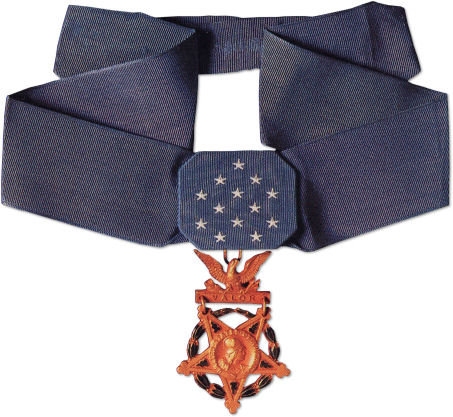
Medal of Honor: M. Kocak

MATEJ KOCAK

Sergeant, US Marine Corps

Born: 31 December 1882, Gbely, Austria
Died: 4 October 1918, Champagne, France

Citation: For extraordinary heroism while serving with the 66th Company, 5th Regiment, 2d Division, in action in the Viller-Cottertes section, south of Soissons, France, 18 July 1918. When a hidden machinegun nest halted the advance of his battalion, Sgt. Kocak went forward alone unprotected by covering fire and worked his way in between the German positions in the face of heavy enemy fire. Rushing the enemy position with his bayonet, he drove off the crew. Later the same day, Sgt. Kocak organized French colonial soldiers who had become separated from their company and led them in an attack on another machinegun nest which was also put out of action.

Citation: When the advance of his battalion was checked by a hidden machinegun nest, he went forward alone, unprotected by covering fire from his own men, and worked in between the German positions in the face of fire from enemy covering detachments. Locating the machinegun nest, he rushed it and with his bayonet drove off the crew. Shortly after this he organized 25 French colonial soldiers who had become separated from their company and led them in attacking another machinegun nest, which was also put out of action.


Notes: Kocak was one of five Marines who received both Navy and Army medals for a single action during World War I.
USNS Sgt Matej Kocak (T-AK 3005), formerly SS John B Waterman, was renamed in his honour when it was taken over by the Military Sealift Command.
Gbely is now in Slovakia.

22 February 2012

Save one book....

If all the books in the world were about to disappear, and you could save one - and only one - which one would you pick? That's what Ali B and her fourth-grade son Mateo are asking over at Literary Lunchbox....

19 February 2012

Victoria Cross: R. H. Keatinge

RICHARD HARTE KEATINGE

Major, Bombay Artillery

Born: 17 June 1825, Dublin, Ireland
Died: 24 May 1904, Horsham, Sussex

Citation: For having rendered most efficient aid at the assault of Chundairee [on 17 March 1858], in voluntarily leading the Column through the breach, which was protected by a heavy cross fire. He was one of the foremost to enter, and was severely wounded in the breach. The Column was saved from a serious loss that would probably have resulted, but for Major Keatinge's knowledge of the small path leading across the ditch, which had been examined during the night by himself and a servant, who declined, when required, to lead the Column, without his master. Having cleared the breach; he led into the Fort, where he was struck down by another dangerous wound. The Commander-in-Chief in India states that the success at Chundairee was mainly owing to this Officer, whose gallantry, really brilliant, he considers was equalled by his ability and devotion.
Major Keatinge was at the time a Political Officer with the 2nd Brigade of the Central India Field Force.

[London Gazette issue 22601 dated 25 Feb 1862, published 25 Feb 1862.]


Note: Chundairee (modern Chunderi) is in Madhya Pradesh state, in central India.

Medal of Honor: W. M. Corry, Jr.

WILLIAM MERRILL CORRY JR

Lieutenant Commander, US Navy

Born: 5 October 1889, Quincy, Florida
Died: 6 October 1920, Hartford, Connecticut

Citation: For heroic service in attempting to rescue a brother officer from a flame-enveloped airplane. On 2 October 1920, an airplane in which Lt. Comdr. Corry was a passenger crashed and burst into flames [near Hartford, Connecticut]. He was thrown 30 feet clear of the plane and, though injured, rushed back to the burning machine and endeavored to release the pilot. In so doing he sustained serious burns, from which he died 4 days later.


Notes: At the time of his death, Corry was assigned as aviation aide to the Commander in Chief, Atlantic Fleet, aboard USS Pennsylvania (BB 38).
USS Corry (DD 334), USS Corry (DD 463), USS Corry (DD 817) and Corry Field (now NTTC Corry Station, Pensacola, Florida) were named in his honour.

18 February 2012

Washington's Birthday

5 USC § 6103 - HOLIDAYS

(a) The following are legal public holidays:
New Year’s Day, January 1.
Birthday of Martin Luther King, Jr., the third Monday in January.
Washington’s Birthday, the third Monday in February.
Memorial Day, the last Monday in May.
Independence Day, July 4.
Labor Day, the first Monday in September.
Columbus Day, the second Monday in October.
Veterans Day, November 11.
Thanksgiving Day, the fourth Thursday in November.
Christmas Day, December 25.

************* ************* *************

2011 Connecticut Code
Title 1 Provisions of General Application
Chapter 2 Legal Holidays and Standard of Time
Sec. 1-4. Days designated as legal holidays.


Sec. 1-4. Days designated as legal holidays. In each year the first day of January (known as New Year's Day), the fifteenth day of January of each year prior to 1986, and commencing on the twentieth day of January in 1986, the first Monday occurring on or after January fifteenth (known as Martin Luther King Day), the twelfth day of February (known as Lincoln Day), the third Monday in February (known as Washington's Birthday), the last Monday in May (known as Memorial Day or Decoration Day), the fourth day of July (known as Independence Day), the first Monday in September (known as Labor Day), the second Monday in October (known as Columbus Day), the eleventh day of November (known as Veterans' Day) and the twenty-fifth day of December (known as Christmas) and any day appointed or recommended by the Governor of this state or the President of the United States as a day of thanksgiving, fasting or religious observance, shall each be a legal holiday[.]

17 February 2012

New destroyer names announced

The Navy has announced that the next three Arleigh Burke class guided missile destroyers (DDG 113-115) will be named after Medal of Honor recipients John Finn (23 Jul 1909–27 May 2010) and Ralph Johnson (1 Jan 1949–5 Mar 1968), and Navy Cross recipient Rafael Peralta (7 Apr 1979–15 Nov 2004). All three ships are currently under construction; USS John Finn is scheduled for delivery in late 2015, and USS Ralph Johnson in late 2016.

ZUI this article from the Defense Times.

12 February 2012

Victoria Cross: W. M'Wheeney

WILLIAM M'WHEENEY

Serjeant, 44th Regiment

Born: 1830, Bangor, County Down, Ireland
Died: 17 May 1866, Dover, Kent

Citation: Volunteered as sharpshooter at the commencement of the siege, and was in charge of the party of the 44th Regiment; was always vigilant and active, and signalised himself on the 20th October, 1854, when one of his party, Private John Keane, 44th Regiment, was dangerously wounded in the Woronzoff Road, at the time the sharpshooters were repulsed from the Quarries by overwhelming numbers. Serjeant M'Wheeney, on his return, took the wounded man on his back, and brought him to a place of safety. This was under a very heavy fire.
He was also the means of saving the life of Corporal Courtney. This man was one of the sharpshooters, and was severely wounded in the head, 5th December, 1854. Serjeant M'Wheeney brought him from under fire, and dug up a slight cover with his bayonet, where the two remained until dark, when they retired.
Serjeant M'Wheeney volunteered for the advanced guard of General Eyre's Brigade, in the Cemetery, on the 18th June, 1855, and was never absent from duty during the war.

[London Gazette issue 21971 dated 24 Feb 1857, published 24 Feb 1857.]

Medal of Honor: J. G. Hanson

JACK G HANSON

Private First Class, US Army; Company F, 31st Infantry Regiment

Born: 18 September 1930, Escaptawpa, Mississippi
Died: 7 June 1951, near Pachi-dong, Korea

Citation: Pfc. Hanson, a machine gunner with the 1st Platoon, Company F, distinguished himself by conspicuous gallantry and intrepidity at the risk of his life above and beyond the call of duty in action against an armed enemy of the United Nations [near Pachi-dong, Korea, on 7 June 1951]. The company, in defensive positions on two strategic hills separated by a wide saddle, was ruthlessly attacked at approximately 0300 hours, the brunt of which centered on the approach to the divide within range of Pfc. Hanson's machine gun. In the initial phase of the action, 4 riflemen were wounded and evacuated and the numerically superior enemy, advancing under cover of darkness, infiltrated and posed an imminent threat to the security of the command post and weapons platoon. Upon orders to move to key terrain above and to the right of Pfc. Hanson's position, he voluntarily remained to provide protective fire for the withdrawal. Subsequent to the retiring elements fighting a rearguard action to the new location, it was learned that Pfc. Hanson's assistant gunner and 3 riflemen had been wounded and had crawled to safety, and that he was maintaining a lone-man defense. After the 1st Platoon reorganized, counterattacked, and resecured its original positions at approximately 0530 hours, Pfc. Hanson's body was found lying in front of his emplacement, his machine gun ammunition expended, his empty pistol in his right hand, and a machete with blood on the blade in his left hand, and approximately 22 enemy dead lay in the wake of his action. Pfc. Hanson's consummate valor, inspirational conduct, and willing self-sacrifice enabled the company to contain the enemy and regain the commanding ground, and reflect lasting glory on himself and the noble traditions of the military service.

07 February 2012

Augusta Chiwi honoured

It's not exactly new news, but I just ran across this article (dated 12 Dec 11) from the Marine Corps Times:
A Belgian nurse who saved the lives of hundreds of American soldiers during the Battle of the Bulge was given a U.S. award for valor Monday — 67 years late.

Congolese-born Augusta Chiwy, now 93, received the Civilian Award for Humanitarian Service medal from U.S. Ambassador Howard Gutman at a ceremony in the military museum in Brussels.

“She helped, she helped, and she helped,” Gutman said at the ceremony. He said the long delay in presenting the award was because it was assumed that Chiwy had been killed when a bomb destroyed her hospital.

*******

“What I did was very normal,” Chiwy said during the ceremony. “I would have done it for anyone. We are all children of God.”

But Col. J.P. McGee, who commands a brigade of the 101st Airborne Division based in Fort Campbell, Ky., said that to the wounded soldiers Chiwy was “a goddess.”

“Men lived and families were reunited due to your efforts,” he said.

McGee said the Army’s doctor in Bastogne, John Prior, had joked that the German snipers couldn’t hit Chiwy because she was so tiny. But Chiwy, who moved to Belgium from the colony of Congo before the war, responded that they were just bad shots.

*******

After the battle, Chiwy slipped into obscurity, working as a hospital nurse treating spinal injuries. She married a Belgian soldier and had two children.

Fans of the Band of Brothers mini-series will remember Chiwy (whose name is also spelt Chiwi) as the black nurse who appeared in episode six, "Bastogne."

RIP: Florence Green

Florence Green
19 Feb 1901 - 5 Feb 2012


The last known veteran of World War I has died, just two and a half years before the centennial of that war's beginning. ZUI this article from the Eastern Daily Press:
She passed away in her sleep at a care home in King’s Lynn just two weeks before her 111th birthday.

The great-grandmother was only 17-years-old when she joined the Women’s Royal Air Force in the late summer of 1918.

Come the 11th day of the 11th month, she was working as a waitress at RAF Marham, when the pilots greeted news of the German surrender by clambering into their planes and bombing nearby RAF Narborough airfield with bags of flour.

Last year, she became the last surviving person to have seen active service in the first world war following the death of British-born sailor Claude Choules in Australia last year.

*******

She married her husband Walter – a porter at King’s Lynn station – two years after the war. They had three children together, Mr Green passed away in 1970.

As well as her daughter May, she also leaves behind her youngest daughter, June Evetts, 76, who lives in Oundle, near Peterborough and a son, Bob, 86, who lives in Edinburgh. She is also survived by four grandchildren and seven great-grandchildren.

*******

Mrs Green was only identified as a surviving war veteran in 2008, when a researcher of gerontology found her service record, listed under her maiden name, Patterson, at the National Archives.

Though she never saw the front line, her service in the WRAF qualifies her for veteran status.

*******

The WRAF in which Mrs Green served was founded only months before she joined up. Its original intent was to provide female mechanics in order to free up men for service.

But the organisation saw huge enrolment, with women volunteering for positions as drivers and mechanics and filling other wartime needs.

*******

History certainly records RAF Marham as a busy place to have served, as the battle in the skies grew in significance as the war progressed. FE2bs, RE7s, BE2s – wooden aircraft with engines less powerful than those on most modern motorbikes – set off for bombing raids throughout the day.

Today it is the base for four squadrons of Tornadoes, ground-attack aircraft that are still serving in Afghanistan. The pilots of these supersonic jets have rather different concerns than their First World War counterparts.

According to the Gerontology Research Group, Mrs Green was the sixth-oldest person in England at the time of her death.

Doesn't seem possible that it's been fifty years since was reading the WWI sesquitennial articles in Life magazine - I still remember the fold-outs and the pages full of photographs.

Edit 0951 17 Feb 12: ZUI also this article, with photographs, from the MOD Defence News.

05 February 2012

George Cross: Awang anak Rawang

AWANG anak RAWANG

Iban Scout; attached 10 Platoon, D Company, 1st Battalion The Worcestershire Regiment

Born: 1925, Federation of Malaya
Died: TBD

Citation: During operations against the bandits in Malaya a section of a platoon of the Worcestershire Regiment was ambushed by about 50 of the enemy. The leading scout was killed instantly and the Section Commander fatally wounded. Awang anak Rawang was hit through the thigh bone and at the same time a soldier, moving behind him, was hit below the knee, the bullet completely shattering the bone. Awang anak Rawang, although wounded and lying exposed under heavy rifle and automatic fire, collected his own weapons and that of the soldier and dragged him into the cover of the jungle. In view of the impending bandit attack Awang, completely disregarding his own wound, took up a position to defend the injured man. There he remained, firing on every attempt made by the bandits to approach, and successfully drove off several attacks. Ultimately Awang was again wounded, the bullet shattering his right arm and rendering further use of his rifle or parang impossible. Despite loss of blood from his undressed wounds, he dragged himself over to the wounded soldier and took a grenade from the man's pouch. He resumed his position on guard, pulled out the pin of the grenade with his teeth and with the missile in his left hand defied the bandits to approach. So resolute was his demeanour that the bandits, who had maintained their attacks for some forty minutes, and who were now threatened by the other sections, withdrew.
The coolness, fortitude and offensive spirit displayed by Awang anak Rawang were of the highest order. Despite being twice severely wounded he showed the utmost courage and resolution to continue the fight and protect the injured soldier.

[London Gazette issue 39387 dated 20 Nov 191, published 16 Nov 1951.]

Victoria Cross: J. B. Mackey

JOHN BERNARD MACKEY

Corporal, 2nd/3rd Australian Pioneer Battalion, Australian Military Forces

Born: 16 May 1922, Leichhardt, Sydney, New South Wales, Australia
Died: 12 May 1945, Tarakan Island, Borneo

Citation: For most conspicuous bravery in the face of strong enemy resistance in the attack on the Helen feature at Tarakan on 12th May, 1945.
Corporal Mackey was in charge of a section of the 2nd/3rd Australian Pioneer Battalion in the attack on the feature known as Helen, East of Tarakan town. Led by Corporal Mackey the section moved along a narrow spur with scarcely width for more than one man when it came under fire from three well sited positions near the top of a very steep razor-backed ridge. The ground fell away almost sheer on each side of the track making it almost impossible to move to a flank so Corporal Mackey led his men forward.
He charged the first Light Machine Gun position but slipped and after wrestling with one enemy, bayoneted him, and charged straight on to the Heavy Machine Gun which was firing from a bunker position six yards to his right. He rushed this post and killed the crew with grenades.
He then jumped back and changing his rifle for a sub-machine gun he attacked farther up the steep slope another Light Machine Gun position which was firing on his platoon. Whilst charging he fired his gun and reached within a few feet of the enemy position when he was killed by Light Machine Gun fire but not before he had killed two more enemy.
By his exceptional bravery and complete disregard for his own life Corporal Mackey was largely responsible for the killing of seven Japanese and the elimination of two machine gun posts which enabled his platoon to gain its objective, from which the Company continued to engage the enemy. His fearless action and outstanding courage were an inspiration to the whole battalion.

[London Gazette issue 37340 dated 8 Nov 1945, published 6 Nov 1945.]

Medal of Honor: E. V. Rickenbacker

EDWARD VERNON RICKENBACKER

First Lieutenant, US Army Air Corps; 94th Aero Squadron

Born: 8 October 1890, Columbus, Ohio
Died: 27 July 1973, Zürich, Switzerland

Citation: For conspicuous gallantry and intrepidity above and beyond the call of duty in action against the enemy near Billy, France, 25 September 1918. While on a voluntary patrol over the lines, 1st Lt. Rickenbacker attacked 7 enemy planes (5 type Fokker, protecting two type Halberstadt). Disregarding the odds against him, he dived on them and shot down one of the Fokkers out of control. He then attacked one of the Halberstadts and sent it down also.


Note: Rickenbacker was the top US ace of World War I, with a total of 26 enemy aircraft. In addition to the Medal of Honor, he was awarded the Distinguished Service Cross with six oak leaf clusters denoting subsequent awards.
Rickenbacker Air National Guard Base (formerly Rickenbacker Air Force Base) and Rickenbacker International Airport, both in Columbus OH, were named in his honour.

01 February 2012

Book list - Jan 12

Dead As a Dinosaur - mystery, by Frances and Richard Lockridge
When The Star Kings Die - SF, by John Jakes
Cats Are Not Peas: A Calico History of Genetics - genetics, by Laura Gould


A very slow start to the year - only three books last month (none a reread), though I also read about half of Scavenger, by David Morrell, before giving up on it. Again, I'm not setting an official goal this year.

No more Carnegie Medal winners yet, so I'm still at 56 of 72.

29 January 2012

Victoria Cross: K. Muir

KENNETH MUIR

Major, The Argyll and Sutherland Highlanders (Princess Louise's)

Born: 6 March 1912, Chester, Cheshire
Died: 23 September 1950, near Kumch'on, South Korea

Citation: On 23rd September, 1950, "B" and "C" Companies of the 1st Battalion, The Argyll and Sutherlands [sic] Highlanders, attacked an enemy-held feature, Hill 282, and by 0800 hours had consolidated upon it.
Some difficulty was experienced in evacuating the wounded from the position and demands were made for stretcher-bearing parties to be sent forward by the Battalion. At this juncture the position came under mortar and shell fire.
At approximately 0900 hours a stretcher-bearing party arrived and with it came the Battalion Second-in-Command, Major K. MUIR. He proceeded to organise the evacuation of the casualties.
At approximately 0930 hours, small parties of the enemy started to infiltrate on the left flank necessitating the reinforcing of the forward platoon. For the next hour this infiltration increased, as did the shelling and mortaring, causing further casualties within the two companies.
By 1100 hours, casualties were moderately severe and some difficulty was being experienced in holding the enemy. In addition, due to reinforcing the left flank and to providing personnel to assist with the wounded, both companies were so inextricably mixed that it was obvious that they must come under a unified command. Major MUIR, although only visiting the position, automatically took over command and with complete disregard for his own personal safety, started to move around the forward elements, cheering on and encouraging the men to greater efforts despite the fact that ammunition was running low. He was continually
under enemy fire, and, despite entreaties from officers and men alike, refused to take cover.
An air-strike against the enemy was arranged and air recognition panels were put out on the ground. At approximately 1215 hours the air-strike came in, but unfortunately the aircraft hit the Companies' position instead of that of the enemy. The main defensive position was hit with fire bombs and machine gun fire, causing more casualties and necessitating the withdrawal of the remaining troops to a position some fifty feet below the crest. There is no doubt that a complete retreat from the hill would have been fully justified at this time. Only some thirty fighting men remained and ammunition was extremely low. Major MUIR, however, realised that the enemy had not taken immediate advantage of the unfortunate incident and that the crest was still unoccupied although under fire.
With the assistance of the three remaining officers, he immediately formed a small force of some thirty all ranks and personally led a counter-attack on the crest. To appreciate fully the implication of this, it is necessary to realise how demoralising the effect of the air-strike had been and it was entirely due to the courage, determination and splendid example of this officer that such a counterattack was possible. All ranks responded magnificently and the crest was re-taken.
From this moment on, Major MUIR'S actions were beyond all possible praise. He was determined that the wounded would have adequate time to be taken out and he was just as determined that the enemy would not take the crest. Grossly outnumbered and under heavy automatic fire, Major MUIR moved about his small force re-distributing fast diminishing ammunition and when the ammunition for his own weapon was spent, he took over a 2 inch mortar which he used with very great effect against the enemy. While firing the mortar, he was still shouting encouragements and advice to his men and for a further five minutes the enemy were held. Finally, Major MUIR was hit with two bursts of automatic fire which mortally wounded him, but even then he retained consciousness and was still as determined to fight on. His last words were: — "The Gooks will never drive the Argylls off this hill".
The effect of his splendid leadership on the men was nothing short of amazing and it was entirely due to his magnificent courage and example and the spirit which he imbued in those about him that all wounded were evacuated from the hill, and, as was subsequently discovered, very heavy casualties inflicted on the enemy in the defence of the crest.

[London Gazette issue 39115 dated 5 Jan 1951, published 2 Jan 1951.]

Medal of Honor: F. Du Moulin

FRANK DU MOULIN

Apprentice, US Navy; USS Sabine

Born: 1850, Philadelphia, Pennsylvania
Died: unknown

Citation: On the 5th of September 1867, Du Moulin jumped overboard and saved from drowning Apprentice D'Orsay, who had fallen from the mizzen topmast rigging of the Sabine, in New London Harbor, and was rendered helpless by striking the mizzen rigging and boat davit in the fall.

27 January 2012

RIP: Delma Kollar

Delma Kollar
31 Oct 1897 - 24 Jan 2012

ZUI this article from the Eugene (OR) Register-Guard:
She lived in three different centuries and celebrated more birthdays than most human beings who ever lived. But just like the rest of us, Delma Kollar, the oldest known Oregonian, who was thought by official record-keepers to be the world’s fourth-oldest person, proved to be mortal after all. She died Tuesday morning at the Creswell Health and Rehabilitation Center at the age of 114. Or was it 113?

*******

According to the Los Angeles-based Gerontology Research Group, which verifies the ages of supercentenarians (110 or older) worldwide for the Guinness Book of World Records, Kollar was born on Oct. 31, 1897.

Kollar’s family says she wasn’t issued a birth certificate until the 1950s. Family members say she was born Delma Dorothie Lowman on Oct. 31, 1898, in Lone Elm, Kan. But based on 1900 and 1910 census records found online a few years ago by Gerontology Research Group analyst Robert Young, the group listed her birthday as 1897.

*******

A schoolteacher in Kansas and California before moving to Oregon in 1982 with her second husband, Harry Kollar, Delma Kollar outlived both her husbands (her first husband and college sweetheart, Earl Hoggatt, died in 1966) and two of her three children. She had six grandchildren, 10 great-grandchildren, 11 great-great-grandchildren and one great-great-great-grandchild.

Jean Cooper, 87, of Cottage Grove, is Kollar’s lone surviving child. Her other two children, Bill Hoggatt and Earlene Duncan, died in their 60s, he of congestive heart failure, she of a brain tumor. Kollar’s parents both lived into their 90s, and she had two aunts who lived past 100, according to a family history that Kollar put together years ago.

I haven't blogged about supercentenarians for a while. The Gerontology Research Group (GRG) reports that a total of 75 (71 women and 4 men) died in 2011, including 114-year-old Maria Gomes Valentim (9 Jul 1896–21 Jun 2011), of Brazil, who at the time of her death was listed as the oldest person in the world. Kollar is the fifth supercentenarian listed as dying in 2012, the others being Marcelle Narbonne (25 Mar 1898-1 Jan 2012) of France, Frederica Sagor Maas (6 Jul 1900-5 Jan 2012) of California, Terue Ichikawa (10 May 1900-19 Jan 2012) of Japan and Angela Rogges-Marvulli (19 Nov 1900-23 Jan 2012) of Italy.

The GRG's list of validated living supercentenarians (people who have reached their 110th birthday) currently includes 72 people (6 men and 66 women), ranging from Besse Cooper of Georgia (born 26 Aug 1896 in Tennessee) to Masayo Ogawara of Japan (born 2 Aug 1901). 19 of them live in the US, though none are in Oregon.

52 of the living supercentenarians were born in the 19th century, the youngest being Hermine Nistler of Austria (born 24 Dec 1900); the oldest of those born in the 20th century is Irene Pearce of England (born 5 Jan 1901). The oldest of the six men is Jiroemon Kimura of Japan (born 19 Apr 1897), the third-oldest living person.

24 January 2012

Beer Can Appreciation Day


Today. According to Holiday Insights, "Beer Can Appreciation Day celebrates that great day in 1935 when beer was first sold in cans."

Personally, I find it hard to appreciate anything that contains a substance as revolting as beer, but YMMV....

RIP: John F. Baker, Jr.


John F Baker Jr
30 Oct 1945 - 20 Jan 2012


ZUI this article from The State:
Army Master Sgt. John F. Baker Jr., who received the Medal of Honor for saving the lives of eight of his fellow soldiers, killing 10 Viet Cong and knocking out six machine gun bunkers after his unit was ambushed Nov. 5, 1966, in Vietnam, died Friday evening after collapsing in his Northeast Richland home. He was 66.

*******

Baker was born in Davenport, Iowa, and went to high school in nearby Moline, Ill. In 2008, the I-280 Bridge connecting Davenport with Rock Island, Ill., was renamed in his honor.

During the Vietnam War, Baker was a 5-foot-2-inches tall, 105-pound “tunnel rat” – a soldier who, armed with only a pistol and a flashlight, would crawl into enemy tunnels to clear them. He was one of only 239 service members to receive the Medal of Honor in Vietnam.

There are now 83 living Medal of Honor recipients.

************* *** *************

JOHN FRANKLIN BAKER JR

Sergeant (then Private First Class), US Army; Company A, 2d Battalion, 27th Infantry, 25th Infantry Division

Born: 30 October 1945, Davenport, Iowa
Died: 20 January 2012, Richland, South Carolina

Citation: For conspicuous gallantry and intrepidity in action at the risk of his life above and beyond the call of duty. En route to assist another unit that was engaged with the enemy [in the Republic of Vietnam, on 5 November 1966], Company A came under intense enemy fire and the lead man was killed instantly. Sgt. Baker immediately moved to the head of the column and together with another soldier knocked out 2 enemy bunkers. When his comrade was mortally wounded, Sgt. Baker, spotting 4 Viet Cong snipers, killed all of them, evacuated the fallen soldier and returned to lead repeated assaults against the enemy positions, killing several more Viet Cong. Moving to attack 2 additional enemy bunkers, he and another soldier drew intense enemy fire and Sgt. Baker was blown from his feet by an enemy grenade. He quickly recovered and single-handedly destroyed 1 bunker before the other soldier was wounded. Seizing his fallen comrade's machine gun, Sgt. Baker charged through the deadly fusillade to silence the other bunker. He evacuated his comrade, replenished his ammunition and returned to the forefront to brave the enemy fire and continue the fight. When the forward element was ordered to withdraw, he carried 1 wounded man to the rear. As he returned to evacuate another soldier, he was taken under fire by snipers, but raced beyond the friendly troops to attack and kill the snipers. After evacuating the wounded man, he returned to cover the deployment of the unit. His ammunition now exhausted, he dragged 2 more of his fallen comrades to the rear. Sgt. Baker's selfless heroism, indomitable fighting spirit, and extraordinary gallantry were directly responsible for saving the lives of several of his comrades, and inflicting serious damage on the enemy. His acts were in keeping with the highest traditions of the U.S. Army and reflect great credit upon himself and the Armed Forces of his country.

Newbery and Caldecott winners announced

The 2012 winner of the John Newbery Medal for the most distinguished contribution to American literature for children is Dead End in Norvelt, written by Jack Gantos and published by Farrar Straus Giroux. The Newbery Honor Books (ie, runners-up) are Inside Out & Back Again, by Thanhha Lai and Breaking Stalin's Nose, by Eugene Yelchin.

Amazon and Barnes & Noble both have it, of course.*

The Randolph Caldecott Medal, for the most distinguished American picture book for children, was awarded to A Ball for Daisy, written and illustrated by Chris Raschka, and published by Schwartz & Wade Books. The Caldecott Honor Books are Blackout, written and illustrated by John Rocco; Grandpa Green, written and illustrated by Lane Smith; and Me … Jane, written and illustrated by Patrick McDonnell.

Amazon and Barnes & Noble both have this one, too.*

(I'll let you do your own searches for the Honor Books.)

The American Library Association (ALA), who give both of the above awards, also announced a few others, including:
The Michael L Printz Award, for excellence in young-adult literature: Where Things Come Back, by John Corey Whaley.

The Coretta Scott King Book Award, recognizing an African-American author and illustrator of outstanding books for children and young adults: (author) Heart and Soul: The Story of America and African Americans, by Kadir Nelson, and (illustrator) Underground: Finding the Light to Freedom, written and illustrated by Shane W Evans.

The Pura Belpré Awards, for Latino authors and illustrators whose work best portrays, affirms and celebrates the Latino cultural experience in children's books: (author) Under the Mesquite, by Guadalupe Garcia McCall, and (illustrator) Diego Rivera: His World and Ours, written and illustrated by Duncan Tonatiuh.

The Margaret A Edwards Award, for lifetime achievement in writing for young adults: Susan Cooper.

The Theodor Seuss Geisel Award, for the most distinguished book for beginning readers: Tales for Very Picky Eaters, written and illustrated by Josh Schneider.

The Robert F Sibert Medal, for the most distinguished informational book for children: Balloons over Broadway: The True Story of the Puppeteer of Macy’s Parade," by Melissa Sweet.

The YALSA Excellence in Nonfiction Award: The Notorious Benedict Arnold: A True Story of Adventure, Heroism & Treachery, by Steve Sheinkin.

The Mildred L Batchelder Award, for the most outstanding children's book translated from a foreign language and subsequently published in the United States: Soldier Bear, originally written in Dutch (as Soldaat Wojtek) by Philip Hopman and translated by Laura Watkinson.

No ALA press release yet (that I can find, anyway), but PR Newswire has the complete list of awards, winners, and Honor Books here.


* Amazon and B&N links are provided for information. Buying from your local independent bookseller is of course strongly recommended!!

22 January 2012

Victoria Cross: L. Calvert

LAURENCE CALVERT MM

Sergeant, The King's Own Yorkshire Light Infantry

Born: 16 February 1892, Leeds, Yorkshire
Died: 7 July 1964, Dagenham, Essex

Citation: For most conspicuous bravery and devotion to duty in attack [on 12 September 1918, at Havrincourt, France,] when the success of the operation was rendered doubtful owing, to severe enfilade machine-gun fire. Alone and single-handed Sjt. Calvert, rushing forward against the machine-gun team, bayoneted three and shot four.
His valour and determination in capturing single-handed two machine guns and killing the crews thereof enabled the ultimate objective to be won. His personal gallantry inspired all ranks.

[London Gazette issue 31012 dated 15 Nov 918, published 12 Nov 1918.]

Medal of Honor: W. L. Nelson

WILLIAM LLOYD NELSON

Sergeant, US Army; 60th Infantry, 9th Infantry Division

Born: 22 February 1918, Dover, Delaware
Died: 24 April 1943, Djebel Dardys, Tunisia

Citation: For conspicuous gallantry and intrepidity at risk of life, above and beyond the call of duty in action involving actual conflict [at Djebel Dardys, northwest of Sedjenane, Tunisia]. On the morning of 24 April 1943, Sgt. Nelson led his section of heavy mortars to a forward position where he placed his guns and men. Under intense enemy artillery, mortar, and small-arms fire, he advanced alone to a chosen observation position from which he directed the laying of a concentrated mortar barrage which successfully halted an initial enemy counterattack. Although mortally wounded in the accomplishment of his mission, and with his duty clearly completed, Sgt. Nelson crawled to a still more advanced observation point and continued to direct the fire of his section. Dying of handgrenade wounds and only 50 yards from the enemy, Sgt. Nelson encouraged his section to continue their fire and by doing so they took a heavy toll of enemy lives. The skill which Sgt. Nelson displayed in this engagement, his courage, and self-sacrificing devotion to duty and heroism resulting in the loss of his life, was a priceless inspiration to our Armed Forces and were in keeping with the highest tradition of the U.S. Army.

17 January 2012

Hot Buttered Rum Day

Today is National Hot Buttered Rum Day. Strikes me as a good idea....

Recipe here.

Or here.

Or here.

Or here.

Variants here.

for the teetotalers.


15 January 2012

Victoria Cross: A. Atkinson

ALFRED ATKINSON

Sergeant, Yorkshire Regiment

Born: 6 February 1874, Leeds, Yorkshire
Died: 21 February 1900, near Paardeberg Drift, South Africa

Citation: During the battle of Paardeburg, 18th February, 1900, Sergeant A. Atkinson, 1st Battalion Yorkshire Regiment, went out seven times, under heavy and close fire, to obtain water for the wounded. At the seventh attempt he was wounded in the head, and died a few days afterwards.

[London Gazette issue 27462 dated 8 Aug 1902, published 8 Aug 1902.]

Medal of Honor: J. H. Denig

JOHN HENRY DENIG

Sergeant, US Marine Corps; USS Brooklyn

Born: 8 September 1838, York, Pennsylvania
Died: 10 December 1876, York, Pennsylvania

Citation: On board the U.S.S. Brooklyn during action against rebel forts and gunboats and with the ram Tennessee, in Mobile Bay, 5 August 1864. Despite severe damage to his ship and the loss of several men on board as enemy fire raked her decks, Sgt. Denig fought his gun with skill and courage throughout the furious 2-hour battle which resulted in the surrender of the rebel ram Tennessee and in the damaging and destruction of batteries at Fort Morgan.

08 January 2012

Victoria Cross: R. C. Nesbitt

RANDOLPH COSBY NESBITT

Captain, Mashonaland Mounted Police

Born: 20 September 1867, Queenstown, Cape Colony, South Africa
Died: 23 July 1956, Cape Town, South Africa

Citation: This officer, on the 19th June, 1896, led the Mazoe Rescue Patrol, consisting of only thirteen men, fought his way through the rebels to get to Salthouse's party, and succeeded in bringing them back to Salisbury, with heavy fighting, in which three of his small force were killed and five wounded, and fifteen horses killed and wounded.

[London Gazette issue 26850 dated 7 May 1897, published 7 May 1897.]


Note: Mashonaland is now a part of northern Zimbabwe.

Medal of Honor: Farley, Miller, Moore and Blake

WILLIAM FARLEY

Boatswain's Mate, US Navy; USS Marblehead

Born: 1835, Whitefield, Maine
Died: Unknown

Citation: Served on board the U.S.S. Marblehead off Legareville, Stono River, [South Carolina,] 25 December 1863, during an engagement with the enemy on John's Island. Behaving in a gallant manner, Farley animated his men and kept up a rapid and effective fire on the enemy throughout the engagement which resulted in the enemy's abandonment of his positions, leaving a caisson and 1 gun behind.


JAMES MILLER

Quartermaster, US Navy; USS Marblehead

Born: 1835, Denmark
Died: 4 March 1914, Pennsylvania(?)

Citation: Served as quartermaster on board the U.S. Steam Gunboat Marblehead off Legareville, Stono River, 25 December 1863, during an engagement with the enemy on John's Island. Acting courageously under the fierce hostile fire, Miller behaved gallantly throughout the engagement which resulted in the enemy's withdrawal and abandonment of its arms.


Note: USS Miller (DD 535) was named in his honor.


CHARLES MOORE

Landsman, US Navy; USS Marblehead

Born: 1839, Ireland
Died: Unknown

Citation: Serving on board the U.S. Steam Gunboat Marblehead off Legareville, Stono River, 25 December 1863, during an engagement with the enemy on John's Island. Wounded in the fierce battle, Moore returned to his quarters until so exhausted by loss of blood that he had to be taken below. This engagement resulted in the enemy's abandonment of his positions, leaving a caisson and one gun behind.


ROBERT BLAKE

Contraband, US Navy; USS Marblehead

Born: South Santee, South Carolina
Died: Unknown

Citation: On board the U.S. Steam Gunboat Marblehead off Legareville, Stono River, 25 December 1863, in an engagement with the enemy on John's Island. Serving the rifle gun, Blake, an escaped slave, carried out his duties bravely throughout the engagement which resulted in the enemy's abandonment of positions, leaving a caisson and one gun behind.


Note: According to Wikipedia, Blake was the second black to earn the Medal of Honor, and the first to actually receive the medal. At the time of this action he was serving as a steward to Lt Cmdr Richard W Meade, Marblehead's CO.
"Contraband" was a term used in the US military during the Civil War to describe escaped slaves who were serving with Union forces.

04 January 2012

Carnegie Medal books

Having finished reading the Newbery Medal winners in August of '09, I'm continuing with the books which have been awarded the Andrew Carnegie Medal - the British equivalent of the Newbery Medal, now awarded by the Chartered Institute of Library and Information Professionals (CILIP).

The medal was first awarded in 1937, for the best children's book of 1936, but there have been three years when no book was considered suitable, so there are only 72 winners thus far. In addition to the gold medal, the winner receives £500 worth of books to donate to a library of his/her/their choice.

Here's the list. (Dates marked in red indicate the six books I had already read before last year; dates in purple indicate the ones I've read since.)

1936: Pigeon Post, by Arthur Ransome
1937: The Family from One End Street, by Eve Garnett
1938: The Circus is Coming (aka Circus Shoes), by Noel Streatfield
1939: Radium Woman, by Eleanor Doorly
1940: Visitors from London, by Kitty Barne
1941: We Couldn't Leave Dinah, by Mary Treadgold
1942: The Little Grey Men, by 'BB' (D J Watkins-Pitchford)
1943: Prize withheld as no book was considered suitable
1944: The Wind on the Moon, by Eric Linklater
1945: Prize withheld as no book was considered suitable
1946: The Little White Horse, by Elizabeth Goudge
1947: Collected Stories for Children, Walter De La Mare
1948: Sea Change, by Richard Armstrong
1949: The Story of Your Home, by Agnes Allen
1950: The Lark on the Wing, by Elfrida Vipont
1951: The Wool-pack, by Cynthia Harnett
1952: The Borrowers, by Mary Norton
1953: A Valley Grows Up, by Edward Osmond
1954: Knight Crusader, by Ronald Welch (Felton Ronald Oliver)
1955: The Little Bookroom, by Eleanor Farjeon
1956: The Last Battle, by C S Lewis
1957: A Grass Rope, by William Mayne
1958: Tom's Midnight Garden, by Philipa Pearce
1959: The Lantern Bearers, by Rosemary Sutcliff
1960: The Making of Man, by Dr I W Cornwall
1961: A Stranger at Green Knowe, by Lucy M Boston
1962: The Twelve and the Genii, by Pauline Clarke
1963: Time of Trial, by Hester Burton
1964: Nordy Bank, by Sheena Porter
1965: The Grange at High Force, by Philip Turner
1966: Prize withheld as no book was considered suitable
1967: The Owl Service, by Alan Garner
1968: The Moon in the Cloud, by Rosemary Harris
1969: The Edge of the Cloud, by Kathleen Peyton
1970: The God Beneath the Sea, by Leon Garfield and Edward Blishen
1971: Josh, by Ivan Southall
1972: Watership Down, by Richard Adams
1973: The Ghost of Thomas Kempe, by Penelope Lively
1974: The Stronghold, by Mollie Hunter
1975: The Machine Gunners, by Robert Westall
1976: Thunder and Lightnings, by Jan Mark
1977: The Turbulent Term of Tyke Tiler, by Gene Kemp
1978: The Exeter Blitz, by David Rees
1979: Tulku, by Peter Dickinson
1980: City of Gold and Other Stories from the Old Testament, by Peter Dickinson
1981: The Scarecrows, by Robert Westall
1982: The Haunting, by Margaret Mahy
1983: Handles, by Jan Mark
1984: The Changeover, by Margaret Mahy
1985: Storm, by Kevin Crossley-Holland
1986: Granny was a Buffer Girl, by Berlie Doherty
1987: The Ghost Drum, by Susan Price
1988: A Pack of Lies, by Geraldine McCaughrean
1989: Goggle-eyes, by Anne Fine
1990: Wolf, by Gillian Cross
1991: Dear Nobody, by Berlie Doherty
1992: Flour Babies, by Anne Fine
1993: Stone Cold, by Robert Swindells
1994: Whispers in the Graveyard, by Theresa Breslin
1995: Northern Lights, by Philip Pullman*
1996: Junk, by Melvin Burgess
1997: River Boy, by Tim Bowler
1998: Skellig, by David Almond
1999: Postcards From No Man's Land, by Aidan Chambers
2000: The Other Side of Truth, by Beverley Naidoo
2001: The Amazing Maurice and his Educated Rodents, by Terry Pratchett
2002: Ruby Holler, by Sharon Creech
2003: A Gathering Light, by Jennifer Donnelly**
2004: Millions, by Frank Cottrell Boyce
2005: Tamar, by Mal Peet
2006: ***
2007: Just in Case, by Meg Rosoff
2008: Here Lies Arthur, by Philip Reeve
2009: Bog Child, by Siobhan Dowd
2010: The Graveyard Book, by Neil Gaiman
2011: Monsters of Men, by Patrick Ness
2012: To be announced....

So the count now is 56 down, 16 to go.

Nominations for the 2012 winner - a book first published in the UK between 1 Sep 2010 and 31 Aug 2011 (a book first published in another country must have been co-published in the UK within three months of the original publication date) - closed on 21 Oct 11. The short list will be announced in late March, and the winner in June.


* His Dark Materials, Book 1. Published in the US as The Golden Compass.

** Published in the US as A Northern Light.

*** Up through the award for 2005, the winners were referred to by the year of publication. Beginning in 2007, the winners were referred to by the year the award was given, as with the American Newbery Medal. Thus there is no "2006 winner" of the Carnegie Medal. Tamar, the 2005 winner, was published in '05, and received the medal in '06. Just in Case, the 2007 winner, was published in '06 and received the award in '07.

Book list - 2011

Here's the complete list of books I read in 2011. I didn't set a goal for this year, so I can't report success in reaching it (nor must I admit to failure, either).

An asterisk indicates a reread. Numbers refer to the order in which the books were read.

"Adult" Fiction (68 books)
1. Elleander Morning - AH, by Jerry Yulsman *
3. Six Geese A-Slaying - mystery, by Donna Andrews
4. Murder with Peacocks - mystery, by Donna Andrews
5. Crouching Buzzard, Leaping Loon - mystery, by Donna Andrews
6. Discord's Apple - modern fantasy, by Carrie Vaughn
8. Dreadnought - AH/steampunk, by Cherie Priest
10. The Masterharper of Pern - SF, by Anne McCaffrey
13. Cowboy Angels - SF, by Paul McAuley
14. Murder with Puffins - mystery, by Donna Andrews
15. Dragonseye (aka Red Star Rising) - SF, by Anne McCaffrey *
16. All the Weyrs of Pern - SF, by Anne McCaffrey *
17. Abracadaver - historical mystery, by Peter Lovesey
18. Here Abide Monsters - fantasy, by Andre Norton *
20. The Tick of Death (aka Invitation to a Dynamite Party) - historical mystery, by Peter Lovesey
21. Revenge of the Wrought-Iron Flamingos - mystery, by Donna Andrews
25. The Skies of Pern - SF, by Anne McCaffrey *
26. We'll Always Have Parrots - mystery, by Donna Andrews
30. Atlantis and Other Places: Stories of Alternate History - AH (short stories), by Harry Turtledove
33. Rough Cider - mystery, by Peter Lovesey
34. Dragonsdawn - SF, by Anne McCaffrey *
35. Cryoburn - SF, by Lois McMaster Bujold
38. No Nest for the Wicket - mystery, by Donna Andrews
39. Dragonflight - SF, by Anne McCaffrey *
40. The Penguin Who Knew Too Much - mystery, by Donna Andrews
41. Dragonquest - SF, by Anne McCaffrey *
44. Owls Well That Ends Well - mystery, by Donna Andrews
46. The White Dragon - SF, by Anne McCaffrey *
48. Other Worlds Than Ours - SF (short stories), by Nelson Bond
49. King David's Spaceship - SF, by Jerry Pournelle *
51. Cockatiels at Seven - mystery, by Donna Andrews
52. Agatha H and the Airship City - steampunk, by Phil & Kaja Foglio
53. Mirkheim - SF, by Poul Anderson *
54. Swan for the Money - mystery, by Donna Andrews
55. The People of the Wind - SF, by Poul Anderson
56. The Man Who Counts - SF, by Poul Anderson *
59. High Justice - SF (short stories), by Jerry Pournelle
63. Blind Justice - historical mystery, by Bruce Alexander
64. Stork Raving Mad - mystery, by Donna Andrews
66. Side Jobs - modern fantasy (short stories), by Jim Butcher
70. The Real Macaw - mystery, by Donna Andrews
72. A Flock of Ships - WWII fiction, by Brian Callison *
73. Ghost Story - modern fantasy, by Jim Butcher
74. The Old Buzzard Had It Coming - historical mystery, by Donis Casey
77. Hornswoggled - historical mystery, by Donis Casey
78. Alas, Babylon - WWIII fiction, by Pat Frank *
79. A Murder, a Mystery, and a Marriage - mystery, by Mark Twain
81. The Drop Edge of Yonder - historical mystery, by Donis Casey
84. The Tragedy of Pudd'nhead Wilson - humour, by Mark Twain
86. Over the Wine-Dark Sea - historical fiction, by H N Turteltaub
87. The Guns of the South - AH, by Harry Turtledove *
88. The Sky Took Him - historical mystery, by Donis Casey
89. Crying Blood - historical mystery, by Donis Casey
91. The Gryphon's Skull - historical fiction, by H N Turteltaub
93. The Trouble with Humans - SF (short stories), by Christopher Anvil
96. The Enchantment Emporium - modern fantasy, by Tanya Huff
97. Huck Finn & Tom Sawyer Among the Indians - fiction, by Mark Twain and Lee Nelson
103. The Sacred Land - historical fiction, by H N Turteltaub
104. Owls to Athens - historical fiction, by H N Turteltaub
105. Nemesis - historical mystery, by Lindsey Davis
106. Flint - western, by Louis L'Amour *
109. Fire Time - SF, by Poul Anderson *
111. Deathblow Hill - mystery, by Phoebe Atwood Taylor
115. Mystery of the Cape Cod Players - mystery, by Phoebe Atwood Taylor
116. The Sky People - AH/SF, by S M Stirling *
117. The Inheritance - mystery, by Simon Tolkien
118. Murder Comes First - mystery, by Frances and Richard Lockridge
119. The Man with the Iron Heart - AH/WWII fiction, by Harry Turtledove
120. Creepers - thriller, by David Morrell

Children's/YA Fiction (30)
7. Firestorm! - children's historical fiction, by Joan Hiatt Harlow
11. Please Ignore Vera Dietz - YA, by A S King
12. Moon Over Manifest - children's historical fiction, by Claire Vanderpool (Newbery Medal, 2011)
22. Time for the Stars - YA SF, by Robert A Heinlein *
23. The Shadows - children's fantasy, by Jacqueline West
24. Dragonsinger - YA SF, by Anne McCaffrey *
27. A Great Big Ugly Man Came up and Tied His Horse to Me: A Book of Nonsense Verse - children's poetry, compiled and illustrated by Wallace Tripp *
28. Dragonsong - YA SF, by Anne McCaffrey *
29. Rose's Are Red, Violet's Are Blue and Other Silly Poems - children's poetry, compiled and illustrated by Wallace Tripp
31. The Stronghold - children's historical fiction, by Mollie Hunter (Carnegie Medal, 1974)
32. Dragondrums - YA SF, by Anne McCaffrey *
37. The Exeter Blitz - children's historical fiction, by David Rees (Carnegie Medal, 1978)
42. Doggirl - YA, by Robin Brande
43. Everybody Sees the Ants - YA, by A S King (ARC)
57. Thunder and Lightnings - children's, by Jan Mark (Carnegie Medal 1976)
60. Ghost Drum - children's fantasy, by Susan Price (Carnegie Medal 1987)
62. Jordan Freeman Was My Friend - children's historical fiction, by Richard White
65. The Kindling - YA postapocalyptic, by Jennifer Armstrong and Nancy Butcher
67. Time of Trial - children's historical fiction, by Hester Burton (Carnegie Medal, 1963)
69. The Evolution of Calpurnia Tate - YA historical fiction, by Jacqueline Kelly
71. Josh - children's, by Ivan Southall (Carnegie Medal, 1971)
75. Wolf - YA, by Gillian Cross (Carnegie Medal, 1990)
76. Aliens on Vacation - children's SF, by Clete Barrett Smith
80. The Latte Rebellion - YA, by Sarah Jamila Stevenson
85. The Snowstorm (aka The Snow Ghosts) - children's time travel, by Beryl Netherclift
90. Miss Peregrine's Home for Peculiar Children - YA, by Ransom Riggs
94. Into the Parallel - YA SF, by Robin Brande
112. The Hunger Games - YA SF, by Suzanne Collins
113. Catching Fire - YA SF, by Suzanne Collins
121. The Odious Ogre - children's, by Norton Juster

Non-Fiction (23)
2. Caesars' Wives: Sex, Power, and Politics in the Roman Empire - ancient history, by Annelise Freisenbruch
9. Maria: My Own Story - memoirs, by Maria von Trapp
19. Elsie and Mairi Go to War: Two Extraordinary Women on the Western Front - WW I, by Diane Atkinson
36. The Judith Durham Story: Colours of My Life - biography, by Graham Simpson
45. Thumbs, Toes, and Tears: And Other Traits That Make Us Human - palaeoanthropology, by Chip Walter
47. Vet in the Vestry - memoirs, by Alexander Cameron *
50. African Exodus: The Origins of Modern Humanity - palaeoanthropology, by Chris Stringer and Robin McKie
58. Roar of the Tiger - WWII memoirs, by James H Howard
61. The Making of Man - children's palaeoanthropology, by Dr I W Cornwall (Carnegie Medal, 1960)
68. Once & Future Giants: What Ice Age Extinctions Tell Us About the Fate of Earth's Largest Animals - ecology, by Sharon Levy
82. Gunsmoke Over the Atlantic: First Naval Actions of the Civil War - USCW, by Jack D Coombe
83. The Confederate States of America: What Might Have Been - AH, by Roger L Ransom
92. Grierson's Raid: A Daring Cavalry Strike Through the Heart of the Confederacy - USCW, by Tom Lalicki
95. The Pun Also Rises: How the Humble Pun Revolutionized Language, Changed History, and Made Wordplay More Than Some Antics - humour, by John Pollack
98. Smugglers of Spirits: Prohibition and the Coast Guard Patrol - memoirs, by Harold Waters
99. Rum Row: The Real McCoy, the Bootleg Queen, and the Liquor Fleet That Fueled the Roaring Twenties - US history, by Robert Carse
100. Westward Bound in the Schooner Yankee - travel, by Captain and Mrs Irving Johnson
101. The Wolf: How One German Raider Terrorized the Allies in the Most Epic Voyage of WWI - WW I, by Richard Guilliatt
102. Sailing to See: Picture Cruise in the Schooner Yankee - travel, by Captain and Mrs Irving Johnson
107. Why Evolution Is True - science, by Jerry A Coyne
108. Four Queens: The Provençal Sisters Who Ruled Europe - European history, by Nancy Bazelon Goldstone
110. Yankee's Wander World: Circling the Globe in the Brigantine Yankee - travel, by Irving and Electa Johnson *
114. Here on Earth: A Natural History of the Planet - Gaia, by Tim F Flannery

The biggest categories were mysteries (28), SF (26), historical fiction (23), history (9), fantasy (8) and Carnegie Medal winners (8, bringing my total thus far up to 56 of the 72). Donna Andrews was the most-read author of the year (13 books), as I discovered the Meg Langslow mystery series; Anne McCaffrey was second (11), as I reread several of the Pern books. And 25 of the books were rereads.

My favourites? After reading Into the Parallel, by Robin Brande, I was all set to call it the best book of the year - but then in December I read The Hunger Games.... So the latter, by Suzanne Collins, gets the yellow sticky for Best Book I Read in 2011, and Brande's book comes in at number two, with The Enchantment Emporium, by Tanya Huff, and Ghost Story, by Jim Butcher, right behind them. These 24 (listed in the order in which I read them) were also very good:
The Masterharper of Pern, by Anne McCaffrey
Moon Over Manifest, by Claire Vanderpool
A Great Big Ugly Man Came up and Tied His Horse to Me: A Book of Nonsense Verse, compiled and illustrated by Wallace Tripp
Cryoburn, by Lois McMaster Bujold
Doggirl, by Robin Brande
Everybody Sees the Ants, by A S King (ARC)
Agatha H and the Airship City, by Phil and Kaja Foglio
Jordan Freeman Was My Friend, by Richard White
Stork Raving Mad, by Donna Andrews
Side Jobs, by Jim Butcher
The Evolution of Calpurnia Tate, by Jacqueline Kelly
The Real Macaw, by Donna Andrews
A Flock of Ships, by Brian Callison
The Old Buzzard Had It Coming, by Donis Casey
Alas, Babylon, by Pat Frank
The Latte Rebellion, by Sarah Jamila Stevenson
Over the Wine-Dark Sea, by H N Turteltaub
The Wolf: How One German Raider Terrorized the Allies in the Most Epic Voyage of WWI, by Richard Guilliatt
Why Evolution Is True, by Jerry A Coyne
Catching Fire, by Suzanne Collins
Mystery of the Cape Cod Players, by Phoebe Atwood Taylor
The Inheritance, by Simon Tolkien
The Man with the Iron Heart, by Harry Turtledove
Creepers, by David Morrell

Having not set a goal for last year, I'm not setting one for this year either. But I do hope to do a lot more reading this year....

03 January 2012

RIP: Mike Colalillo


Mike Colalillo
2 Dec 1925 - 30 Dec 2011


ZUI this article from The Republic:
Mike Colalillo, the last Medal of Honor recipient in Minnesota, has died. He was 86.

Colalillo died Friday at a Duluth nursing home, the Dougherty Funeral Home confirmed Monday.

He received the nation's highest military honor for bravery in combat for killing or wounding 25 Germans and helping a seriously wounded comrade to safety during a fierce firefight near Untergriesheim, Germany, on April 7, 1945, toward the end of World War II.

*******

In a 1949 news interview, Colalillo said: "I never wanted to kill anybody, and I never had any particular yen to be a hero. Heroes are a dime a dozen in my book."

Colalillo never called attention to his heroics, his daughter said.

*******

Colalillo's wife, Lina, died in 2007. A daughter, Joan Colalillo, died in 2001. He is survived by [his daughter, Michelle] Schneeberger, and his son, Al Colalillo, of Hayward, Wis.

There are now 84 living Medal of Honor recipients.

************* *** *************

MIKE COLALILLO

Private First Class, US Army; Company C, 398th Infantry, 100th Infantry Division

Born: 2 December 1925, Hibbing, Minnesota
Died: 30 December 2011, Duluth, Minnesota

Citation: He was pinned down with other members of his company during an attack against strong enemy positions [on 7 April 1945] in the vicinity of Untergriesheim, Germany. Heavy artillery, mortar, and machinegun fire made any move hazardous when he stood up, shouted to the company to follow, and ran forward in the wake of a supporting tank, firing his machine pistol. Inspired by his example, his comrades advanced in the face of savage enemy fire. When his weapon was struck by shrapnel and rendered useless, he climbed to the deck of a friendly tank, manned an exposed machinegun on the turret of the vehicle, and, while bullets rattled about him, fired at an enemy emplacement with such devastating accuracy that he killed or wounded at least 10 hostile soldiers and destroyed their machinegun. Maintaining his extremely dangerous post as the tank forged ahead, he blasted 3 more positions, destroyed another machinegun emplacement and silenced all resistance in his area, killing at least 3 and wounding an undetermined number of riflemen as they fled. His machinegun eventually jammed; so he secured a submachinegun from the tank crew to continue his attack on foot. When our armored forces exhausted their ammunition and the order to withdraw was given, he remained behind to help a seriously wounded comrade over several hundred yards of open terrain rocked by an intense enemy artillery and mortar barrage. By his intrepidity and inspiring courage Pfc. Colallilo gave tremendous impetus to his company's attack, killed or wounded 25 of the enemy in bitter fighting, and assisted a wounded soldier in reaching the American lines at great risk of his own life.

01 January 2012

George Cross: B. Gimbert and J. W. Nightall

BENJAMIN GIMBERT

Driver, London and North Eastern Railway Company

Born: 6 February 1903
Died: 6 May 1976


JAMES WILLIAM NIGHTALL

Fireman, London and North Eastern Railway Company

Born: 1922
Died: 2 June 1944, Soham, Cambridgeshire

Joint Citation: As an ammunition train was pulling into a station in Cambridgeshire [on 2 June 1944], the driver, Gimbert, discovered that the wagon next to the engine was on fire. He immediately drew Nightall's attention to the fire and brought the train to a standstill. By the time the train had stopped the whole of the truck was enveloped in flames and, realising the danger, the driver instructed the fireman to try to uncouple the truck immediately behind the blazing vehicle. Without the slightest hesitation Nightall, although he knew that the truck contained explosives, uncoupled the vehicle and rejoined his driver on the footplate.
The blazing van was close to the station buildings and was obviously liable to endanger life in the village. The driver and fireman realised that it was essential to separate the truck from the remainder of the train and run it into the open. Driver Gimbert set the engine in motion and as he approached a signal box he warned the signalman to stop any trains which were likely to be involved and indicated what he intended to do. Almost immediately the vehicle blew up. Nightall was killed and Gimbert was very severely injured.
Gimbert and Nightall were fully aware of the contents of the wagon which was on fire and displayed outstanding courage and resource in endeavouring to isolate it. When they discovered that the wagon was on fire they could easily have left the train and sought shelter, but realising that if they did not remove the burning vehicle the whole of the train, which consisted of 51 wagons of explosives, would have blown up, they risked their lives in order to minimise the effect of the fire. There is no doubt that if the whole train had been involved, as it would have been but for the gallant action of the men concerned, there would have been serious loss of life and property.

[London Gazette issue 36623 dated 25 Jul 1944, published 21 Jul 1944.]


Notes: Frank Bridges, the signalman at Soham station, was also killed in the explosion.
In 1981, two Class 47 freight locomotives were named in honour of Gimbert and Nightall. Both of these having been withdrawn from service, on 2 Jun 04 - the 60th anniversary of the explosion - two Class 66 freight locomotives were also named in their honour.

Victoria Cross: S. Garvin

STEPHEN GARVIN

Colour-Serjeant, 1st Battalion, 60th Rifles

Born: 1826, Cashel, County Tipperary, Ireland
Died: 29 November 1942, Cambridge, Cambridgeshire

Citation: For daring and gallant conduct before Delhi on the 23rd of June, 1857, in volunteering to lead a small party of men, under a heavy fire, to the "Sammy House," for the purpose of dislodging a number of the Enemy in position there, who kept up a destructive fire on the advanced battery of heavy guns, in which, after a sharp contest, he succeeded. Also recommended for gallant conduct throughout the operations before Delhi.

[London Gazette issue 22347 dated 20 Jan 1860, published 20 Jan 1860.]

Medal of Honor; W. J. Donovan

WILLIAM JOSEPH DONOVAN

Lieutenant Colonel, US Army; 165th Infantry, 42d Division

Born: 1 January 1883, Buffalo, New York
Died: 8 February 1959, Washington, District of Columbia

Citation: Lt. Col. Donovan personally led the assaulting wave in an attack upon a very strongly organized position [near Landres-et-St Georges, France, on 14-15 October 1918], and when our troops were suffering heavy casualties he encouraged all near him by his example, moving among his men in exposed positions, reorganizing decimated platoons, and accompanying them forward in attacks. When he was wounded in the leg by machine-gun bullets, he refused to be evacuated and continued with his unit until it withdrew to a less exposed position.


Note: Lt Col (later Maj Gen) Donovan is best known as head of the Office of Strategic Services (OSS) during World War II.

Book list - Dec 11

Yankee's Wander World: Circling the Globe in the Brigantine Yankee - travel, by Irving and Electa Johnson *
Deathblow Hill - mystery, by Phoebe Atwood Taylor
The Hunger Games - YA SF, by Suzanne Collins
Catching Fire - YA SF, by Suzanne Collins
Here on Earth: A Natural History of the Planet - Gaia, by Tim F Flannery
Mystery of the Cape Cod Players - mystery, by Phoebe Atwood Taylor
The Sky People - AH/SF, by S M Stirling *
The Inheritance - mystery, by Simon Tolkien
Murder Comes First - mystery, by Frances and Richard Lockridge
The Man with the Iron Heart - AH, by Harry Turtledove
Creepers - thriller, by David Morrell
The Odious Ogre - children's, by Norton Juster


Twelve books last month, two of them rereads (marked by asterisks). I didn't set an official goal this year, though I did expect to read around 150 books; the actual total turned out to be 121.

Again, no Carnegie Medal winners, so I'm still at only 56 of 72. Need to do something about that....

31 December 2011

Honours

The 2012 New Year Honours List has been released, and I see:

Order of the British Empire - Dames Commander of the Order of the British Empire

Penelope Margaret, Mrs LIVELY, CBE
Author. For services to Literature.
(London, N1)

Order of the British Empire - Commanders of the Order of the British Empire

Ms Helena BONHAM CARTER
Actor. For services to Drama.
(London, NW3)

Order of the British Empire - Officers of the Order of the British Empire

Dr Maggie Mary GEE
Author. For services to Literature.
(London, NW10)

Order of the British Empire - Members of the Order of the British Empire

Geoffrey Thomas Leslie ASHE
Historian. For services to Heritage.
(Glastonbury, Somerset

Alex BRYCHTA
Illustrator. For services to Children's Literature.
(Surrey)

Dame Penelope received the Carnegie Medal for her novel The Ghost of Thomas Kempe (1973), and also the Man Booker Prize for Moon Tiger (1987). Helena Bonham Carter has a long list of credits, beginning in 1983; I know her as Bellatrix Lestrange in the last four Harry Potter films. Don't think I'd ever heard of Maggie Gee, but some of her books look interesting; I'll be looking for them at the library. Geoffrey Ashe has written several books delving into the possible real history behind the King Arthur legends. Alex Brychta did the illustrations for the Magic Key series, used in many British schools to teach reading.

And congratulations to Chief Petty Officer Coxswain (Submarines) Martin Farr MBE, listed in the Defence New Year's Honours List for 2012.