16 October 2011

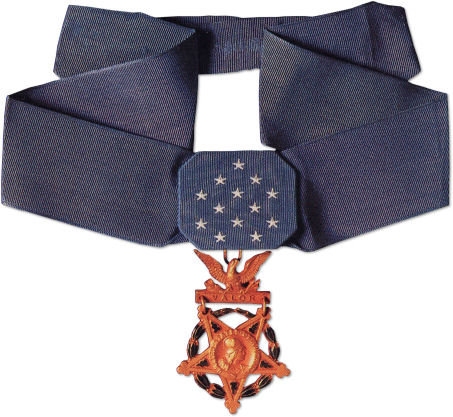
Medal of Honor: W. W. Bradley, Jr.

WILLIS WINTER BRADLEY JR

Lieutenant (later Commander), US Navy; USS Pittsburgh (CA 4)

Born: 28 June 1884, Ransomville, New York
Died: 27 August 1954, Santa Barbara, California

Citation: For extraordinary heroism and devotion to duty while serving on the U.S.S. Pittsburgh, at the time of an accidental explosion of ammunition on that vessel. On 23 July 1917, some saluting cartridge cases were being reloaded in the after casemate: through an accident an explosion occurred. Comdr. Bradley (then Lieutenant), who was about to enter the casemate, was blown back by the explosion and rendered momentarily unconscious, but while still dazed, crawled into the casemate to extinguish burning materials in dangerous proximity to a considerable amount of powder, thus preventing further explosions.


Note: USS Bradley (FF 1041) was named in his honour.

09 October 2011

Victoria Cross: C. J. Melliss

CHARLES JOHN MELLISS

Captain (local Major), Indian Staff Corps; attached West African Frontier Force

Born: 12 September 1862, Mhow, India
Died: 6 June 1936, Camberley, Surrey

Citation: On the 30th September, 1900, at Obassa, Major Melliss, seeing that the enemy were very numerous, and intended to make a firm stand, hastily collected all stray men and any he could get together, and charged at their head, into the dense bush where the enemy were thick. His action carried all along with him ; but the enemy were determined to have a hand-to-hand fight. One fired at Major Melliss, who put his sword through the man, and they rolled over together. Another Ashanti shot him through the foot, the wound paralysing the limb. His wild rush had, however, caused a regular panic among the enemy, who were at the same time charged by the Sikhs, and killed in numbers.
Major Melliss also behaved with great gallantry on three previous occasions.

[London Gazette issue 27266 dated 15 Jan 1901, published 15 Jan 1901.]


Note: Obassa is now in Ghana.

Medal of Honor: R. R. Leisy

LEISY, ROBERT RONALD

Second Lieutenant, US Army; Company B, 1st Battalion, 8th Cavalry, 1st Cavalry Division

Born: 1 March 1945, Stockton, California
Died: 2 December 1969, Phuoc Long Province, Republic of Vietnam

Citation: For conspicuous gallantry and intrepidity in action at the risk of his life above and beyond the call of duty. 2d Lt. Leisy, Infantry, Company B, distinguished himself while serving as platoon leader during a reconnaissance mission [in Phuoc Long Province, Republic of Vietnam, on 2 December 1969]. One of his patrols became heavily engaged by fire from a numerically superior enemy force located in a well-entrenched bunker complex. As 2d Lt. Leisy deployed the remainder of his platoon to rescue the beleaguered patrol, the platoon also came under intense enemy fire from the front and both flanks. In complete disregard for his safety, 2d Lt. Leisy moved from position to position deploying his men to effectively engage the enemy. Accompanied by his radio operator he moved to the front and spotted an enemy sniper in a tree in the act of firing a rocket-propelled grenade at them. Realizing there was neither time to escape the grenade nor shout a warning, 2d Lt. Leisy unhesitatingly, and with full knowledge of the consequences, shielded the radio operator with his body and absorbed the full impact of the explosion. This valorous act saved the life of the radio operator and protected other men of his platoon who were nearby from serious injury. Despite his mortal wounds, 2d Lt. Leisy calmly and confidently continued to direct the platoon's fire. When medical aid arrived, 2d Lt. Leisy valiantly refused attention until the other seriously wounded were treated. His display of extraordinary courage and exemplary devotion to duty provided the inspiration and leadership that enabled his platoon to successfully withdraw without further casualties. 2d Lt. Leisy's gallantry at the cost of his life are in keeping with the highest traditions of the military service and reflect great credit on him, his unit, and the U.S. Army.

02 October 2011

George Cross: D. A. Copperwheat

DENNIS ARTHUR COPPERWHEAT

Lieutenant, Royal Navy; HMS Penelope

Born: 23 May 1914
Died: 8 September 1992

Citation: The KING has been graciously pleased to approve the Award of the GEORGE CROSS to -
Lieutenant Dennis Arthur Copperwheat, Royal Navy, H.M.S. Penelope.
For great bravery at Malta. During heavy air attacks on Valletta [on 22 March 1942], Lieutenant Copperwheat was sent in charge of a party of men from H.M.S. Penelope to scuttle a Merchantman, laden with ammunition, which was burning in the harbour. Owing to the fires, it was impossible to place scuttling charges in the holds, and they had to be slung over the side of the ship. As they worked, ammunition was exploding all round them from burning stowages on deck. The ship lay 40 yards from the shore, to which the electric cables for firing the scuttling charges could only just reach. Lieutenant Copperwheat sent his working party to shelter, and stayed himself to fire the charges from a position where he was exposed to the full blast of the explosion, which lifted him bodily. But for his brave action the ship must have blown up, and grave damage would have been done to the harbour.
Moreover, much of the ammunition was saved and some very heavy bombs, part of the cargo, were soon afterwards dropped in Italy.

[London Gazette issue 35788 dated 17 Nov 1942, published 13 Nov 1942.]


Note: The ship in question was a Norwegian merchantman, SS Talabot.

Victoria Cross: J. Sinnott

JOHN SINNOTT

Lance-Corporal, 84th Regiment

Born: 1829, Wexford, County Wexford, Ireland
Died: 20 July 1896, Clapham, Southwest London

Citation: For conspicuous gallantry at Lucknow, on the 6th of October, 1857, in going out with Serjeants Glinn and Mullins and Private Mullins, to rescue Lieutenant Gibaut, who, in carrying out water to extinguish a fire in the breastwork, had been mortally wounded, and lay outside. They brought in the body under a heavy fire. Lance-Corporal Sinnott was twice wounded. His comrades unanimously elected him for the Victoria Cross, as the most worthy. He had previously repeatedly accompanied Lieutenant Gibaut when he carried out water to extinguish the fire.
Despatch from Lieutenant-General Sir James Outram, Bart., G.C.B., dated 2nd December 1857.

[London Gazette issue 22212 dated 24 Dec 1858, published 24 Dec 1858.]

Medal of Honor: J. H. Howard

JAMES HOWELL HOWARD

Lieutenant Colonel, US Army Air Corps

Born: 8 April 1913, Canton, China
Died: 18 March 1995, Bay Pines, Florida

Citation: For conspicuous gallantry and intrepidity above and beyond the call of duty in action with the enemy near Oschersleben, Germany, on 11 January 1944. On that day Col. Howard was the leader of a group of P51 aircraft providing support for a heavy bomber formation on a long-range mission deep in enemy territory. As Col. Howard's group met the bombers in the target area the bomber force was attacked by numerous enemy fighters. Col. Howard, with his group, at once engaged the enemy and himself destroyed a German ME. 110. As a result of this attack Col. Howard lost contact with his group, and at once returned to the level of the bomber formation. He then saw that the bombers were being heavily attacked by enemy airplanes and that no other friendly fighters were at hand. While Col. Howard could have waited to attempt to assemble his group before engaging the enemy, he chose instead to attack single-handed a formation of more than 30 German airplanes. With utter disregard for his own safety he immediately pressed home determined attacks for some 30 minutes, during which time he destroyed 3 enemy airplanes and probably destroyed and damaged others. Toward the end of this engagement 3 of his guns went out of action and his fuel supply was becoming dangerously low. Despite these handicaps and the almost insuperable odds against him, Col. Howard continued his aggressive action in an attempt to protect the bombers from the numerous fighters. His skill, courage, and intrepidity on this occasion set an example of heroism which will be an inspiration to the U.S. Armed Forces.

Note: Howard was originally a Navy pilot, flying Grumman F3F-1 fighters aboard USS Enterprise (CV 6). He left the Navy in June of 1941 to join the American Volunteer Group (AVG) - the Flying Tigers. Flying a Curtiss P-40 Warhawk, he completed 56 missions and was credited with shooting down six Japanese aircraft. After the Flying Tigers were officially absorbed by the Army Air Corps in 1942, he returned to the United States and joined the Army Air Corps.
His memoir, Roar of the Tiger, was published in 1991.

01 October 2011

Carnegie Medal books

Having finished reading the Newbery Medal winners in August of '09, I'm continuing with the books which have been awarded the Andrew Carnegie Medal - the British equivalent of the Newbery Medal, now awarded by the Chartered Institute of Library and Information Professionals (CILIP).

The medal was first awarded in 1937, for the best children's book of 1936, but there have been three years when no book was considered suitable, so there are only 72 winners thus far. In addition to the gold medal, the winner receives £500 worth of books to donate to a library of his/her/their choice.

Here's the list. (Dates marked in red indicate the six books I had already read before last year; dates in purple indicate the ones I've read since.)

1936: Pigeon Post, by Arthur Ransome
1937: The Family from One End Street, by Eve Garnett
1938: The Circus is Coming (aka Circus Shoes), by Noel Streatfield
1939: Radium Woman, by Eleanor Doorly
1940: Visitors from London, by Kitty Barne
1941: We Couldn't Leave Dinah, by Mary Treadgold
1942: The Little Grey Men, by 'BB' (D J Watkins-Pitchford)
1943: Prize withheld as no book was considered suitable
1944: The Wind on the Moon, by Eric Linklater
1945: Prize withheld as no book was considered suitable
1946: The Little White Horse, by Elizabeth Goudge
1947: Collected Stories for Children, Walter De La Mare
1948: Sea Change, by Richard Armstrong
1949: The Story of Your Home, by Agnes Allen
1950: The Lark on the Wing, by Elfrida Vipont
1951: The Wool-pack, by Cynthia Harnett
1952: The Borrowers, by Mary Norton
1953: A Valley Grows Up, by Edward Osmond
1954: Knight Crusader, by Ronald Welch (Felton Ronald Oliver)
1955: The Little Bookroom, by Eleanor Farjeon
1956: The Last Battle, by C S Lewis
1957: A Grass Rope, by William Mayne
1958: Tom's Midnight Garden, by Philipa Pearce
1959: The Lantern Bearers, by Rosemary Sutcliff
1960: The Making of Man, by Dr I W Cornwall
1961: A Stranger at Green Knowe, by Lucy M Boston
1962: The Twelve and the Genii, by Pauline Clarke
1963: Time of Trial, by Hester Burton
1964: Nordy Bank, by Sheena Porter
1965: The Grange at High Force, by Philip Turner
1966: Prize withheld as no book was considered suitable
1967: The Owl Service, by Alan Garner
1968: The Moon in the Cloud, by Rosemary Harris
1969: The Edge of the Cloud, by Kathleen Peyton
1970: The God Beneath the Sea, by Leon Garfield and Edward Blishen
1971: Josh, by Ivan Southall
1972: Watership Down, by Richard Adams
1973: The Ghost of Thomas Kempe, by Penelope Lively
1974: The Stronghold, by Mollie Hunter
1975: The Machine Gunners, by Robert Westall
1976: Thunder and Lightnings, by Jan Mark
1977: The Turbulent Term of Tyke Tiler, by Gene Kemp
1978: The Exeter Blitz, by David Rees
1979: Tulku, by Peter Dickinson
1980: City of Gold and Other Stories from the Old Testament, by Peter Dickinson
1981: The Scarecrows, by Robert Westall
1982: The Haunting, by Margaret Mahy
1983: Handles, by Jan Mark
1984: The Changeover, by Margaret Mahy
1985: Storm, by Kevin Crossley-Holland
1986: Granny was a Buffer Girl, by Berlie Doherty
1987: The Ghost Drum, by Susan Price
1988: A Pack of Lies, by Geraldine McCaughrean
1989: Goggle-eyes, by Anne Fine
1990: Wolf, by Gillian Cross
1991: Dear Nobody, by Berlie Doherty
1992: Flour Babies, by Anne Fine
1993: Stone Cold, by Robert Swindells
1994: Whispers in the Graveyard, by Theresa Breslin
1995: Northern Lights, by Philip Pullman*
1996: Junk, by Melvin Burgess
1997: River Boy, by Tim Bowler
1998: Skellig, by David Almond
1999: Postcards From No Man's Land, by Aidan Chambers
2000: The Other Side of Truth, by Beverley Naidoo
2001: The Amazing Maurice and his Educated Rodents, by Terry Pratchett
2002: Ruby Holler, by Sharon Creech
2003: A Gathering Light, by Jennifer Donnelly**
2004: Millions, by Frank Cottrell Boyce
2005: Tamar, by Mal Peet
2006: ***
2007: Just in Case, by Meg Rosoff
2008: Here Lies Arthur, by Philip Reeve
2009: Bog Child, by Siobhan Dowd
2010: The Graveyard Book, by Neil Gaiman
2011: Monsters of Men, by Patrick Ness

So the count now is 56 down, 16 to go. The ILLs are still coming in - My thanks to the J Eugene Smith Library, Eastern Connecticut State College, Willimantic CT; the Connecticut State Library Library Service Centre, Willimantic CT; the Fletcher Memorial Library, Hampton CT; and one other library, which I forgot to record.

* His Dark Materials, Book 1. Published in the US as The Golden Compass.

** Published in the US as A Northern Light.

*** Up through the award for 2005, the winners were referred to by the year of publication. Beginning in 2007, the winners were referred to by the year the award was given, as with the American Newbery Medal. Thus there is no "2006 winner" of the Carnegie Medal. Tamar, the 2005 winner, was published in '05, and received the medal in '06. Just in Case, the 2007 winner, was published in '06 and received the award in '07.

Book list - Sep 11

The Tragedy of Pudd'nhead Wilson - humour, by Mark Twain
The Snowstorm (aka The Snow Ghosts) - children's time travel, by Beryl Netherclift
Over the Wine-Dark Sea - historical fiction, by H N Turteltaub
The Guns of the South - AH, by Harry Turtledove *
The Sky Took Him - historical mystery, by Donis Casey
Crying Blood - historical mystery, by Donis Casey
Miss Peregrine's Home for Peculiar Children - YA, by Ransom Riggs
The Gryphon's Skull - historical fiction, by H N Turteltaub
Grierson's Raid: A Daring Cavalry Strike Through the Heart of the Confederacy - USCW, by Tom Lalicki
The Trouble with Humans - SF (short stories), by Christopher Anvil


Ten books last month, with only one reread (marked by an asterisk). I'm not setting an official goal this year, though I do expect to read around 150 books.

No Carnegie Medal winners this time round, so I'm still at 56 of 72.

Words of wisdom

October. This is one of the peculiarly dangerous months to speculate in stocks in. The others are July, January, September, April, November, May, March, June, December, August and February.
-- Mark Twain
The Tragedy of Pudd'nhead Wilson

25 September 2011

Victoria Cross: G. L. Goodlake

GERALD LITTLEHALES GOODLAKE

Brevet Major, Coldstream Guards

Born: 14 May 1832, Wadley, Berkshire
Died: 5 April 1890, Denham, Middlesex

Citation: For distinguished gallantry whilst in command of the sharpshooters furnished by the Coldstream Guards, on the 28th October, 1854, on the occasion of "the powerful sortie on the 2nd Division," when he held the Windmill Ravine, below the Picquet House, against a much larger force of the enemy. The party of sharpshooters then under his command killed thirty-eight (one an officer) and took three prisoners of the enemy, (of the latter, one an Officer) Major Goodlake being the sole Officer in command.
Also, for distinguished gallantry on the occasion of the surprise of a picquet of the enemy, in November, at the bottom of the Windmill Ravine, by the sharpshooters, under his sole leading and command, when the knapsacks and rifles of the enemy's party fell into his hands.

[London Gazette issue 21971 dated 24 Feb 1857, published 24 Feb 1857.]

Medal of Honor: Henrechon, Volz, Catherwood and Harrison

GEORGE FRANCIS HENRECHON

Machinist's Mate Second Class, US Navy; USS Pampanga (PG 39)

Born: 22 November 1885, Hartford, Connecticut
Died: 16 August 1929, Hartford, Connecticut

Citation: While attached to the U.S.S. Pampang, Henrechon was one of a shore party moving in to capture Mundang, Philippine Islands, on 24 September 1911. Ordered to take station within 100 yards of a group of nipa huts close to the trail, Henrechon advanced and stood guard as the leader and his scout party first searched the surrounding deep grasses, then moved into the open area before the huts. Instantly enemy Moros opened point-blank fire on the exposed men and approximately 20 Moros rushed the small group from inside the huts and from other concealed positions. Henrechon, responding to the calls for help, was one of the first on the scene. When his rifle jammed after the first shot, he closed in with rifle, using it as a club to break the stock over the head of the nearest Moro and then, drawing his pistol, started in pursuit of the fleeing outlaws. Henrechon's aggressive charging of the enemy under heavy fire and in the face of great odds contributed materially to the success of the engagement.


JACOB VOLZ

Carpenter's Mate Third Class, US Navy; USS Pampanga (PG 39)

Born: 23 June 1889, Sutton, Nebraska
Died: 22 July 1965, Portland, Oregon

Citation: While attached to the U.S.S. Pampang, Volz was one of a shore party moving in to capture Mundang, on the island of Basilan, Philippine Islands, on 24 September 1911. Investigating a group of nipa huts close to the trail, the advance scout party was suddenly taken under point-blank fire and rushed by approximately 20 enemy Moros attacking from inside the huts and other concealed positions. Volz responded instantly to calls for help and, finding all members of the scout party writhing on the ground but still fighting, he blazed his rifle into the outlaws with telling effect, destroying several of the Moros and assisting in the rout of the remainder. By his aggressive charging of the enemy under heavy fire and in the face of great odds, Volz contributed materially to the success of the engagement.


JOHN HUGH CATHERWOOD

Ordinary Seaman, US Navy; USS Pampanga (PG 39)

Born: 7 August 1888, Springfield, Illinois
Died: 18 December 1930, Springfield, Illinois

Citation: While attached to the U.S.S. Pampang, Catherwood was one of a shore party moving in to capture Mundang, on the island of Basilan, Philippine Islands, on the morning of 24 September 1911. Advancing with the scout party to reconnoiter a group of nipa huts close to the trail, Catherwood unhesitatingly entered the open area before the huts, where his party was suddenly taken under point-blank fire and charged by approximately 20 enemy Moros coming out from inside the native huts and from other concealed positions. Struck down almost instantly by the outlaws' deadly fire, Catherwood, although unable to rise, rallied to the defense of his leader and fought desperately to beat off the hostile attack. By his valiant effort under fire and in the face of great odds, Catherwood contributed materially toward the destruction and rout of the enemy.


BOLDEN REUSH HARRISON

Seaman, US Navy; USS Pampanga (PG 39)

Born: 26 April 1886, Savannah, Tennessee
Died: 26 January 1952, Savannah, Tennessee

Citation: While attached to the U.S.S. Pampang, Harrison was one of a shore party moving in to capture Mundang, on the island of Basilan, Philippine Islands, on 24 September 1911. Harrison instantly responded to the calls for help when the advance scout party investigating a group of nipa huts close to the trail, was suddenly taken under point-blank fire and rushed by approximately 20 enemy Moros attacking from inside the huts and from other concealed positions. Armed with a double-barreled shotgun, he concentrated his blasting fire on the outlaws, destroying 3 of the Moros and assisting in the rout of the remainder. By his aggressive charging of the enemy under heavy fire and in the face of great odds, Harrison contributed materially to the success of the engagement.


Note: Hospital Apprentice Fred H McGuire also received the Medal of Honor for this action.

18 September 2011

Victoria Cross: F. T. Peters

FREDERICK THORNTON PETERS, DSO DSC

Acting Captain, Royal Navy; commanding HMS Walney

Born: 17 September 1889, Charlottetown, Prince Edward Island, Canada
Died: 13 November 1942, off Plymouth, Devon

Citation: The KING has been graciously pleased to approve the award of the VICTORIA CROSS to:
the late Acting Captain Frederick Thornton Peters, D.S.O., D.S.C., Royal Navy,
for valour in taking H.M.S. Walney, in an enterprise of desperate hazard, into the harbour of Oran on the 8th November, 1942. Captain Peters led his force through the boom towards the jetty in the face of point-blank fire from shore batteries, a Destroyer and a Cruiser. Blinded in one eye, he alone of the seventeen Officers and Men on the bridge survived. The Walney reached the jetty disabled and ablaze, and went down with her colours flying.

[London Gazette issue 36019 dated 18 May 1943, published 14 May 1943.]


Note: The attack on the Vichy-controlled port of Oran, in Algeria, was carried out as Operation RESERVIST, part of the North African invasion (Operation TORCH). The goal of RESERVIST was to capture facilities and ships at Oran before they could be destroyed, but the plan failed when the two sloops carrying the invasion force, HM Ships Walney and Hartland, were sunk.

Medal of Honor: H. H. Miyamura

HIROSHI H MIYAMURA

Corporal, US Army; Company H, 7th Infantry Regiment, 3rd Infantry Division

Born: Gallup, New Mexico
Died: 24 April 1951, near Taejon-ni, Korea

Citation: Cpl. Miyamura, a member of Company H, distinguished himself by conspicuous gallantry and intrepidity above and beyond the call of duty in action against the enemy [near Taejon-ni, Korea]. On the night of 24 April [1951], Company H was occupying a defensive position when the enemy fanatically attacked threatening to overrun the position. Cpl. Miyamura, a machine gun squad leader, aware of the imminent danger to his men unhesitatingly jumped from his shelter wielding his bayonet in close hand-to-hand combat killing approximately 10 of the enemy. Returning to his position, he administered first aid to the wounded and directed their evacuation. As another savage assault hit the line, he manned his machine gun and delivered withering fire until his ammunition was expended. He ordered the squad to withdraw while he stayed behind to render the gun inoperative. He then bayoneted his way through infiltrated enemy soldiers to a second gun emplacement and assisted in its operation. When the intensity of the attack necessitated the withdrawal of the company Cpl. Miyamura ordered his men to fall back while he remained to cover their movement. He killed more than 50 of the enemy before his ammunition was depleted and he was severely wounded. He maintained his magnificent stand despite his painful wounds, continuing to repel the attack until his position was overrun. When last seen he was fighting ferociously against an overwhelming number of enemy soldiers. Cpl. Miyamura's indomitable heroism and consummate devotion to duty reflect the utmost glory on himself and uphold the illustrious traditions on the military service.

15 September 2011

Medal of Honor awarded for Afghanistan

ZUI this article from the Los Angeles Times:
A small team of American and Afghan troops was pinned down in a remote village under withering fire from three sides. A young lieutenant was begging for artillery or air support. Without it, he yelled, "we are going to die out here."

Can't be done, came the reply. It might kill civilians.

Less than a mile away, Marine Cpl. Dakota L. Meyer heard the radio exchange in agony. His buddies were dying, yet Meyer was under orders to stay where he was. Four times he requested permission to go to their aid, and four times he was refused.

After two hours, Meyer decided to defy his superiors. The powerfully built 21-year-old with a soft Kentucky drawl climbed into the turret of a gun truck mounted with a .50-caliber machine gun and, with another Marine driving, raced toward the battle.

On Thursday, Meyer was at the White House to receive the Medal of Honor, the nation's highest award for valor, for saving the lives of 36 combatants — 13 Americans and 23 Afghans — and personally killing at least eight Taliban fighters that day, Sept. 8, 2009. He is the first living Marine to receive the award since the Vietnam War.

*******

Trained as a sniper, Meyer volunteered to go to Afghanistan in 2009 because he wanted to see action. His unit, the 3rd Battalion of the 3rd Marine Regiment based in Hawaii, was deploying to Iraq, but Meyer had already done a tour there two years earlier and found it too quiet for his tastes. In Afghanistan, he would be part of a sniper team assigned to a unit training Afghan forces in Kunar province, a remote and rugged area near the Pakistan border.

"The main reason I went is because I wanted to fight," he later told the Marine Corps Times.

President Obama's remarks during the presentation can be found here.

************* *** *************

DAKOTA L MEYER

Corporal, US Marine Corps; Marine Embedded Training Team 2-8, Regional Corps Advisory Command 3-7

Born: 26 June 1988, Greensburg, Kentucky
Died: TBD

Citation: For conspicuous gallantry and intrepidity at the risk of his life above and beyond the call of duty while serving with Marine Embedded Training Team 2-8, Regional Corps Advisory Command 3-7, in Kunar Province, Afghanistan, on 8 September 2009. Corporal Meyer maintained security at a patrol rally point while other members of his team moved on foot with two platoons of Afghan National Army and Border Police into the village of Ganjgal for a pre-dawn meeting with village elders. Moving into the village, the patrol was ambushed by more than 50 enemy fighters firing rocket propelled grenades, mortars, and machine guns from houses and fortified positions on the slopes above. Hearing over the radio that four U.S. team members were cut off, Corporal Meyer seized the initiative. With a fellow Marine driving, Corporal Meyer took the exposed gunner’s position in a gun-truck as they drove down the steeply terraced terrain in a daring attempt to disrupt the enemy attack and locate the trapped U.S. team. Disregarding intense enemy fire now concentrated on their lone vehicle, Corporal Meyer killed a number of enemy fighters with the mounted machine guns and his rifle, some at near point blank range, as he and his driver made three solo trips into the ambush area. During the first two trips, he and his driver evacuated two dozen Afghan soldiers, many of whom were wounded. When one machine gun became inoperable, he directed a return to the rally point to switch to another gun-truck for a third trip into the ambush area where his accurate fire directly supported the remaining U.S. personnel and Afghan soldiers fighting their way out of the ambush. Despite a shrapnel wound to his arm, Corporal Meyer made two more trips into the ambush area in a third gun-truck accompanied by four other Afghan vehicles to recover more wounded Afghan soldiers and search for the missing U.S. team members. Still under heavy enemy fire, he dismounted the vehicle on the fifth trip and moved on foot to locate and recover the bodies of his team members. Corporal Meyer’s daring initiative and bold fighting spirit throughout the 6-hour battle significantly disrupted the enemy’s attack and inspired the members of the combined force to fight on. His unwavering courage and steadfast devotion to his U.S. and Afghan comrades in the face of almost certain death reflected great credit upon himself and upheld the highest traditions of the Marine Corps and the United States Naval Service.

11 September 2011

Victoria Cross: C. L. Smith

CLEMENT LESLIE SMITH

Lieutenant, Duke of Cornwall's Light Infantry; attached Somali Mounted Infantry

Born: 17 January 1878, Cowes, Isle of Wight
Died: 14 December 1927, Alassio, Italy

Citation: At the commencement of the fight at Jidballi, on 10th January, 1904, the enemy made a very sudden and determined rush on the 5th Somali Mounted Infantry, from under cover of bushes close at hand. They were supported by rifle fire, advanced very rapidly and got right amongst our men.
Lieutenant Smith, Somali Mounted Infantry, and Lieutenant J. K. Welland, M.D., Royal Army Medical Corps, went out to the aid of Hospital Assistant Eahamat Ali, who was wounded, and endeavoured to bring him out of action on a horse, but the rapidity of the enemy's advance rendered this impossible, and the Hospital Assistant was killed. Lieutenant Smith then did all that any man could do to bring out Doctor Welland, helping him to mount a horse, and, when that was shot, a mule. This also was hit, and Doctor Welland was speared by the enemy. Lieutenant Smith stood by Doctor Welland to the end, and when that Officer was killed, was within a few paces of him, endeavouring to keep off the enemy with his revolver. At that time the dervishes appeared to be all round him, and it was marvellous that he escaped with his life.

[London Gazette issue 27683 dated 7 Jun 1904, published 7 Jun 1904.]

Medal of Honor: E. L. Kinser

ELBERT LUTHER KINSER

Sergeant, US Marine Corps Reserve; Company I, 3d Battalion, 1st Marines, 1st Marine Division

Born: 21 October 1922, Greeneville, Tennessee
Died: 4 May 1945, Okinawa

Citation: For conspicuous gallantry and intrepidity at the risk of his life above and beyond the call of duty while acting as leader of a Rifle Platoon, serving with Company I, 3d Battalion, 1st Marines, 1st Marine Division, in action against Japanese forces on Okinawa Shima in the Ryukyu Chain, 4 May 1945. Taken under sudden, close attack by hostile troops entrenched on the reverse slope while moving up a strategic ridge along which his platoon was holding newly won positions, Sgt. Kinser engaged the enemy in a fierce hand grenade battle. Quick to act when a Japanese grenade landed in the immediate vicinity, Sgt. Kinser unhesitatingly threw himself on the deadly missile, absorbing the full charge of the shattering explosion in his own body and thereby protecting his men from serious injury and possible death. Stouthearted and indomitable, he had yielded his own chance of survival that his comrades might live to carry on the relentless battle against a fanatic enemy. His courage, cool decision and valiant spirit of self-sacrifice in the face of certain death sustained and enhanced the highest traditions of the U.S. Naval Service. He gallantly gave his life for his country.

04 September 2011

George Cross: M. Vaughan

MARGARET VAUGHAN

Student

Born: 25 November 1934, Cardiff, Glamorgan, Wales
Died: TBD

Citation: The KING has been pleased to award the Albert Medal to Margaret Vaughan and the late John Howard Davies for their gallantry in the following circumstances: —
On May 28th, 1949, a party of Scouts, aged between 11 and 15 years, visiting Sully Island were cut off by the rising tide from a causeway which led to the mainland. Most of the boys got safely across, but two of them were forced off the causeway by the strong tide. The leader of the party returned to help the elder boy but in the struggle he too became exhausted. Margaret Vaughan (aged 14 years) saw from the beach the difficulties they were in. She undressed and swam towards them over a distance of some 30 yards in cold, rough water and against strong currents due to the rising tide. On reaching them she towed the boy to the shore while he supported himself by grasping the straps of her costume and his leader's coat. At about ten feet from the shore a life belt was thrown in which the boy was placed by the other two and the three reached the shore safely. Margaret Vaughan's action probably saved the life of the Scout leader as well as that of the elder boy.
Meanwhile, John Howard Davies (aged 13 years) had safely reached the mainland when he saw that his friend, who was unable to swim, was being forced away from the causeway into deep water. He stripped to the waist and went back along the causeway to help him. By swimming out he was able to grasp his friend, and hold him up in the water. Both boys shouted for help and it was obvious that they would not get ashore unaided. By this time a rescue boat had put out from the shore but Davies became exhausted by his efforts and before the boat could reach them he was forced to release his hold on his friend and they drifted apart. The boat rescued the friend but no further sign of Davies was seen. His body was subsequently recovered. There is no doubt that in returning to the aid of his friend after he himself had reached safety Davies gave his life in this rescue attempt.

[London Gazette issue 38751 dated 1 Nov 1949, published 1 Nov 1949.]


Notes: The Albert Medal, first instituted by Royal Warrant on 7 March 1866, was discontinued in 1971, and all living recipients thereof were invited to exchange their medals for the George Cross.
Sully Island is a small tidal island in Wales, seven miles south of the city of Cardiff.

Victoria Cross: Gobind Singh

GOBIND SINGH

Lance-Dafadar, Indian Cavalry

Born: 7 December 1887, Damoi Village, Jodhpur, India
Died: 9 December 1942, Nagaur, Rajputana, India

Citation: For most conspicuous bravery and devotion to duty in thrice volunteering to carry messages between the regiment and Brigade Headquarters, a distance of 1 1/2 miles over open ground which was under the observation and heavy fire of the enemy. He succeeded each time in delivering his message, although on each occasion his horse was shot and he was compelled to finish his journey on foot.

[London Gazette issue 30471 dated 11 Jan 1918, published 8 Jan 1918.]


Note: Lance Daffadar is an Indian army rank equivalent to a corporal in the cavalry. The equivalent rank in other Indian army units is Naik.

Medal of Honor: Brady, Cooney and Johnsen

GEORGE F BRADY

Chief Gunner's Mate, US Navy; USS Winslow (TB 5)

Born: 7 September 1867, Ireland
Died: unknown

Citation: On board the torpedo boat Winslow during the actions at Cardenas, Cuba, 11 May 1898. Conspicuously gallant during this period, Brady, by his energy in assisting to sustain fire, his efforts to repair the steering gear and his promptness in maintaining watertight integrity, was largely instrumental in saving the vessel.


THOMAS CALVIN COONEY

Chief Machinist, US Navy; USS Winslow (TB 5)

Born: 18 July 1853, Westport, Nova Scotia, Canada
Died: 8 January 1907

Citation: On board the U.S. Torpedo Boat Winslow during the action at Cardenas, Cuba, 11 May 1898. Following the piercing of the boiler by an enemy shell, Cooney, by his gallantry and promptness in extinguishing the resulting flames, saved the boiler tubes from burning out.


HANS JOHNSEN

Chief Machinist, US Navy; USS Winslow (TB 5)

Born: 3 January 1865, Sandnes, Norway
Died: 17 June 1920, New Jersey(?)

Citation: On board the torpedo boat Winslow during the action at Cardenas, Cuba, 11 May 1898. Showing great presence of mind, Johnsen turned off the steam from the engine which had been wrecked by a shell bursting in the cylinder.

01 September 2011

Book list - Aug 11

Ghost Story - modern fantasy, by Jim Butcher
The Old Buzzard Had It Coming - historical mystery, by Donis Casey
Wolf - YA, by Gillian Cross (Carnegie Medal, 1990)
Aliens on Vacation - children's SF, by Clete Barrett Smith
Hornswoggled - historical mystery, by Donis Casey
Alas, Babylon - WWIII fiction, by Pat Frank *
A Murder, a Mystery, and a Marriage - mystery, by Mark Twain
The Latte Rebellion - YA, by Sarah Jamila Stevenson
The Drop Edge of Yonder - historical mystery, by Donis Casey
Gunsmoke Over the Atlantic: First Naval Actions of the Civil War - USCW, by Coombe
The Confederate States of America: What Might Have Been - AH, by Roger L Ransom


Eleven books last month, one of them a reread (marked by an asterisk). I'm not setting an official goal this year, though I do expect to read around 200 books.

The one Carnegie Medal winner brings me up to 56 of 72. I regret to say that I didn't make note of which library to thank for the ILL.