02 December 2012

Victoria Cross: T. de C. Hamilton

THOMAS de COURCY HAMILTON

Captain, 68th Regiment

Born: 20 July 1825, Stranraer, Galloway, Scotland
Died: 3 March 1908, Cheltenham, Gloucestershire

Citation: For having, on the night of the llth May, 1855, during a most determined sortie, boldly charged the enemy, with a small force, from a battery of which they had obtained possession in great numbers, thereby saving the works from falling into the hands of the enemy.
He was conspicuous on this occasion for his gallantry, and daring conduct.

[London Gazette issue 21971 dated 24 Feb 1857, published 24 Feb 1857.]

30 November 2012

Alba gu bràth


Alba gu brath!


If the Irish can go around saying "Erin go bragh" on St Patrick's Day, then I can say "Alba gu bràth" on St Andrew's....

14 November 2012

RIP: James L. Stone

ZUI this article from the Biloxi (MS) Sun Herald:
On the evening of Nov. 21, 1951, James L. Stone looked out from his hilltop outpost in Korea and sensed what was coming. He was an Army lieutenant whose eight months of combat experience were enough to alert him to the imminence of an enemy assault.

The attack began at 9 p.m. with artillery and mortar fire and raged through the night as hundreds of Chinese stormed the hill. By the next day, half the men in the platoon were dead and their 28-year-old lieutenant had been shot three times.

But the lieutenant survived to spend nearly 30 years in the Army, rising to the rank of colonel and receiving the nation's highest military decoration for valor.

*******

Stone died Nov. 9 in Arlington, Texas, the Congressional Medal of Honor Society announced. The cause was not disclosed. He was 89.

*******

When U.S. reinforcements retook the hill the next day, Collier wrote, they found 545 enemy dead.

"I am not proud of that," Stone told the Fort Worth Star-Telegram in 2005. "I hate to see men killed. But, it's either you or them."

James Lamar Stone was born Dec. 27, 1922, in Pine Bluff, Ark. He studied chemistry and zoology at the University of Arkansas, where he received a bachelor's degree, according to the Fort Worth Star-Telegram.

After the Korean War, Col. Stone served in Germany, oversaw ROTC units and served a year in Vietnam. A complete list of survivors could not be determined.

There are now 80 surviving Medal of Honor recipients.

************* *** *************

JAMES LAMAR STONE

First Lieutenant, US Army; Company E, 8th Cavalry Regiment, 1st Cavalry Division

Born: 27 December 1922, Pine Bluff, Arkansas
Died: 9 November 2012, Arlington, Texas

Citation: 1st Lt. Stone distinguished himself by conspicuous gallantry and indomitable courage above and beyond the call of duty in action against the enemy [near Sokkogae, Korea, on the night of 21-22 November 1951]. When his platoon, holding a vital outpost position, was attacked by overwhelming Chinese forces, 1st Lt. Stone stood erect and exposed to the terrific enemy fire calmly directed his men in the defense. A defensive flame-thrower failing to function, he personally moved to its location, further exposing himself, and personally repaired the weapon. Throughout a second attack, 1st Lt. Stone, though painfully wounded, personally carried the only remaining light machine gun from place to place in the position in order to bring fire upon the Chinese advancing from 2 directions. Throughout he continued to encourage and direct his depleted platoon in its hopeless defense. Although again wounded, he continued the fight with his carbine, still exposing himself as an example to his men. When this final overwhelming assault swept over the platoon's position his voice could still be heard faintly urging his men to carry on, until he lost consciousness. Only because of this officer's driving spirit and heroic action was the platoon emboldened to make its brave but hopeless last ditch stand.

11 November 2012

Medal of Honor: The Unknown Americans


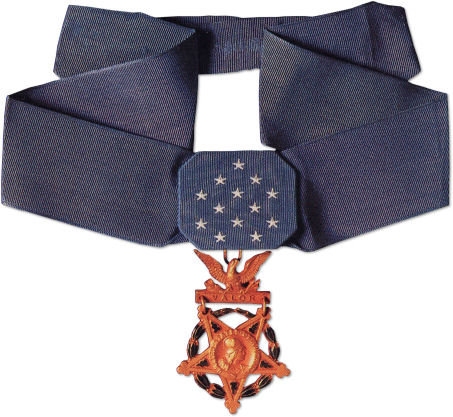
Left to right: Army, Navy/Marine Corps and Air Force Medals of Honor


By virtue of an act of Congress approved 24 August 1921, the Medal of Honor, emblem of highest ideals and virtues is bestowed in the name of the Congress of the United States upon the unknown American, typifying the gallantry and intrepidity, at the risk of life above and beyond the call of duty, of our beloved heroes who made the supreme sacrifice in the World War. They died in order that others might live (293.8, A.G:O.) (War Department General Orders, No. 59, 13 Dec. 1921, sec. I).

*******

AN ACT To authorize the President to award the Medal of Honor to the unknown American who lost his life while serving overseas in the armed forces of the United states during the Second World War.

Be it enacted by the Senate and House of Representatives of the United States of America in Congress assembled, That the President is hereby authorized and directed to award, in the name of Congress, a Medal of Honor to the unknown American who lost his life while serving overseas in the armed forces of the United States during the Second World War, and who will lie buried in the Memorial Amphitheater of the National Cemetery at Arlington, Virginia, as authorized by the Act of June 24, 1946, Public Law 429, Seventy-ninth Congress.

Approved March 9, 1948. Public Law 438, 80th Congress.

*******

AN ACT To authorize the President to award the Medal of Honor to the unknown American who lost his life while serving overseas in the Armed Forces of the United States during the Korean conflict.

Be it enacted by the Senate and House of Representatives of the United States of America in Congress assembled, That the President is hereby authorized and directed to award, in the name of the Congress, a Medal of Honor to the unknown American who lost his life while serving overseas in the Armed Forces of the United States during the Korean conflict, and who will lie buried in the Memorial Amphitheater of the National Cemetery at Arlington, Virginia, as authorized by the Act of August 3, 1956, Public Law 975, Eighty_fourth Congress.

Approved August 31, 1957. Public Law 85_251.

*******

AN ACT To authorize the President to award the Medal of Honor to the unknown American who lost his life while serving in the Armed Forces of the United States in Southeast Asia during the Vietnam era and who has been selected to be buried in the Memorial Amphitheater at Arlington National Cemetery.

Be it enacted by the Senate and House of Representatives of the United States of America in Congress assembled, That the President is hereby authorized and directed to award, in the name of the Congress, a Medal of Honor to the unknown American who lost his life while serving in Southeast Asia during the Vietnam era as a member of the Armed Forces of the United States and who has been selected to lie buried in the Memorial Amphitheater of the National Cemetery at Arlington, Virginia, as authorized by the National Cemeteries Act of 1973.

07 November 2012

Australian VC awarded for Afghanistan


ZUI this article (dated 1 Nov 12) from the Melbourne Herald Sun:
AN AUSTRALIAN infantry soldier who repeatedly broke cover in a hail of Taliban gunfire and helped clear the way for the rescue of casualties has been awarded the nation's highest military honour, the Victoria Cross.
Corporal Daniel Keighran, 29, from Nambour in Queensland, had the medal pinned on his chest by the Governor-General at a ceremony in Canberra today attended by the Prime Minister, Opposition Leader, military top brass and other dignitaries.
Corporal Keighran was involved in a firefight between Taliban fighters and Australian and Afghan troops. He repeatedly broke cover to draw fire, allowing the enemy locations to be identified and neutralised.

*******

Defence force chief David Hurley said the battle near the village of Derapet in Oruzgan province showed there was nothing simple about war.
"Battles are frightening, confusing and confronting. But there are also moments of crystal clarity.''
Corporal Keighran "deliberately and repeatedly'' drew intense enemy fire away from other members of his patrol, General Hurley said.
"Despite the enemy bullets biting into the dirt at his feet he returned fire and provided critical information about the insurgents' positions,'' he said.
Corporal Keighran acted with exceptional clarity and composure and helped turn the fight in our favour, General Hurley said.

*******

Prime Minister Julia Gillard, who met with Corporal Keighran and his wife yesterday, expressed a "tremendous sense of pride".
Corporal Keighran had been modest about his "amazing acts of valour", Ms Gillard said.
"To you Corporal Keighran, here today, despite your modesty we acknowledge those acts of valour," the Prime Minister said.
"We acknowledge them because it is always important to accurately record the history of our nation and what makes our nation and these acts of courage speak to who we are as Australians."

*******

Warrant Officer Keith Payne, who was awarded the Victoria Cross for acts of gallantry in the Vietnam War, also attended the ceremony.
Corporal Mark Donaldson, who was awarded the honour in 2009, attended the ceremony. SAS Corporal Ben Roberts-Smith, the last recipient, was unable to attend but his wife Emma was at the ceremony.
The Victoria Cross for Australia is the "decoration for according recognition to persons who in the presence of the enemy, perform acts of the most conspicuous gallantry, or daring or pre-eminent acts of valour or self-sacrifice or display extreme devotion to duty."

 ZUI also this article  from news.com.au. The citation for Keighran's VC, along with his official biography, can be found here.

************* *** *************

DANIEL ALAN KEIGHRAN

Corporal, 6th Battalion The Royal Australian Regiment

Born: 18 June 1983, Nambour, Queensland
Died: TBD

Citation: For the most conspicuous acts of gallantry and extreme devotion to duty in action in circumstances of great peril at Derapet, Uruzgan Province, Afghanistan as part of the Mentoring Task Force One on Operation SLIPPER.
Corporal Keighran deployed to Afghanistan in February 2010 with the 6th Battalion Royal Australian Regiment. On 24 August 2010 he was a member of a partnered fighting patrol with soldiers of the Afghan National Army’s 1st Kandak, 4th Brigade, 205th (Hero) Corps which was engaged by a numerically superior and coordinated enemy attack from multiple firing points in three separate locations. The attack was initiated by a high volume of sustained and accurate machine-gun and small-arms fire which pinned down the combined Australian and Afghan patrol and caused a loss of momentum.
In the early stages of the attack, and upon realising that the forward elements of the patrol needed effective fire support, Corporal Keighran and another patrol member moved under sustained and accurate enemy fire to an exposed ridgeline to identify enemy locations and direct the return fire of both Australian and Afghan machine guns.
On reaching this position and with complete disregard for his own wellbeing, Corporal Keighran deliberately drew enemy fire by leaving the limited cover he had and moved over the ridgeline in order to positively identify targets for the machine gunners of the combined patrol. After identifying some of the enemy firing positions, Corporal Keighran, under persistent enemy fire continued to lead and mentor his team and move around the ridge to both direct the fire of the Afghan and Australian machine gunners and to move them to more effective firing positions.
As the intensity of enemy fire grew, Corporal Keighran returned to the crest of the ridgeline to identify targets and adjust the fire of Australian Light Armoured vehicles. His actions resulted in the effective suppression of enemy firing points, which assisted in turning the fight in the favour of the combined patrol. Moving to a new position, Corporal Keighran deliberately and repeatedly again exposed himself to heavy enemy fire to assist in target identification and the marking of the forward line of troops for fire support elements whilst simultaneously engaging the enemy. Realising that the new position provided a better location for the patrol’s joint fire controller, Corporal Keighran moved over 100 metres across exposed parts of the ridgeline, attracting a high volume of accurate enemy fire, to locate and move the fire controller to the new position. He then rose from cover again to expose his position on four successive occasions, each movement drawing more intense fire than the last in order to assist in the identification of a further three enemy firing points that were subsequently engaged by fire support elements.
During one of these occasions, when his patrol sustained an Australian casualty, Corporal Keighran with complete disregard for his own safety, left his position of cover on the ridgeline to deliberately draw fire away from the team treating the casualty. Corporal Keighran remained exposed and under heavy fire while traversing the ridgeline, in order to direct suppressing fire and then assist in the clearance of the landing zone to enable evacuation of the casualty.
Corporal Keighran’s acts of the most conspicuous gallantry to repeatedly expose himself to accurate and intense enemy fire, thereby placing himself in grave danger, ultimately enabled the identification and suppression of enemy firing positions by both Australian and Afghan fire support elements. These deliberate acts of exceptional courage in circumstances of great peril were instrumental in permitting the withdrawal of the combined Australian and Afghan patrol with no further casualties. His valour is in keeping with the finest traditions of the Australian Army and the Australian Defence Force.


Photograph © Commonwealth of Australia 2012

21 October 2012

Victoria Cross: F. E. H. Farquharson

FRANCIS EDWARD HENRY FARQUHARSON

Lieutenant, 42nd Regiment

Born: 25 March 1837, Glasgow, Scotland
Died: 12 September 1875, Haberton, Devonshire

Citation: THE Queen has been graciously pleased to confirm the grant of the decoration of the Victoria Cross to the undermentioned Officer of Her Majesty's Army, which decoration has been provisionally conferred upon him by the Commander-in-Chief in India, in accordance with the rules laid down in Her Majesty's Warrant instituting the same, for an Act of Bravery performed by him in that country, when serving under his personal Command, as recorded against his name; viz.:

For conspicuous bravery, when engaged before Lucknow, on the 9th March, 1858, in having led a portion of his Company, stormed a bastion mounting two guns, and spiked the guns, by which the advanced position, held during the night of the 9th of March, was rendered secure from the fire of Artillery.
Lieutenant Farquharson was severely wounded, while holding an advanced position, on the morning of the 10th of March.

[London Gazette issue 22278 dated 21 Jun 1859, published 21 Jun 1859.]

14 October 2012

Victoria Cross: R. Humpston and J. Bradshaw

ROBERT HUMPSTON

Private, 2nd Battalion The Rifle Brigade

Born: 1832, Derby, Derbyshire
Died: 22 December 1884, Nottingham, Nottinghamshire

Citation: A Russian Rifle Pit, situated among the rocks overhanging the Woronzoff Road, between the 3rd parallel, Right Attack, and the Quarries (at that period in possession of the enemy), was occupied every night by the Russians, and their Riflemen commanded a portion of the Left Attack, and impeded the work in a new battery then being erected on the extreme right front of the 2nd parallel, Left Attack.
It was carried in daylight on the 22nd of April, 1855, by two riflemen, one of whom was Private Humpston; he received a gratuity of 5l., and was promoted.
The Rifle Pit was subsequently destroyed on further support being obtained.

[London Gazette issue 21971 dated 24 Feb 1857, published 24 Feb 1857.]


JOSEPH BRADSHAW

Private, 2nd Battalion The Rifle Brigade

Born: 1835, Dromkeen, County Limerick, Ireland
Died: 29 August 1893, St Johns, Limerick, County Limerick, Ireland

Citation: A Russian Rifle Pit, situated among the rocks overhanging the Woronzoff Road between the 3rd parallel, Right Attack, and the Quarries, (at that period in possession of the enemy), was occupied every night by the Russians, and their Riflemen commanded a portion of the Left Attack, and impeded the work in a new Battery then being erected on the extreme right front of the 2nd parallel, Left Attack.
It was carried in daylight on the 22nd of April, 1855, by two Riflemen, one of whom was Private Bradshaw; he has since received the French War Medal.
The Rifle Pit was subsequently destroyed on further support being obtained.

[London Gazette issue 21971 dated 24 Feb 1857, published 24 Feb 1857.]

07 October 2012

Book list - Apr-Sep 12

Empress of Outer Space - SF, by A Bertram Chandler *
Sea of Thunder: Four Commanders and the Last Great Naval Campaign 1941-1945 - WW II, by Evan Thomas
Old Possum's Book of Practical Cats - children's poetry, by T S Eliot
A Natural History of Domesticated Mammals - agriculture, by Juliet Clutton-Brock
Cold War Hot: Alternate Decisions of the Cold War - AH, by Peter Tsouras
Cathedral, Forge and Waterwheel: Technology and Invention in the Middle Ages - history, by Frances and Joseph Gies *
The Callahan Cousins - children's, by Elizabeth Doyle Carey
Time Crime - SF/AH, by H Beam Piper
Null-ABC - SF, by H Beam Piper
Rendezvous with Rama - SF, by Arthur C Clarke *
The Blue-Eyed Aborigine - children's historic fiction, by Rosemary Hayes
In the Courts of the Crimson Kings - AH/SF, by S M Stirling *
Some Like It Hawk - mystery, by Donna Andrews
1632 - AH, by Eric Flint *
1633 - AH, by David Weber and Eric Flint *
The Grange at High Force - children's, by Philip Turner (Carnegie Medal, 1965)
The Turbulent Term of Tyke Tiler - children's, by Gene Kemp (Carnegie Medal, 1977)
1634: The Baltic War - AH, by David Weber and Eric Flint
1634: The Bavarian Crisis - AH, by Eric Flint and Virginia DeMarce
1635: The Eastern Front - AH, by Eric Flint


Only 20 books in the last six months, including six rereads (marked, as usual, by asterisks). After I finished rereading Rendezvous with Rama, I tried reading its first sequel, Rama II (by Arthur C Clarke and Gentry Lee), but I just couldn't get interested in any of the characters so I gave up on it after a few chapters. The two Carnegie Medal winners bring me up to 58 of 73.

02 September 2012

George Cross: M. P. Benner

MICHAEL PAUL BENNER

Second Lieutenant, Royal Engineers

Born: 14 April 1935
Died: 1 July 1957, The Großglockner, Austria

Citation: The QUEEN has been graciously pleased to approve the posthumous award of the GEORGE GROSS to the undermentioned in recognition of great gallantry:—

Second Lieutenant Michael Paul BENNER (448764), Corps of Royal Engineers.

In Austria during the summer of 1957, Second Lieutenant BENNER was in command of a party of noncommissioned officers and men training in moving and living in mountainous country. On the 1st July, after a week in the mountains, he led six of his men on a traverse of the 12,400 feet Grossglockner. The summit was successfully reached at 6 p.m. after the long ascent but a storm had caused delay and made conditions unexpectedly difficult. In preparation for a descent by the ordinary route, which normally is not difficult, the party unroped.
Second Lieutenant BENNER led the way down a ridge closely followed by Sapper Phillips. The storm and the lateness of the hour made the steps, kicked in the snow, icy and slippery. Sapper Phillips missed his foothold and began to slide down a fairly steep snow slope. Seeing this, BRENNER [sic] jumped out of his own secure foothold on to the open slope and caught the falling man, holding him with one hand and endeavouring with the other to dig his ice-axe into the snow. This he could not succeed in doing. Both men slid down the slope together until they disappeared to their death over the steep face of the mountain.
In making his attempt to intercept Sapper Philips this gallant young officer took, as he well knew, a desperate risk. As the two gathered speed down the slope he must have realised that he could save himself only by releasing his grasp of Sapper Phillips' arm but he did not do so. He held on to the last, struggling to obtain a grip in the snow with his feet and axe.
With supreme courage and devotion he sacrificed his life endeavouring to save his companion.

[London Gazette issue 41421 dated 17 Jun 1958, published 13 Jun 1958.]

Victoria Cross: Home, Salkeld, Smith and Hawthorne

DUNCAN CHARLES HOME

Lieutenant, Bengal Engineers

Born: 10 June 1828, Jubbelpore, India
Died: 1 October 1857, Malagarh, India


PHILIP SALKELD

Lieutenant, Bengal Engineers

Born: 13 October 1830, Fontmell Magna, Dorset
Died: 10 October 1857, Bulandshahr, India

Lieutenants Duncan Charles Home and Philip Salkeld, Bengal Engineers, upon whom the Victoria Cross was provisionally conferred by Major-General Sir Archdale Wilson, Bart., K.C.B., for their conspicuous bravery in the performance of the desperate duty of blowing in the Cashmere Gate of the Fortress of Delhi, in broad daylight, under a heavy fire of musketry, on the morning of the 14th September, 1857, preparatory to the assault, would have been recommended to Her Majesty for confirmation in that distinction, had they survived.

[London Gazette issue 22154 dated 18 Jun 1858, published 18 Jun 1858.]


Note: As originally established in 1856, the Victoria Cross was only awarded to living recipients. This rule was not changed until 1905, by King Edward VII. However, as Home and Salkeld had actually been notified of the award by Major-General Wilson before their deaths, in their case the medals were presented posthumously. (There does not seem to have been any other announcement in the Gazette regarding this.)


JOHN SMITH

Serjeant, Bengal Sappers and Miners

Born: February 1814, Ticknall, Derbyshire
Died: 26 June 1864, Jullunder, India

Citation: " For conspicuous gallantry, in conjunction with Lieutenants Home and Salkeld, in the performance of the desperate duty of blowing in the Cashmere Gate of the fortress of Delhi in broad daylight, under a heavy and destructive fire of musketry, on the morning of the 14th September, 1857, preparatory to the assault."
(General Order of Major-General Sir Archdale Wilson, Bart., K.C.B., dated Head Quarters, Delhi City, September 21, 1857.

[London Gazette issue 22131 dated 27 Apr 1858, published 27 Apr 1858.]


ROBERT HAWTHORNE

Bugler, 52nd Regiment

Born: 1822, Maghera, County Londonderry, Ireland
Died: 2 February 1879, Manchester, Lancashire

Citation: " Bugler Hawthorne, who accompanied the explosion party, not only performed the dangerous duty on which he was employed, but previously attached himself to Lieutenant Salkeld, of the Engineers, when dangerously wounded, bound up his wounds under a heavy musketry fire, and had him removed without further injury."
(General Order of Major-General Sir Archdale Wilson, Bart., K.C.B., dated Head Quarters, Delhi City, September 21, 1857.

[London Gazette issue 22131 dated 27 Apr 1858, published 27 Apr 1858.]

Medal of Honor: J. L. Levitow

JOHN L LEVITOW

Airman First Class (later Sergeant), US Air Force; 3d Special Operations Squadron

Born: 1 November 1945, Hartford, Connecticut
Died: 8 November 2000, Rocky Hill, Connecticut

Citation: For conspicuous gallantry and intrepidity in action at the risk of his life above and beyond the call of duty [at Long Binh Army post, Republic of Vietnam, on 24 February 1969]. Sgt. Levitow (then A1c.), U.S. Air Force, distinguished himself by exceptional heroism while assigned as a loadmaster aboard an AC-47 aircraft flying a night mission in support of Long Binh Army post. Sgt. Levitow's aircraft was struck by a hostile mortar round. The resulting explosion ripped a hole 2 feet in diameter through the wing and fragments made over 3,500 holes in the fuselage. All occupants of the cargo compartment were wounded and helplessly slammed against the floor and fuselage. The explosion tore an activated flare from the grasp of a crewmember who had been launching flares to provide illumination for Army ground troops engaged in combat. Sgt. Levitow, though stunned by the concussion of the blast and suffering from over 40 fragment wounds in the back and legs, staggered to his feet and turned to assist the man nearest to him who had been knocked down and was bleeding heavily. As he was moving his wounded comrade forward and away from the opened cargo compartment door, he saw the smoking flare ahead of him in the aisle. Realizing the danger involved and completely disregarding his own wounds, Sgt. Levitow started toward the burning flare. The aircraft was partially out of control and the flare was rolling wildly from side to side. Sgt. Levitow struggled forward despite the loss of blood from his many wounds and the partial loss of feeling in his right leg. Unable to grasp the rolling flare with his hands, he threw himself bodily upon the burning flare. Hugging the deadly device to his body, he dragged himself back to the rear of the aircraft and hurled the flare through the open cargo door. At that instant the flare separated and ignited in the air, but clear of the aircraft. Sgt. Levitow, by his selfless and heroic actions, saved the aircraft and its entire crew from certain death and destruction. Sgt. Levitow's gallantry, his profound concern for his fellowmen, at the risk of his life above and beyond the call of duty are in keeping with the highest traditions of the U.S. Air Force and reflect great credit upon himself and the Armed Forces of his country.

26 August 2012

Victoria Cross: A. Henry

ANDREW HENRY

Serjeant-Major, G Battery, Royal Artillery (later Captain, Land Transport Corps)

Born: 1 November 1823, Woolwich, Southeast London
Died: 14 October 1870, Plymouth, Devonshire

Citation: For defending the guns of his battery against overwhelming numbers of the enemy at the Battle of Inkerman, and continuing to do so until he had received twelve bayonet wounds. He was at the time Serjeant-Major of G. Battery, 2nd Division.

[London Gazette issue 21971 dated 24 Feb 1857, published 24 Feb 1857.]

Go Topless Day

...is today!

19 August 2012

Go Topless Day

In conjunction with Women's Equality Day, next Sunday - 26 Aug 2012 - is Go Topless Day.

29 July 2012

Victoria Cross: G. G. E. Wylly and J. H. Bisdee

GUY GEORGE EGERTON WYLLY

Lieutenant, Tasmanian Imperial Bushmen

Born: 17 February 1880, Hobart, Tasmania, Australia
Died: 9 January 1962, Camberley, Surrey

Citation: On the 1st September, 1900, near Warm Bad, Lieutenant Wylly was with the advanced scouts of a foraging party. They were passing through a narrow gorge, very rocky and thickly wooded, when the enemy in force suddenly opened fire at short range from hidden cover, wounding six out of the party of eight, including Lieutenant Wylly. That Officer, seeing that one of his men was badly wounded in the leg, and that his horse was shot, went back to the man's assistance, made him take his (Lieutenant Wylly's) horse, and opened fire from behind a rock to cover the retreat of the others, at the imminent risk of being cut off himself. Colonel T. E. Hickman, D.S.O., considers that the gallant conduct of Lieutenant Wylly saved Corporal Brown from being killed or captured, and that his subsequent action in firing to cover the retreat was "instrumental in saving others of his men from death or capture."

[London Gazette issue 27249 dated 23 Nov 1900, published 23 Nov 1900.]


JOHN HUTTON BISDEE

Private, Tasmanian Imperial Bushmen

Born: 28 September 1869, Melton Mowbray, Tasmania, Australia
Died: 14 January 1930, Jericho, Tasmania, Australia

Citation: On the 1st September, 1900, Private Bisdee was one of an advanced scouting party passing through a rocky defile near Warm Bad, Transvaal. The enemy, who were in ambuscade, opened a sudden fire at close range, and six out of the party of eight were hit, including two Officers. The horse of one of the wounded Officers broke away and bolted. Private Bisdee gave the Officer his stirrup leather to help him out of action, but finding that the Officer was too badly wounded to go on, Private Bisdee dismounted, placed him on his horse, mounted behind him, and conveyed him out of range.
This act was performed under a very hot fire, and in a very exposed place.

[London Gazette issue 27246 dated 13 Nov 1900, published 13 Nov 1900.]

16 July 2012

I side with....

Election year again (already?) and therefore time for another of those polls to see which presidential candidates I agree with. I like this one because it lets you give more than just Yes/No answers.

Mitt Romney - 90% on domestic policy, foreign policy, economic, healthcare, immigration, and environmental issues.
Ron Paul - 66% on domestic policy, immigration, social, and environmental issues.
Barack Obama - 65% on foreign policy, economic, science, and social issues.
Gary Johnson - 63% on domestic policy, healthcare, and environmental issues.
Virgil Goode - 30% on domestic policy and healthcare issues.
Jimmy McMillan - 19% on no major issues.
Jill Stein - 18% on no major issues.
Stewart Alexander - 4% on no major issues.
Connecticut Voters - 44% on social issues.
American Voters - 59% on social and environmental issues.

90% Republican
65% Democratic
64% Libertarian
18% Green

Immigration: I side the most with Mitt Romney and Ron Paul on 94% of immigration issues.
Science: I side the most with Barack Obama on 80% of science issues.
Healthcare: I side the most with Mitt Romney on 100% of healthcare issues.
Domestic Policy: I side the most with Mitt Romney on 95% of domestic policy issues.
Foreign Policy: I side the most with Mitt Romney on 90% of foreign policy issues.
The Economy: I side the most with Mitt Romney on 91% of economic issues.
Social: I side the most with Ron Paul on 92% of social issues.
The Environment: I side the most with Gary Johnson, Ron Paul, and Mitt Romney on 96% of environmental issues.

15 July 2012

Victoria Cross: Harrington, Jennings, Park, Laughnan and McInnes

HASTINGS EDWARD HARRINGTON

Lieutenant, Bengal Artillery

Born: 9 November 1832, Hinton Parva, Wiltshire
Died: 20 July 1861, Agra, India


EDWARD JENNINGS

Rough-Rider, Bengal Artillery

Born: 1820, Ballinrobe, County Mayo, Ireland
Died: 10 May 1889, North Shields, Northumberland


JAMES PARK

Gunner, Bengal Artillery

Born: 1835, Glasgow, Scotland
Died: 14 June 1858, Lucknow, India


THOMAS LAUGHNAN

Gunner, Bengal Artillery

Born: August 1824, Kilmadaugh, County Galway
Died: 23 July 1864, County Galway, Ireland


HUGH McINNES

Gunner, Bengal Artillery

Born: October 1835, Glasgow, Scotland
Died: 7 December 1879, Glasgow, Scotland

Joint Citation: Elected respectively, under the 13th clause of the Royal Warrant of the 29th of January, 1856, by the Officers and non-commissioned officers generally, and by the private soldiers of each troop or battery, for conspicuous gallantry at the relief of Lucknow, from the 14th to the 22nd of November, 1857

[London Gazette issue 22212 dated 24 Dec 1858, published 24 Dec 1858.]

08 July 2012

Victoria Cross: M. C. Dixon

MATTHEW CHARLES DIXON

Brevet Lieutenant-Colonel, Royal Regiment of Artillery

Born: 5 February 1821, Avranches, Brittany, France
Died: 8 January 1905, Pembury, Kent

Citation: On the 17th April, 1855, about 2 P.M., when the battery he commanded was blown up by a shell from the enemy, which burst in the Magazine, destroyed the parapets, killed and wounded ten men, disabled five guns, and covered a sixth with earth; for most gallantly re-opening fire with the remaining gun before the enemy had ceased cheering from their parapets (on which they had mounted) and fighting it until sunset, despite the heavy concentrated fire of the enemy's batteries, and the ruined state of his own.

[London Gazette issue 21971 dated 24 Feb 1857, published 24 Feb 1857.]

04 July 2012

Words of wisdom

July 4. Statistics show that we lose more fools on this day than in all the other days of the year put together. This proves, by the number left in stock, that one Fourth of July per year is now inadequate, the country has grown so.
-- Mark Twain
The Tragedy of Pudd'nhead Wilson