01 December 2013

George Cross: G. I. Richardson and C. Walker

GERALD IRVING RICHARDSON

Superintendent, Lancashire Constabulary

Born: 2 November 1932, Blackpool, Lancashire
Died: 23 August 1971, Blackpool, Lancashire


CARL WALKER

Constable, Lancashire Constabulary

Born: 31 March 1934
Died: TBD

Joint Citation: The QUEEN has been graciously pleased to give orders for the following awards of the George Cross, the George Medal and the British Empire Medal for Gallantry (Civil Division) and for the publication in the London Gazette of the name of the person specially shown below as having received an expression of Commendation for Brave Conduct.

George Cross

Gerald Irving RICHARDSON (Deceased), Superintendent, Lancashire Constabulary.
Carl WALKER, Constable, Lancashire Constabulary.

Awarded the George Medal:

Ian HAMPSON, Constable, Lancashire Constabulary.
Andrew HILLIS, Constable, Lancashire Constabulary.
Patrick JACKSON, Constable, Lancashire Constabulary.
Kenneth MACKAY, Sergeant, Lancashire Constabulary.

Awarded the British Empire Medal for Gallantry (Civil Division):

Edward GRAY, Inspector, Lancashire Constabulary.
Edward HANLEY, Constable, Lancashire Constabulary.

Queen's Commendation for Brave Conduct:

Stephen Drummond REDPATH, Inspector, Lancashire Constabulary.

Following an armed robbery at a jewellers in Blackpool [on 23 August 1971], Constable Walker, having been directed to the scene by radio, arrived to see the bandits running towards a Triumph Estate car. All the men succeeded in getting into the car and a shotgun was pointed through the window at P.C. Walker; the car was then driven away followed by the Constable. A chase at high speeds then ensued; at several stages Constable Walker lost contact briefly with the Triumph but came upon it stationary in a blind alley. All the occupants were out of the car; the Constable remained in his Panda car which he parked at right angles to the alley, thus blocking the exit. The men then climbed back into the Triumph which was reversed at a fast speed down the alley into the side of the Panda car. As the car drove away from the alley Constable Hampson arrived on the scene in his Panda car. He saw Constable Walker sitting in his car, in a shocked condition, and he followed the Triumph. The bandit's car was driven in a fast and dangerous manner through various streets and Constable Hampson during the whole of this chase remained five to ten yards behind the Triumph relaying his position to Blackpool Central by personal radio. The Triumph suddenly screeched to a halt and Constable Hampson pulled up about five or six yards behind it. One of the gunmen ran back to the Panda car and shot the Constable through the passenger door window of the Panda car. The Constable, who was badly wounded in the chest, fell from the car into the roadway but managed to raise himself, reached his radio transmitter and gave his position to Control Room. A number of police cars were now in the area and Constable Walker, who had resumed the pursuit in his damaged Panda car saw the Triumph, and positioned his Panda at a junction to block its route. As he did so Constable Jackson in a Panda car, and Constable Hillis in a C.I.D. car, drove either side of his Panda, trapping the Triumph between them. Constable Jackson collided with the offside of the Triumph and Constable Hillis with the front nearside. All the gunmen climbed out of the Triumph. Constable Jackson was thrown across the front seat of his Panda car by the force of the collision and the driver of the Triumph threatened him and then ran towards an alley to the next street. Constable Hillis got out of his police car and saw the five men who were then retreating from the crashed car. The officer ran towards them and the driver of the Triumph pointed a pistol at him and fired two or three shots from a distance of about six feet, but did not hit him. Constable Hillis raised his arm in front of his face and when at this stage one of the robbers broke away, he ran after him and caught him after a violent struggle. In the meantime, another police car had arrived at the scene with Inspector Gray, Inspector Redpath and Superintendent Richardson. Inspector Redpath got out of the car and then the officers saw three of the gunmen, running towards an alley. Inspector Redpath ran after them. Inspector Gray with Superintendent Richardson drove into the next road in an effort to head them off. The three men were by now running along the alley, followed by Constables Walker and Jackson and when Constable Walker was about ten yards from the bandits the driver of the Triumph turned and fired a shot at him. The officer carried on running towards him, and when the man reached the end of the alley he turned to face the Constable and fired a second time; at a distance of about six feet he fired a third time and hit him in the groin. The man pointed the gun at Constable Walker again, looked at the officer who was clutching his injured leg, then turned away towards a Ford Transit delivery van which was parked outside a butcher's shop. The man jumped into the driving seat of the butcher's van, and two of the men ran to the back of the van and jumped in just as Inspector Gray and Superintendent Richardson arrived on the scene in their police car; the butcher's van moved off rapidly. Constable Jackson got into the police car with Superintendent Richardson and Inspector Gray, who then drove off in pursuit of the butcher's van which attempted to turn into an alley, collided with a garden wall and stopped. The police car stopped behind the van and Inspector Gray went to the rear of the van, attempting to keep the doors closed and trap the men inside. Superintendent Richardson and Constable Jackson ran to the front passenger door and saw that the front of the van was empty, the driver having clambered out and run to the rear of the van. The Superintendent and the Constable then went to the rear of the van just as the doors burst open and the men appeared and jumped out; two of the men ran off down the alley. Superintendent Richardson and Inspector Gray tried to talk the driver into surrendering his gun; but he continued to threaten the officers, turned round and ran off. The Police Officers ran after him, Superintendent Richardson leading, followed by Inspector Gray. A few yards into the alley Superintendent Richardson caught hold of the gunman. The man turned, thrust his gun into the Superintendent's stomach and fired. Before Inspector Gray could reach them the man fired a second time as Superintendent Richardson was falling to the ground. The man then escaped in a stolen van. Superintendent Richardson was taken to Blackpool Victoria Hospital where he died later the same morning. The other two bandits were seen by Sergeant Mackay and Constable Hanley, who had just arrived in the area in a C.I.D. car. These officers, still in their car, entered the pursuit and caught up with the two fugitives, one of whom levelled his pistol at Sergeant Mackay's head as the C.I.D. car drew alongside him. The Sergeant swung the driver's door open and it struck the man, knocking him off balance. The police car stalled and Constable Hanley, who was getting out of the passenger door, stumbled and fell. Both men ran off with Constable Hanley and other officers chasing them on foot Sergeant Mackay re-started the police car and drove after them, he quickly overtook the men and they turned round; one, who was only about six feet from the front of the car, levelled the revolver at Sergeant Mackay and pulled the trigger, but the gun did not fire. The Sergeant drove the car directly at the two men knocking them off balance, he knocked them off their feet several times by driving at them, he then got out of the police car and ran towards one of the men. During the chase through the alleys the men had run almost all the way back to the butcher's shop where Constable Walker had been shot. Inspector Redpath, who was still outside the butcher's shop, saw them emerge from the end of the alley, running directly towards him. Sergeant Mackay was immediately behind one of them and closing on him. The Inspector saw that he was carrying a revolver but he stood his ground waiting for him to come closer. The Sergeant then crash-tackled the man and brought him to the ground with his arms sprawled out in front of him, immediately in front of Inspector Redpath, who kicked the gun out of his hand. Constable Hanley, who was chasing the other man, knocked him down and arrested him. Throughout the pursuit which followed the robbery, all the police officers concerned were aware that they faced the threat of death or serious injury, but gave no thought to their own safety in their efforts to effect the arrest of armed and dangerous criminals.

[London Gazette issue 45826 dated 14 Nov 1972, published 13 Nov 1972.]

Medal of Honor: Kirby, Elson, Higgins and Cox

DENNIS THOMAS KIRBY

Major, 8th Missouri Infantry

Born: 15 September 1835
Died: 18 April 1922

Citation: Seized the colors when the color bearer was killed and bore them himself in the assault [at Vicksburg, Mississippi, on 22 May 1863].


JAMES M ELSON

Sergeant, Company C, 9th Iowa Infantry

Born: 6 November 1838, Coshocton, Ohio
Died: 26 March 1894, Shellsburg, Iowa

Citation: Carried the colors in advance of his regiment and was shot down while attempting to plant them on the enemy's works [at Vicksburg, Mississippi, on 22 May 1863].


THOMAS J HIGGINS

Sergeant, Company D, 99th Illinois Infantry

Born: 8 June 1831
Died: 15 August 1917

Citation: When his regiment fell back in the assault, repulsed, this soldier continued to advance and planted the flag on the parapet [at Vicksburg, Mississippi, on 22 May 1863], where he was captured by the enemy.

Note: Sgt Higgins was recommended for the Medal of Honor by men of the 2nd Texas Infantry.


ROBERT M COX

Corporal, Company K, 55th Illinois Infantry

Born: 1845
Died: 1932

Citation: Bravely defended the colors planted on the outward parapet of Fort Hill [at Vicksburg, Mississippi, on 22 May 1863].

19 November 2013

Living Medal of Honor recipients


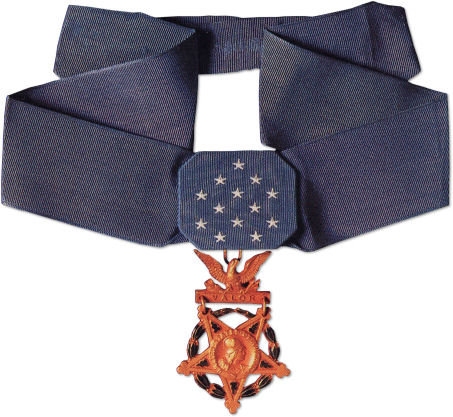
Left to right: Army, Navy/Marine Corps and Air Force Medals of Honor


In this morning's post about John Hawk, I said that there are now 78 surviving MoH recipients. The complete list, with links to individual pages, can be found at the CMOHS site here; below is a simplified list, like that which I posted two years ago.

World War II

Charles H Coolidge, Technical Sergeant, US Army
Francis S Currey, Sergeant, US Army
Walter D Ehlers, Staff Sergeant, US Army
Arthur J Jackson, Private First Class, US Marine Corps
Robert D Maxwell, Technician Fifth Grade, US Army
Wilburn K Ross, Private, US Army
George T Sakato, Private, US Army
Hershel W Williams, Corporal, US Marine Corps

Korean War

Hector A Cafferata Jr, Private, US Marine Corps
Duane E Dewey, Corporal, US Marine Corps
Rodolfo P Hernandez, Corporal, US Army
Thomas J Hudner Jr, Lieutenant, US Navy
Einar H Ingman Jr, Sergeant, US Army
Hiroshi H Miyamura, Corporal, US Army
Ola L Mize, Master Sergeant, US Army
Ronald E Rosser, Corporal, US Army
Tibor Rubin, Corporal, US Army
Robert E Simanek, Private First Class, US Marine Corps
Ernest E West, Private First Class, US Army

Vietnam War

John P Baca, Specialist Fourth Class, US Army
Donald E Ballard, Hospital Corpsman Second Class, US Navy
Harvey C Barnum Jr, Captain, US Marine Corps
Gary B Beikirch, Sergeant, US Army
Patrick H Brady, Major, US Army
Paul W Bucha, Captain, US Army
Jon R Cavaiani, Staff Sergeant, US Army
Bruce P Crandall, Major, US Army
Sammy L Davis, Sergeant, US Army
Drew D Dix, Staff Sergeant, US Army
Roger H C Donlon, Captain, US Army
Frederick E Ferguson, Chief Warrant Officer, US Army
Bernard F Fisher, Major, US Air Force
Michael J Fitzmaurice, Specialist Fourth Class, US Army
James P Fleming, Captain, US Air Force
Robert F Foley, Captain, US Army
Wesley L Fox, Captain, US Marine Corps
Harold A Fritz, Captain, US Army
Charles C Hagemeister, Specialist Fifth Class, US Army
Frank A Herda, Specialist Fourth Class, US Army
Robert R Ingram, Hospital Corpsman Third Class, US Navy
Joe M Jackson, Lieutenant Colonel, US Air Force
Jack H Jacobs, Captain, US Army
Don J Jenkins, Staff Sergeant, US Army
Thomas G Kelley, Lieutenant Commander, US Navy
Allan J Kellogg Jr, Gunnery Sergeant, US Marine Corps
Joseph R Kerrey, Lieutenant (Junior Grade), US Navy
Thomas J Kinsman, Specialist Fourth Class, US Army
Howard V Lee, Major, US Marine Corps
Peter C Lemon, Sergeant, US Army
Angelo J Liteky, Captain, US Army
Gary L Littrell, Sergeant First Class, US Army
James E Livingston, Captain, US Marine Corps
Allen J Lynch, Sergeant, US Army
Walter J Marm Jr, First Lieutenant, US Army
John J McGinty III, Second Lieutenant, US Marine Corps
Robert J Modrzejewski, Major, US Marine Corps
Thomas R Norris, Lieutenant, US Navy
Robert E O'Malley, Sergeant, US Marine Corps
Robert M Patterson, Sergeant, US Army
Richard A Pittman, Sergeant, US Marine Corps
Alfred V Rascon, Specialist Fourth Class, US Army
Ronald E Ray, Captain, US Army
Gordon R Roberts, Sergeant, US Army
Clarence E Sasser, Specialist Fifth Class, US Army
James M Sprayberry, Captain, US Army
Kenneth E Stumpf, Specialist Fourth Class, US Army
James A Taylor, Captain, US Army
Brian M Thacker, First Lieutenant, US Army
Michael E Thornton, Engineman Second Class, US Navy
Leo K Thorsness, Lieutenant, US Air Force
Jay R Vargas, Major, US Marine Corps
Gary G Wetzel, Specialist Fourth Class, US Army

Afghanistan

Ty M Carter, Specialist, US Army
Salvatore A Giunta, Specialist, US Army
Dakota Meyer, Corporal, US Marine Corps
Leroy A Petry, Staff Sergeant, US Army
Clinton Romesha, Staff Sergeant, US Army
William D Swenson, Captain, US Army

That breaks down to:
8 World War II (6 Army, 2 Marine Corps)
11 Korean War (7 Army, 1 Navy and 3 Marine Corps)
53 Vietnam War (33 Army, 6 Navy, 10 Marine Corps and 4 Air Force)
6 Afghanistan (5 Army, 1 Marine Corps)

51 Army
7 Navy
16 Marine Corps
4 Air Force
(The only Coast Guardsman ever to be awarded the Medal, Signalman First Class Douglas A Munro, received it posthumously after his death at Guadalcanal in 1942.)

RIP: John D. Hawk

ZUI this article from the Kitsap (WA) Sun:
World War II hero and longtime educator John “Bud” Hawk, 89, died Monday morning.

One of the area’s most renowned residents, Hawk received the Medal of Honor and France’s Legion of Honor awards. Named after him were the Rollingbay post office on Bainbridge Island, where he grew up, and an education center at Joint Base Lewis-McChord.

*******

After returning to Bremerton, Hawk earned a bachelor’s degree in biology from the University of Washington. He was a teacher and principal in the Central Kitsap School District for 31 years, retiring in 1983.

*******

Son Mark, of Des Moines, also survives Hawk. Another son was killed in an accident while walking to school in 1956.

Hawk’s wife died several years ago.
There are now 78 surviving Medal of Honor recipients, eight of whom were awarded the medal for WWII service.

************* *** *************

JOHN DRUSE HAWK

Sergeant, US Army; Company E, 359th Infantry, 90th Infantry Division

Born: 30 May 1924, San Francisco, California
Died: 4 November 2013, Bremerton, Washington

Citation: He manned a light machinegun on 20 August 1944, near Chambois, France, a key point in the encirclement which created the Falaise Pocket. During an enemy counterattack, his position was menaced by a strong force of tanks and infantry. His fire forced the infantry to withdraw, but an artillery shell knocked out his gun and wounded him in the right thigh. Securing a bazooka, he and another man stalked the tanks and forced them to retire to a wooded section. In the lull which followed, Sgt. Hawk reorganized 2 machinegun squads and, in the face of intense enemy fire, directed the assembly of 1 workable weapon from 2 damaged guns. When another enemy assault developed, he was forced to pull back from the pressure of spearheading armor. Two of our tank destroyers were brought up. Their shots were ineffective because of the terrain until Sgt. Hawk, despite his wound, boldly climbed to an exposed position on a knoll where, unmoved by fusillades from the enemy, he became a human aiming stake for the destroyers. Realizing that his shouted fire directions could not be heard above the noise of battle, he ran back to the destroyers through a concentration of bullets and shrapnel to correct the range. He returned to his exposed position, repeating this performance until 2 of the tanks were knocked out and a third driven off. Still at great risk, he continued to direct the destroyers' fire into the Germans' wooded position until the enemy came out and surrendered. Sgt. Hawk's fearless initiative and heroic conduct, even while suffering from a painful wound, was in large measure responsible for crushing 2 desperate attempts of the enemy to escape from the Falaise Picket and for taking more than 500 prisoners.

10 November 2013

Medal of Honor: Jordan, Martin, Young and Gardner

THOMAS JORDAN

Quartermaster, US Navy; USS Galena

Born: 12 April 1840, Portsmouth, Virginia
Died: 17 July 1930

Citation: On board the U.S.S. Galena during the attack on enemy forts at Mobile Bay, 5 August 1864. Securely lashed to the side of the Oneida which had suffered the loss of her steering apparatus and an explosion of her boiler from enemy fire, the Galena aided the stricken vessel past the enemy forts to safety. Despite heavy damage to his ship from raking enemy fire, Jordan performed his duties with skill and courage throughout the action.


EDWARD S MARTIN

Quartermaster, US Navy; USS Galena

Born: 1840, Ireland
Died: 23 December 1901

Citation: On board the U.S.S. Galena during the attack on enemy forts at Mobile Bay, 5 August 1864. Securely lashed to the side of the Oneida which had suffered the loss of her steering apparatus and an explosion of her boiler from enemy fire, the Galena aided the stricken vessel past the enemy forts to safety. Despite heavy damage to his ship from raking enemy fire, Martin performed his duties with skill and courage throughout the action.


EDWARD B YOUNG

Coxswain, US Navy; USS Galena

Born: 1835, Bergan, New Jersey
Died: 24 February 1867

Citation: On board the U.S.S. Galena during the attack on enemy forts at Mobile Bay, 5 August 1864. Securely lashed to the side of the Oneida which had suffered the loss of her steering apparatus and an explosion of her boiler from enemy fire, the Galena aided the stricken vessel past the enemy forts to safety. Despite heavy damage to his ship from raking enemy fire, Young performed his duties with skill and courage throughout the action.


WILLIAM GARDNER Seaman, US Navy; USS Galena

Born: 1832, Ireland
Died: Unknown

Citation: As seaman on board the U.S.S. Galena in the engagement at Mobile Bay, 5 August 1864. Serving gallantly during this fierce battle which resulted in the capture of the rebel ram Tennessee and the damaging of Fort Morgan. Gardner behaved with conspicuous coolness under the fire of the enemy.


Note: USS Galena was a wooden-hulled broadside ironclad - one of the first three ironclads built for the US Navy - commissioned in 1862.

03 November 2013

George Cross: J. Hendry

JAMES HENDRY

Corporal, 1 Tunnelling Company, Royal Canadian Engineers

Born: 20 December 1911, Falkirk, Stirlingshire, Scotland
Died: 13 June 1941

Citation: The KING has been graciously pleased, on the advice of Canadian Ministers, to approve the posthumous award of the GEORGE CROSS, in recognition of most conspicuous gallantry in carrying out hazardous work in a very brave manner, to: —
B.28593 Corporal James Hendry, The Corps of Royal Canadian Engineers

[London Gazette issue 35962 dated 2 Apr 1943, published 30 Mar 1943.]


Note: No 1 Tunnelling Company was digging a tunnel between Loch Spey and Loch Laggan, to supply water to the British Aluminium works at Fort William, when a fire broke out in a explosive store near Loch Laggan. Cpl Hendry ordered his mates to run to safety and attempted to extinguish the blaze, but was killed in the ensuing explosion.

27 October 2013

Medal of Honor: J. P. Fleming

JAMES PHILLIP FLEMING

First Lieutenant (later Captain), US Air Force; 20th Special Operations Squadron

Born: 12 March 1943, Sedalia, Missouri
Died: TBD

Citation: For conspicuous gallantry and intrepidity in action at the risk of his life above and beyond the call of duty. Capt. Fleming (then 1st Lt.) distinguished himself as the Aircraft Commander of a UH-1F transport Helicopter. Capt. Fleming went to the aid of a 6-man special forces long range reconnaissance patrol that was in danger of being overrun by a large, heavily armed hostile force [near Duc Co, Republic of Vietnam, on 26 November 1968]. Despite the knowledge that 1 helicopter had been downed by intense hostile fire, Capt. Fleming descended, and balanced his helicopter on a river bank with the tail boom hanging over open water. The patrol could not penetrate to the landing site and he was forced to withdraw. Dangerously low on fuel, Capt. Fleming repeated his original landing maneuver. Disregarding his own safety, he remained in this exposed position. Hostile fire crashed through his windscreen as the patrol boarded his helicopter. Capt. Fleming made a successful takeoff through a barrage of hostile fire and recovered safely at a forward base. Capt. Fleming's profound concern for his fellowmen, and at the risk of his life above and beyond the call of duty are in keeping with the highest traditions of the U.S. Air Force and reflect great credit upon himself and the Armed Forces of his country.

06 October 2013

George Cross: R. J. H. Ryan and R. V. Ellingworth

RICHARD JOHN HAMMERSLEY RYAN

Lieutenant-Commander, Royal Navy; HMS Vernon

Born: ca 1903
Died: 21 September 1940, Dagenham, Essex

REGINALD VINCENT ELLINGWORTH

Chief Petty Officer, Royal Navy; HMS Vernon

Born: ca 1898
Died: 21 September 1940, Dagenham, Essex

Joint Citation: The KING has been graciously pleased to approve the posthumous award of the GEORGE CROSS, for great gallantry and undaunted devotion to duty, to :
Lieutenant-Commander Richard John Hammersley Ryan, Royal Navy.
Chief Petty Officer Reginald Vincent Ellingworth, P/J.26011.

[London Gazette issue 35018 dated 20 Dec 1940, published 17 Dec 1940.]


Note: Lt-Cdr Ryan and CPO Ellingworth were part of the Rendering Mines Safe team at HMSVernon (a stone frigate located at Portsmouth, Hampshire). They were attempting to defuse a parachute mine which had fallen onto a warehouse in Dagenham when it exploded, killing them both.

Victoria Cross: Burslem, Lane and Chaplin

NATHANIEL GODOLPHIN BURSLEM

Lieutenant, 67th Regiment

Born: 2 February 1837, Limerick, County Limerick, Ireland
Died: July 1865, Thames (Waihou) River, New Zealand


THOMAS LANE

Private, 67th Regiment

Born: May 1836, Cork, County Cork, Ireland
Died: 12 April 1889, Kimberley, South Africa

Joint Citation: For distinguished gallantry in swimming the Ditches of the North Taku Fort [on 21 August 1860], and persevering in attempting during the assault, and before the entrance of the Fort had been effected by any one, to enlarge an opening in the Wall, through which they eventually entered, and, in doing so, were both severely wounded.

[London Gazette issue 22538 dated 13 Aug 1861, published 13 Aug 1861.]


Note: Lane, one of eight men whose VCs were forfeited, was stripped of the medal on 7 April 1881 after being convicted of desertion and of theft of a "horse, arms and accoutrements".


JOHN WORTHY CHAPLIN

Ensign, 67th Regiment

Born: 23 July 1840, Ewhurst Park, Hampshire
Died: 18 August 1920, Market Harborough, Leicestershire

Citation: For distinguished gallantry at the North Taku Fort [on 21 August 1860]. This Officer was carrying the Queen's Colour of the Regiment, and first planted the Colours on the breach made by the storming party, assisted by Private Lane, of the 67th Regiment, and subsequently on the cavalier of the Fort, which he was the first to mount. In doing this, he was severely wounded.

[London Gazette issue 22538 dated 13 Aug 1861, published 13 Aug 1861.]


Note: The Taku Forts are located by the Hai (Pei Ho) River estuary, in Tanggu District, 60 km southeast of Tianjin (Tientsin). The action described here took place during the Second Opium War (1856-60).

Medal of Honor: W. P. Brownell

WILLIAM P BROWNELL

Coxswain, US Navy; USS Benton

Born: 12 July 1839
Died: 26 April 1915

Citation: Served as coxswain on board the U.S.S. Benton during the attack on Great Gulf Bay, 2 May 1863, and Vicksburg, 22 May 1863. Carrying out his duties with coolness and courage, Brownell served gallantly against the enemy as captain of a 9-inch gun in the attacks on Great [sic] Gulf and Vicksburg and as a member of the Battery Benton before Vicksburg.

Note: USS Benton was an ironclad river gunboat, converted from a center-wheel catamaran snagboat and named for American senator Thomas Hart Benton.
Grand Gulf is on the Mississippi River, downstream from Vicksburg.

01 October 2013

Book list - Jul-Sep 13

Little Myth Marker - fantasy, by Robert Lynn Asprin
The Windsor Knot - mystery, by Sharyn McCrumb
The Weans - humour, by Robert Nathan *
Partners in Crime - mystery (short stories), by Agatha Christie
A Slice of Murder - mystery, by Chris Cavender
Class Dis-Mythed - fantasy, by Robert Lynn Asprin and Jody Lynn Nye
Death in the Air (aka Death in the Clouds) - mystery, by Agatha Christie
The Hen of the Baskervilles - mystery, by Donna Andrews
Myth-Chief - fantasy, by Robert Lynn Asprin and Jody Lynn Nye
11 Birthdays - children's, by Wendy Mass
Presumed Lost: The Incredible Ordeal of America's Submarine POWs During the Pacific War - WW II, by Stephen L Moore
Eggs Benedict Arnold - mystery, by Laura Childs
Finally - children's, by Wendy Mass
Blondie & Dagwood's America - comics, by Dean Young and Rick Marschall
The Taste of War: World War II and the Battle for Food - WW II, by Lizzie Collingham
13 Gifts - children's, by Wendy Mass
The Barsoom Project - SF, by Larry Niven and Steven Barnes
The Long Earth - SF, by Terry Pratchett and Stephen Baxter


18 books this time round, only one of them a reread (marked by an asterisk). And I'm still at 58 of 74 on the Carnegie Medal winners.

29 September 2013

Victoria Cross: J. Leith

JAMES LEITH

Lieutenant, 14th Light Dragoons

Born: 26 May 1826, Glenkindie, Aberdeenshire
Died: 13 May 1869, Paddington, London

Citation: For conspicuous bravery at Betwah, on the 1st of April, 1858, in having charged alone, and rescued Captain Need, of the same Regiment, when surrounded by a large number of rebel Infantry.
Despatch from Major-General Sir Hugh Henry Rose, G.C.B., dated 28th April, 1858.

[London Gazette issue 22212 dated 24 Dec 1858, published 24 Dec 1858.]

22 September 2013

Victoria Cross: A. Madden

AMBROSE MADDEN

Serjeant-Major, 41st Regiment

Born: 1820, Cork, County Cork, Ireland
Died: 1 January 1863, Jamaica

Citation: For having headed a party of men of the 41st Regiment [at Little Inkerman, in the Crimea, on 26 October 1854], and having cut off and taken prisoners one Russian Officer and fourteen privates, three of whom he, personally and alone, captured.

[London Gazette issue 21971 dated 24 Feb 1857, published 24 Feb 1857.]

15 September 2013

Victoria Cross: J. N. Randle

JOHN NIEL RANDLE

Lieutenant (temporary Captain), The Royal Norfolk Regiment

Born: 22 Dec 1917, Benares, British India
Died: 6 May 1944, Kohima, Assam

Citation: On the 4th May, 1944, at Kohima in Assam, a Battalion of the Norfolk Regiment attacked the Japanese positions on a nearby ridge. Captain Randle took over command of the Company which was leading the attack, when the Company Commander was severely wounded. His handling of a difficult situation in the face of heavy fire was masterly and although wounded himself in the knee by grenade splinters he continued to inspire his men by his initiative, courage and outstanding leadership, until the Company had captured its objective and consolidated its position. He then went forward and brought in all the wounded men who were lying outside the perimeter.
In spite of his painful wound Captain Randle refused to be evacuated and insisted on carrying out a personal reconnaissance with great daring in bright moonlight prior to a further attack by his Company on the positions to which the enemy had withdrawn.
At dawn on 6th May the attack opened led by Captain Randle and one of the platoons succeeded in reaching the crest of the hill held by the Japanese. Another platoon, however, ran into heavy medium machine gun fire from a bunker on the reverse slope of the feature. Captain Randle immediately appreciated that this particular bunker covered not only the rear of his new position but also the line of communication of the Battalion and therefore the destruction of the enemy post was imperative if the operation was to succeed.
With utter disregard of the obvious danger to himself Captain Randle charged the Japanese machine gun post single-handed with rifle and bayonet. Although bleeding in the face and mortally wounded by numerous bursts of machine gun fire he reached the bunker and silenced the gun with a grenade thrown through the bunker slit. He then flung his body across the slit so that the aperture should be completely sealed.
The bravery shown by this officer could not have been surpassed and by his self sacrifice he saved the lives of many of his men and enabled not only his own Company but the whole Battalion to gain its objective and win a decisive victory over the enemy.

[London Gazette issue 36833 dated 12 Dec 1944, published 8 Dec 1944.]


Note: Benares, now known as Varanasi, is a city on the Ganges, in northern India. Assam is the northeastern area of India, to the northeast of Bangladesh; Kohima is a town in the Indian state of Nagaland. (The modern state of Assam is just to the west of Nagaland.)

Medal of Honor: D. L. Truesdale

DONALD LEROY TRUESDALE (later changed to TRUESDELL)

Corporal, US Marine Corps

Born: 8 August 1906, Lugoff, South Carolina
Died: 21 September 1993, Lugoff, South Carolina

Citation: Citation: Cpl. Truesdale was second in command of a Guardia Nacional Patrol in active operations against armed bandit forces in the vicinity of Constancia, near Coco River, northern Nicaragua, on 24 April 1932. While the patrol was in formation on the trail searching for a bandit group with which contact had just previously been made, a rifle grenade fell from its carrier and struck a rock, igniting the detonator. Several men close to the grenade at the time were in danger. Cpl. Truesdale, who was several yards away, could easily have sought cover and safety for himself. Knowing full well the grenade would explode within 2 or 3 seconds, he rushed for the grenade, grasped it in his right hand, and attempted to throw it away from the patrol. The grenade exploded in his hand, blowing it off and inflicting serious multiple wounds about his body. Cpl. Truesdale, in taking the full shock of the explosion himself, saved the members of the patrol from loss of life or serious injury.

12 September 2013

Medal of Honor found at church sale

ZUI this article from Fox News:
A Medal of Honor awarded to a Civil War general has been returned to a Maine town after it was found inside a book at a church fundraising sale.

The Times Record of Brunswick, Maine reports Civil War Gen. Joshua Chamberlain's original Congressional Medal of Honor has been verified as authentic after it was sent anonymously in July to the Pejepscot Historical Society in Brunswick.

************* *** *************

JOSHUA LAWRENCE CHAMBERLAIN

Colonel, 20th Maine Infantry

Born: 8 September 1828, Brewer, Maine
Died: 24 February 1914, Portland, Maine

Citation: Daring heroism and great tenacity in holding his position on the Little Round Top against repeated assaults, and carrying the advance position on the Great Round Top [at Gettysburg, Pennsylvania, on 2 July 1863].

08 September 2013

Victoria Cross: P. A. Kenna and R. H. L. J. de Montmorency

PAUL ALOYSIUS KENNA

Captain, 21st Lancers

Born: 16 August 1862, Everton, Liverpool
Died: 30 August 1915, Suvla Bay, Turkey

Citation: At the Battle of Khartum on the 2nd September, 1898, Captain P. A. Kenna assisted Major Crole Wyndham, of the same Regiment, by taking him on his horse, behind the saddle (Major Wyndham's horse having been killed in the charge), thus enabling him to reach a place of safety; and, after the charge of the 21st Lancers, Captain Kenna returned to assist Lieutenant de Montmorency, who was endeavouring to recover the body of Second Lieutenant R. G. Grenfell.

[London Gazette issue 27023 dated 15 Nov 1898, published 15 Nov 1898.]


THE HONOURABLE RAYMOND HARVEY LODGE JOSEPH de MONTMORENCY

Lieutenant, 21st Lancers

Born: 5 February 1867, Montreal, Canada
Died: 23 February 1900, Stormberg, Cape Colony

Citation: At the Battle of Khartum on the 2nd September, 1898, Lieutenant de Montmorency, after the charge of the 21st Lancers, returned to assist Second Lieutenant R. G. Grenfell, who was lying surrounded by a large body of Dervishes. Lieutenant de Montmorency drove the Dervishes off, and, finding Lieutenant Grenfell dead, put the body on his horse which then broke away. Captain Kenna and Corporal Swarbrick then came to his assistance, and enabled him to rejoin the Regiment, which had begun to open a heavy fire on the enemy.

[London Gazette issue 27023 dated 15 Nov 1898, published 15 Nov 1898.]

Medal of Honor: J. M. Sprayberry

JAMES MICHAEL SPRAYBERRY

Captain (then First Lieutenant), US Army; Company D, 5th Battalion, 7th Cavalry, 1st Cavalry Division (Airmobile)

Born: 24 April 1947, LaGrange, Georgia
Died: TBD

Citation: For conspicuous gallantry and intrepidity in action at the risk of his life above and beyond the call of duty [in the Republic of Vietnam, on 25 Apr 1968]. Capt. Sprayberry, Armor, U.S. Army, distinguished himself by exceptional bravery while serving as executive officer of Company D. His company commander and a great number of the men were wounded and separated from the main body of the company. A daylight attempt to rescue them was driven back by the well entrenched enemy's heavy fire. Capt. Sprayberry then organized and led a volunteer night patrol to eliminate the intervening enemy bunkers and to relieve the surrounded element. The patrol soon began receiving enemy machinegun fire. Capt. Sprayberry quickly moved the men to protective cover and without regard for his own safety, crawled within close range of the bunker from which the fire was coming. He silenced the machinegun with a hand grenade. Identifying several l-man enemy positions nearby, Capt. Sprayberry immediately attacked them with the rest of his grenades. He crawled back for more grenades and when 2 grenades were thrown at his men from a position to the front, Capt. Sprayberry, without hesitation, again exposed himself and charged the enemy-held bunker killing its occupants with a grenade. Placing 2 men to cover his advance, he crawled forward and neutralized 3 more bunkers with grenades. Immediately thereafter, Capt. Sprayberry was surprised by an enemy soldier who charged from a concealed position. He killed the soldier with his pistol and with continuing disregard for the danger neutralized another enemy emplacement. Capt. Sprayberry then established radio contact with the isolated men, directing them toward his position. When the 2 elements made contact he organized his men into litter parties to evacuate the wounded. As the evacuation was nearing completion, he observed an enemy machinegun position which he silenced with a grenade. Capt. Sprayberry returned to the rescue party, established security, and moved to friendly lines with the wounded. This rescue operation, which lasted approximately 71/2 hours, saved the lives of many of his fellow soldiers. Capt. Sprayberry personally killed 12 enemy soldiers, eliminated 2 machineguns, and destroyed numerous enemy bunkers. Capt. Sprayberry's indomitable spirit and gallant action at great personal risk to his life are in keeping with the highest traditions of the military service and reflect great credit upon himself, his unit, and the U.S. Army.

02 September 2013

The photographer and the leopard seal

This is several years old, but I'd never seen it before tonight. A National Geographic photographer goes to Antarctica to take pictures of leopard seals - one of the region's top predators - only to have one of them spend four days trying to teach him to feed himself....


01 September 2013

George Cross: R. P. Goad

ROGER PHILIP GOAD, BEM

Explosives Officer, Metropolitan Police

Born: ca 1935
Died: 29 August 1975, London

Citation: The QUEEN has been graciously pleased to make the undermentioned award:

GEORGE CROSS


Captain Roger Philip GOAD, B.E.M. (Deceased), Explosives Officer, Metropolitan Police.

On 29th August, 1975, a telephone call was made to the office of a national newspaper stating that a bomb had been left in a shop doorway. This information was immediately passed to the Police and two police officers patrolling in the vicinity went to the scene. The officers found a plastic bag in a shop doorway; one of them examined the bag and saw a pocket watch fixed to the top of the contents by adhesive tape. It was almost certainly a bomb and the officers raised the alarm.
The street was taped off, cleared of pedestrians and the occupants of surrounding buildings were warned to keep to the rear of premises and away from windows.
Captain Goad was returning to London after having dealt with a suspect parcel and accepted the call to deal with this device. On his arrival he was briefed by a senior police officer while they walked towards the shop. Some distance from the bomb the police officer stopped and Captain Goad walked on alone and entered the shop doorway. He was seen to bend over the bomb and was in the process of defusing it when it exploded. Captain Goad was killed instantly by the force of the explosion.
Captain Goad displayed exceptional gallantry and devotion to duty in circumstances of extreme danger. He showed no regard for his personal safety when without hesitation he attempted to defuse the bomb.

[London Gazette issue 47027 dated 1 Oct 1976, published 30 Sep 1976.]