19 June 2011

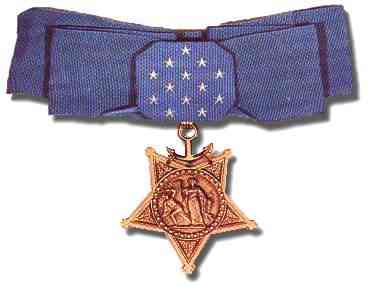
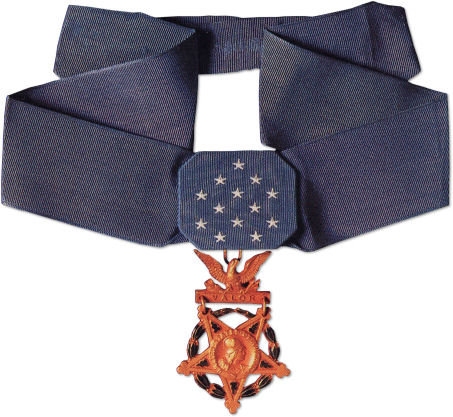
Medal of Honor: A. J. Tomlin

ANDREW JACKSON TOMLIN

Corporal, US Marine Corps; USS Wabash

Born: 15 March 1845, Goshen, New Jersey
Died: 1 November 1906, Goshen, New Jersey

Citation: As corporal of the guard on board the U.S.S. Wabash during the assault on Fort Fisher, on 15 January 1865. As 1 of 200 marines assembled to hold a line of entrenchments in the rear of the fort which the enemy threatened to attack in force following a retreat in panic by more than two-thirds of the assaulting ground forces, Cpl. Tomlin took position in line and remained until morning when relief troops arrived from the fort. When one of his comrades was struck down by enemy fire, he unhesitatingly advanced under a withering fire of musketry into an open plain close to the fort and assisted the wounded man to a place of safety.

13 June 2011

Give a girlfriend a book


15 June, in case you weren't aware (you probably weren't) is
National Give A Girlfriend A Book Day.


Make it happen.


12 June 2011

Victoria Cross: J. W. Foote

JOHN WEIR FOOTE

Honorary Captain, Canadian Chaplain Services

Born: 5 May 1904, Madoc, Ontario, Canada
Died: 2 May 1988, Norwood, Ontario, Canada

Citation: At Dieppe, on 19th August, 1942, Honorary Captain Foote, Canadian Chaplain Services, was Regimental Chaplain with the Royal Hamilton Light Infantry.
Upon landing on the beach under heavy fire he attached himself to the Regimental Aid Post which had been set up in a slight depression on the beach, but which was only sufficient to give cover to men lying down. During the subsequent period of approximately eight hours, while the action continued, this officer not only assisted the Regimental Medical Officer in ministering to the wounded in the Regimental Aid Post, but time and again left this shelter to inject morphine, give first-aid and carry wounded personnel from the open beach to the Regimental Aid Post. On these occasions, with utter disregard for his personal safety, Honorary Captain Foote exposed himself to an inferno of fire and saved many lives by his gallant efforts. During the action, as the tide went out, the Regimental Aid Post was moved to the shelter of a stranded landing craft. Honorary Captain Foote continued tirelessly and courageously to carry wounded men from the exposed beach to the cover of the landing craft. He also removed wounded from inside the landing craft when ammunition had been set on fire by enemy shells. When landing craft appeared he carried wounded from the Regimental Aid Post to the landing craft through very heavy fire.
On several occasions this officer had the opportunity to embark but returned to the beach as his chief concern was the care and evacuation of the wounded. He refused a final opportunity to leave the shore, choosing to suffer the fate of the men he had ministered to for over three years.
Honorary Captain Foote personally saved many lives by his efforts and his example inspired all around him. Those who observed him state that the calmness of this heroic officer, as he walked about, collecting the wounded on the fire-swept beach will never be forgotten.

[London Gazette issue 34766 dated 14 Feb 1946, published 12 Feb 1946.]

Medal of Honor: W. D. Halyburton, Jr.

WILLIAM DAVID HALYBURTON JR

Pharmacist's Mate Second Class, US Naval Reserve; 2d Battalion, 5th Marines, 1st Marine Division

Born: 2 August 1924, Canton, North Carolina
Died: 10 May 1945, Okinawa

Citation: For conspicuous gallantry and intrepidity at the risk of his life above and beyond the call of duty while serving with a Marine Rifle Company in the 2d Battalion, 5th Marines, 1st Marine Division, during action against enemy Japanese forces on Okinawa Shima in the Ryukyu Chain, 10 May 1945. Undaunted by the deadly accuracy of Japanese counterfire as his unit pushed the attack through a strategically important draw, Halyburton unhesitatingly dashed across the draw and up the hill into an open fire-swept field where the company advance squad was suddenly pinned down under a terrific concentration of mortar, machinegun and sniper fire with resultant severe casualties. Moving steadily forward despite the enemy's merciless barrage, he reached the wounded marine who lay farthest away and was rendering first aid when his patient was struck for the second time by a Japanese bullet. Instantly placing himself in the direct line of fire, he shielded the fallen fighter with his own body and staunchly continued his ministrations although constantly menaced by the slashing fury of shrapnel and bullets falling on all sides. Alert, determined and completely unselfish in his concern for the helpless marine, he persevered in his efforts until he himself sustained mortal wounds and collapsed, heroically sacrificing himself that his comrade might live. By his outstanding valor and unwavering devotion to duty in the face of tremendous odds, Halyburton sustained and enhanced the highest traditions of the U.S. Naval Service. He gallantly gave his life in the service of his country.


Note: USS Halyburton (FFG 40) was named in his honour.

07 June 2011

RIP: John Alison

John R Alison
21 Nov 1912 - 6 Jun 2011


ZUI this article from the Wall Street Journal:
John Alison was a U.S. combat ace in World War II and an innovator in developing Air Force commando tactics.

Maj. Gen. Alison, who died Monday at age 98, served in the China-Burma-India and Pacific theaters, was shot down at least twice and had seven confirmed kills as well as a number of probable kills.

An intimate of Air Force commander Henry "Hap" Arnold, he also advised Gen. Dwight Eisenhower on using gliders to ferry troops on D-Day.

*******

...Mr. Alison initiated a daring night interception of Japanese bombers, downing two. His P-40 fighter—ill-equipped for night fighting—was badly shot up and Mr. Alison ended up ditching in a river. He was awarded a Distinguished Service Cross for the action, in part because of the novelty of the night kills.

In 1944, as co-commanders of the first Air Commando Force, Mr. Alison and Lt. Col. Philip Cochran organized an unprecedented operation inside Burma—now Myanmar—then occupied by experienced Japanese jungle fighters.

Using a combined force of fighter planes, bombers, transports, gliders, ambulance planes and newfangled helicopters, the commanders established fortified bases behind Japanese lines in Burma, greatly facilitating a larger assault from British forces. Mr. Alison personally led the force into action, piloting a glider and 15 men to an improvised landing area in a teak forest.

In June 1942, he reported to China to serve as deputy squadron commander in Maj David Lee "Tex" Hill's 75th Fighter Squadron, the USAAF successor to the American Volunteer Group (the Flying Tigers). I remember reading about Alison in a book about the AVG when I was a kid - a long time ago, but I recognised his name immediately when I saw it in the obituaries list.


Left to right: Maj John Alison, Major "Tex" Hill, Capt "Ajax" Baumler
and Lt Mack Mitchell

05 June 2011

George Cross: K. Smith

KENNETH SMITH

Signalman, Royal Corps of Signals; attached Long Range Desert Group

Born: 7 December 1920, Market Rasen, Lincolnshire
Died: 10 January 1945, Ist, Yugoslavia

Citation: The KING has been graciously pleased to approve the posthumous award of the George Cross, in recognition of most conspicuous gallantry in carrying out hazardous work in a very brave manner, to: —
No. 2328696 Signalman Kenneth SMITH, Royal Corps of Signals (Humby, near Grantham, Lincs.).

[London Gazette issue 37311 dated 19 Oct 1945, published 16 Oct 1945.]

Note: Smith was attached to an LRDG patrol based on the Adriatic island of Ist. Sabotage was a daily occurance. He found a time-bomb on a table at his detachment's billet, which was shared with civilians and their children. Realising that the bomb was ticking and could explode at any moment, he carried it out of the building. It exploded while he was still carrying it, and he was blown to pieces. He was the only casualty of the blast, and undoubtably saved many lives.

The island of Ist is now part of Croatia.

Victoria Cross: P. J. Badcoe

PETER JOHN BADCOE

Major, Royal Australian Infantry Corps; Australian Army Training Team Vietnam

Born: 11 January 1934, Malvern, South Australia, Australia
Died: 7 April 1967, Phú Thọ, Thừa Thiên-Huế Province, South Vietnam

Citation: 41400 Major PETER JOHN BADCOE was commissioned as a Second Lieutenant in the Australian Staff Corps in December 1952. He was allotted to the Royal Regiment of Australian Artillery in which he served in a number of Regimental and Staff postings until August 1965. He then transferred to the Royal Australian Infantry Corps and joined the Australian Army Training Team Vietnam in August 1966. He was posted as Sector Operations Officer in Thua Thien Province, South Vietnam.
On 23rd February 1967 he was acting as an Advisor to a Regional Force Company in support of a Sector operation in Phu Thu District. He monitored a radio transmission which stated that the Subsector Adviser, a United States Army Officer, had been killed and that his body was within 50 metres of an enemy machine gun position; further, the United States Medical Adviser had been wounded and was in immediate danger from the enemy. Major BADCOE with complete disregard for his own safety moved alone across 600 metres of fire-swept ground and reached the wounded Adviser, attended to him and ensured his future safety. He then organised a force of one platoon and led them towards the enemy post. His personal leadership, words of encouragement, and actions in the face of hostile enemy fire forced the platoon to successfully assault the enemy position and capture it, where he personally killed the machine gunners directly in front of him. He then picked up the body of the dead officer and ran back to the Command post over open ground still covered by enemy fire.
On 7th March 1967, at approximately 0645 hours, the Sector Reaction Company was deployed to Quang Dien Subsector to counter an attack by the Viet Cong on the Headquarters. Major BADCOE left the Command group after their vehicle broke down and a United States Officer was killed; he joined the Company Headquarters and personally led the company in an attack over open terrain to assault and capture a heavily defended enemy position. In the face of certain death and heavy losses his personal courage and leadership turned certain defeat into victory and prevented the enemy from capturing the District Headquarters.
On 7th April 1967, on an operation in Huong Tra District, Major BADCOE was with the 1st A.R.V.N. Division Reaction Company and some armoured personnel carriers. During the move forward to an objective the company came under heavy small arms fire and withdrew to a cemetery for cover, this left Major BADCOE and his radio operator about 50 metres in front of the leading elements, under heavy mortar fire. Seeing this withdrawal, Major BADCOE ran back to them, moved amongst them and by encouragement and example got them moving forward again. He then set out in front of the company to lead them on; the company stopped again under heavy fire but Major BADCOE continued on to cover and prepared to throw grenades, when he rose to throw, his radio operator pulled him down as heavy small arms fire was being brought to bear on them; he later got up again to throw a grenade and was hit and killed by a burst of machine gun fire. Soon after, friendly artillery fire was called in and the position was assaulted and captured.
Major BADCOE'S conspicuous gallantry and leadership on all these occasions was an inspiration to all, each action, ultimately, was successful, due entirely to his efforts, the final one ending in his death. His valour and leadership were in the highest traditions of the military profession and the Australian Regular Army.

[London Gazette issue 44431 dated 17 Oct 1967, published 13 Oct 1967.]

Medal of Honor: B. F. Hilliker

BENJAMIN FRANKLIN HILLIKER

Musician, Company A, 8th Wisconsin Infantry

Born: 23 May 1843, Golden, New York
Died: 18 October 1916, Los Angeles, California

Citation: When men were needed to oppose a superior Confederate force [at Mechanicsburg, Mississippi, on 4 June 1863,] he laid down his drum for a rifle and proceeded to the front of the skirmish line which was about 120 feet from the enemy. While on this volunteer mission and firing at the enemy he was hit in the head with a minie ball which passed through him. An order was given to "lay him in the shade; he won't last long." He recovered from this wound being left with an ugly scar.

04 June 2011

R-12 wreck located

According to this article from the International Business Times, an exploration team has located and documented the wreck of USS R-12 (SS 89) in 600 feet of water off the Florida Keys. R-12, in use as a training submarine, was lost for unknown reasons on 12 June 1943. Her CO, another officer and three enlisted men who were on watch on the bridge survived; the other 27 crewmen on board were lost, as were 13 trainees and two Brazilian Navy officers who were there to observe a torpedo exercise.

03 June 2011

The Backstroke of the West

What do you get when you take Revenge of the Sith, add Chinese subtitles, and then translate them into English? This....


02 June 2011

FY12 MCPO and SCPO selectees


This year's SCPO list was released today - which reminded me that I hadn't seen the MCPO list.

The MCPO list, dated 4 May, is here. I see two names I recognise - an MS a CS and a nuke ET from Providence.

The SCPO list is here. I see three or four names on this list - another MS CS, an SK LS and one or two A-gangers, all from Prov. (One A-ganger I'm sure of; the other has both a common first name and a common surname, but is probably the one I know.)

Belated congratulations to all selectees!

Medal of Honor to be awarded for Afghanistan

ZUI this article from the Tacoma (WA) News-Tribune:
A Joint Base Lewis-McChord Ranger who lost his right hand while protecting fellow soldiers from a live grenade will become the second living service member to earn a Medal of Honor for actions in Afghanistan, the White House announced Tuesday.

Sgt. 1st Class Leroy Arthur Petry, 31, will receive his medal from President Barack Obama at a White House ceremony July 12. He continues to serve at Lewis-McChord with a 75th Ranger Regiment headquarters unit.

*******

Petry is not available for other interviews, and his regiment is not discussing his honor for now, a Ranger spokeswoman said.

Petry lost his hand and suffered shrapnel injuries during an operation in Paktya, Afghanistan, on May 26, 2008.

He was already wounded when an enemy fighter tossed a grenade into a chicken coop where he was taking cover with two other soldiers. He picked up the weapon, which exploded as he threw it and severed his hand.

*******

Petry, a New Mexico native, will be the ninth service member to earn a Medal of Honor during the wars in Iraq and Afghanistan. Seven of those were awarded posthumously.

Last year, Staff Sgt. Salvator Giunta became the first living, active-duty soldier to earn the military’s highest honor when Obama awarded him a Medal of Honor for his heroism in Afghanistan’s Korengal Valley with the 173rd Airborne Brigade Combat Team.

*******


Petry has deployed eight times in his Army career. He has received two Bronze Stars, a Purple Heart and three Army Commendation Medals.

He and his wife, Ashley, have four children, Brittany, Austin, Reagan and Landon.

01 June 2011

Book list - May 11

Dragonquest - SF, by Anne McCaffrey *
Doggirl - YA, by Robin Brande
Everybody Sees the Ants - YA, by A S King (ARC)
Owls Well That Ends Well - mystery, by Donna Andrews
Thumbs, Toes, and Tears: And Other Traits That Make Us Human - palaeoanthropology, by Chip Walter
The White Dragon - SF, by Anne McCaffrey *
Vet in the Vestry - memoirs, by Alexander Cameron *
Other Worlds Than Ours - SF (short stories), by Nelson Bond


Eight books last month, with three rereads (marked by asterisks). I'm not setting an official goal this year, though I do expect to read around 150 books. And I'm still at 50 of 71 on the Carnegie Medal books.

31 May 2011

The Israel question

There's been a lot of discussion lately about President Obama's stand on Israel and a return to that nation's 1967 borders.

Personally, I think the idea of returning Israel to its former borders has great merit, but I feel that Obama has erred greatly in not going far enough. The borders as shown in the map below are unfortunately not very precise, but I'm sure it would not be difficult to find a sufficient number of surveyors to tend to this.

All those who then find themselves on what they consider to be the wrong side of the line should of course be permitted - even encouraged - to move.


29 May 2011

Victoria Cross: Darwan Singh Negi

DARWAN SINGH NEGI

Naik, 1st Battalion, 39th Garhwal Rifles

Born: 4 March 1883, Karbartir Village, India
Died: 24 June 1950, Kafarteer Village, Uttar Pradesh, India

Citation: For great gallantry on the night of the 23rd-24th November [1914], near Festubert, France, when the regiment was engaged in retaking and clearing the enemy out of our trenches, and, although wounded in two places in the head, and also in the arm, being one of the first to push round each successive traverse, in the face of severe fire from bombs and rifles at the closest range.

[London Gazette issue 28999 dated 7 Dec 1914, published 4 Dec 1914.]


Note: Naik is an Indian Army rank equivalent to a corporal.

Medal of Honor: D. R. Kingsley

DAVID R KINGSLEY

Second Lieutenant, US Army Air Corps; 97th Bombardment Group, 15th Air Force

Born: 27 June 1918, Portland, Oregon
Died: 23 June 1944, near Ploieşti, Rumania

Citation: For conspicuous gallantry and intrepidity in action at the risk of life above and beyond the call of duty, 23 June 1944 near Ploesti, Rumania, while flying as bombardier of a B17 type aircraft. On the bomb run 2d Lt. Kingsley's aircraft was severely damaged by intense flak and forced to drop out of formation but the pilot proceeded over the target and 2d Lt. Kingsley successfully dropped his bombs, causing severe damage to vital installations. The damaged aircraft, forced to lose altitude and to lag behind the formation, was aggressively attacked by 3 ME-109 aircraft, causing more damage to the aircraft and severely wounding the tail gunner in the upper arm. The radio operator and engineer notified 2d Lt. Kingsley that the tail gunner had been wounded and that assistance was needed to check the bleeding. 2d Lt. Kingsley made his way back to the radio room, skillfully applied first aid to the wound, and succeeded in checking the bleeding. The tail gunner's parachute harness and heavy clothes were removed and he was covered with blankets, making him as comfortable as possible. Eight ME-109 aircraft again aggressively attacked 2d Lt. Kingsley's aircraft and the ball turret gunner was wounded by 20mm. shell fragments. He went forward to the radio room to have 2d Lt. Kingsley administer first aid. A few minutes later when the pilot gave the order to prepare to bail out, 2d Lt. Kingsley immediately began to assist the wounded gunners in putting on their parachute harness. In the confusion the tail gunner's harness, believed to have been damaged, could not be located in the bundle of blankets and flying clothes which had been removed from the wounded men. With utter disregard for his own means of escape, 2d Lt. Kingsley unhesitatingly removed his parachute harness and adjusted it to the wounded tail gunner. Due to the extensive damage caused by the accurate and concentrated 20mm. fire by the enemy aircraft the pilot gave the order to bail out, as it appeared that the aircraft would disintegrate at any moment. 2d Lt. Kingsley aided the wounded men in bailing out and when last seen by the crewmembers he was standing on the bomb bay catwalk. The aircraft continued to fly on automatic pilot for a short distance, then crashed and burned. His body was later found in the wreckage. 2d Lt. Kingsley by his gallant heroic action was directly responsible for saving the life of the wounded gunner.

27 May 2011

RIP: Paul J. Wiedorfer

Paul Joseph Wiedorfer
17 Jan 1921 - 25 May 2011


ZUI this article from the Washington Post:
Paul J. Wiedorfer, 89, who as an Army private on Christmas Day 1944 charged two German machine-gun nests and single-handedly saved his platoon mates caught in an ambush, an act for which he received the Medal of Honor, died May 25 at the Baltimore VA Medical Center. His family said he had congestive heart failure.

Mr. Wiedorfer, who was born and grew up in Baltimore, was reportedly Maryland’s last surviving recipient of the Medal of Honor, the military’s highest award for valor.

He was 23 when his unit, part of Gen. George S. Patton’s Third Army, was sent to rescue American troops trapped in Bastogne, Belgium, during the first days of the Battle of the Bulge.

*******

“I was probably a little nuts when I did it,” he told the Baltimore Sun in 1995. “But someone was going to die if something didn’t get done.”

*******

Two months later, crossing the Saar River in Germany, Mr. Wiedorfer’s unit came under mortar fire. The soldier next to him was killed instantly. Mr. Wiedorfer was struck by shrapnel, and the blast shattered his leg and injured his hand. He recuperated at a hospital in England, where he was placed in traction.

One day, a fellow patient was reading the Stars and Stripes newspaper and informed Mr. Wiedorfer that he’d just received the Medal of Honor for his Christmas Day bravery.

*******

Mr. Wiedorfer’s wife, the former Alice Stauffer, died in 2008. A daughter, Nancy Mazer, died in 2010.

Survivors include three children, Randee Wiedorfer of Parkville, Md., Paul J. Wiedorfer Jr. of Baltimore and Gary Wiedorfer of Cocoa, Fla.; six grandchildren; and three great-grandchildren.

ZUI also this article (dated 11 May 2008) from the Baltimore Sun.

There are now 84 living Medal of Honor recipients.

************* *** *************

PAUL JOSEPH WIEDORFER

Private, US Army; Company G, 318th Infantry, 80th Infantry Division

Born: 17 January 1921, Baltimore, Maryland
Died: 25 May 2011, Baltimore, Maryland

Citation: He alone made it possible for his company to advance until its objective was seized. Company G had cleared a wooded area [near Chaumont, Belgium,] of snipers, and [on 25 December 1944] 1 platoon was advancing across an open clearing toward another wood when it was met by heavy machinegun fire from 2 German positions dug in at the edge of the second wood. These positions were flanked by enemy riflemen. The platoon took cover behind a small ridge approximately 40 yards from the enemy position. There was no other available protection and the entire platoon was pinned down by the German fire. It was about noon and the day was clear, but the terrain extremely difficult due to a 3-inch snowfall the night before over ice-covered ground. Pvt. Wiedorfer, realizing that the platoon advance could not continue until the 2 enemy machinegun nests were destroyed, voluntarily charged alone across the slippery open ground with no protecting cover of any kind. Running in a crouched position, under a hail of enemy fire, he slipped and fell in the snow, but quickly rose and continued forward with the enemy concentrating automatic and small-arms fire on him as he advanced. Miraculously escaping injury, Pvt. Wiedorfer reached a point some 10 yards from the first machinegun emplacement and hurled a handgrenade into it. With his rifle he killed the remaining Germans, and, without hesitation, wheeled to the right and attacked the second emplacement. One of the enemy was wounded by his fire and the other 6 immediately surrendered. This heroic action by 1 man enabled the platoon to advance from behind its protecting ridge and continue successfully to reach its objective. A few minutes later, when both the platoon leader and the platoon sergeant were wounded, Pvt. Wiedorfer assumed command of the platoon, leading it forward with inspired energy until the mission was accomplished.

22 May 2011

Victoria Cross: J. A. Wood

JOHN AUGUSTUS WOOD

Captain, 20th Bombay Native Infantry

Born: 10 June 1818, Fort William, Calcutta, India
Died: 23 January 1878, Poona, India

Citation: On the 9th of December, 1856, Captain Wood led the Grenadier Company, which formed the head of the assaulting column sent against Bushire. He was the first man on the parapet of the fort, where he was instantly attacked by a large number of the garrison, who suddenly sprang on him from a trench cut in the parapet itself.
These men fired a volley at Captain Wood and the head of the storming party, when only a yard or two distant from that Officer; but, although Captain Wood was struck by no less than seven musket balls, he at once threw himself upon the enemy, passed his sword through the body of their leader, and, being closely followed by the men of his company, speedily overcame all opposition, and established himself in the place. Captain Wood's decision, energy, and determined valour, undoubtedly contributed in a high degree to the success of the attack. His wounds compelled him to leave the force for a time; but, with the true spirit of a good soldier, he rejoined his regiment, and returned to his duty at Bushire before the wounds were properly healed.

[London Gazette issue 22409 dated 3 Aug 1860, published 3 Aug 1860.]


Note: Bushire, or Bushehr, is on the southwestern coast of Iran, on the Persian Gulf.

Medal of Honor: O. F. P. Hammerberg

OWEN FRANCIS PATRICK HAMMERBERG

Boatswain's Mate Second Class, US Navy

Born: 31 May 1920, Daggett, Michigan
Died: 17 February 1945, Pearl Harbor, Territory of Hawaii

Citation: For conspicuous gallantry and intrepidity at the risk of his life above and beyond the call of duty as a diver engaged in rescue operations at West Loch, Pearl Harbor, 17 February 1945. Aware of the danger when 2 fellow divers were hopelessly trapped in a cave-in of steel wreckage while tunneling with jet nozzles under an LST sunk in 40 feet of water and 20 feet of mud. Hammerberg unhesitatingly went overboard in a valiant attempt to effect their rescue despite the certain hazard of additional cave-ins and the risk of fouling his lifeline on jagged pieces of steel imbedded in the shifting mud. Washing a passage through the original excavation, he reached the first of the trapped men, freed him from the wreckage and, working desperately in pitch-black darkness, finally effected his release from fouled lines, thereby enabling him to reach the surface. Wearied but undaunted after several hours of arduous labor, Hammerberg resolved to continue his struggle to wash through the oozing submarine, subterranean mud in a determined effort to save the second diver. Venturing still farther under the buried hulk, he held tenaciously to his purpose, reaching a place immediately above the other man just as another cave-in occurred and a heavy piece of steel pinned him crosswise over his shipmate in a position which protected the man beneath from further injury while placing the full brunt of terrific pressure on himself. Although he succumbed in agony 18 hours after he had gone to the aid of his fellow divers, Hammerberg, by his cool judgment, unfaltering professional skill and consistent disregard of all personal danger in the face of tremendous odds, had contributed effectively to the saving of his 2 comrades. His heroic spirit of self-sacrifice throughout enhanced and sustained the highest traditions of the U.S. Naval Service. He gallantly gave his life in the service of his country.


Note: USS Hammerberg (DE 1015) was named in his honour.

15 May 2011

Victoria Cross: L. C. Maygar

LESLIE CECIL MAYGAR

Lieutenant, 5th Victorian Mounted Rifles

Born: 26 May 1874, Dean Station, Victoria, Australia
Died: 17 November 1917, Palestine

Citation: At Geelhoutboom, on the 23rd November, 1901, Lieutenant Maygar galloped out and ordered the men of a detached post, which was being outflanked, to retire. The horse of one of them being shot under him, when the enemy were within 200 yards, Lieutenant Maygar dismounted and lifted him on to his own horse, which bolted into boggy ground, causing both of them to dismount. On extricating the horse and finding that it could not carry both, Lieutenant Maygar again put the man on its back, and told him to gallop for cover at once, he himself proceeding on foot. All this took place under a very heavy fire.

[London Gazette issue 27405 dated 11 Feb 1902, published 11 Feb 1902.]