27 October 2013

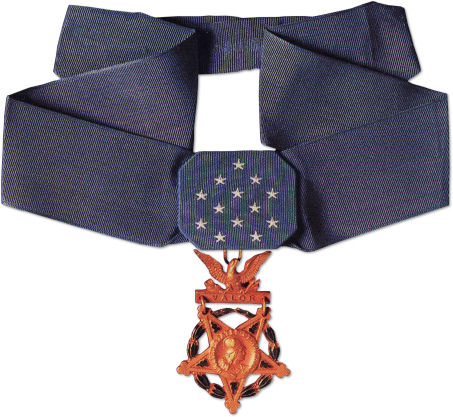
Medal of Honor: J. P. Fleming

JAMES PHILLIP FLEMING

First Lieutenant (later Captain), US Air Force; 20th Special Operations Squadron

Born: 12 March 1943, Sedalia, Missouri
Died: TBD

Citation: For conspicuous gallantry and intrepidity in action at the risk of his life above and beyond the call of duty. Capt. Fleming (then 1st Lt.) distinguished himself as the Aircraft Commander of a UH-1F transport Helicopter. Capt. Fleming went to the aid of a 6-man special forces long range reconnaissance patrol that was in danger of being overrun by a large, heavily armed hostile force [near Duc Co, Republic of Vietnam, on 26 November 1968]. Despite the knowledge that 1 helicopter had been downed by intense hostile fire, Capt. Fleming descended, and balanced his helicopter on a river bank with the tail boom hanging over open water. The patrol could not penetrate to the landing site and he was forced to withdraw. Dangerously low on fuel, Capt. Fleming repeated his original landing maneuver. Disregarding his own safety, he remained in this exposed position. Hostile fire crashed through his windscreen as the patrol boarded his helicopter. Capt. Fleming made a successful takeoff through a barrage of hostile fire and recovered safely at a forward base. Capt. Fleming's profound concern for his fellowmen, and at the risk of his life above and beyond the call of duty are in keeping with the highest traditions of the U.S. Air Force and reflect great credit upon himself and the Armed Forces of his country.

06 October 2013

George Cross: R. J. H. Ryan and R. V. Ellingworth

RICHARD JOHN HAMMERSLEY RYAN

Lieutenant-Commander, Royal Navy; HMS Vernon

Born: ca 1903
Died: 21 September 1940, Dagenham, Essex

REGINALD VINCENT ELLINGWORTH

Chief Petty Officer, Royal Navy; HMS Vernon

Born: ca 1898
Died: 21 September 1940, Dagenham, Essex

Joint Citation: The KING has been graciously pleased to approve the posthumous award of the GEORGE CROSS, for great gallantry and undaunted devotion to duty, to :
Lieutenant-Commander Richard John Hammersley Ryan, Royal Navy.
Chief Petty Officer Reginald Vincent Ellingworth, P/J.26011.

[London Gazette issue 35018 dated 20 Dec 1940, published 17 Dec 1940.]


Note: Lt-Cdr Ryan and CPO Ellingworth were part of the Rendering Mines Safe team at HMSVernon (a stone frigate located at Portsmouth, Hampshire). They were attempting to defuse a parachute mine which had fallen onto a warehouse in Dagenham when it exploded, killing them both.

Victoria Cross: Burslem, Lane and Chaplin

NATHANIEL GODOLPHIN BURSLEM

Lieutenant, 67th Regiment

Born: 2 February 1837, Limerick, County Limerick, Ireland
Died: July 1865, Thames (Waihou) River, New Zealand


THOMAS LANE

Private, 67th Regiment

Born: May 1836, Cork, County Cork, Ireland
Died: 12 April 1889, Kimberley, South Africa

Joint Citation: For distinguished gallantry in swimming the Ditches of the North Taku Fort [on 21 August 1860], and persevering in attempting during the assault, and before the entrance of the Fort had been effected by any one, to enlarge an opening in the Wall, through which they eventually entered, and, in doing so, were both severely wounded.

[London Gazette issue 22538 dated 13 Aug 1861, published 13 Aug 1861.]


Note: Lane, one of eight men whose VCs were forfeited, was stripped of the medal on 7 April 1881 after being convicted of desertion and of theft of a "horse, arms and accoutrements".


JOHN WORTHY CHAPLIN

Ensign, 67th Regiment

Born: 23 July 1840, Ewhurst Park, Hampshire
Died: 18 August 1920, Market Harborough, Leicestershire

Citation: For distinguished gallantry at the North Taku Fort [on 21 August 1860]. This Officer was carrying the Queen's Colour of the Regiment, and first planted the Colours on the breach made by the storming party, assisted by Private Lane, of the 67th Regiment, and subsequently on the cavalier of the Fort, which he was the first to mount. In doing this, he was severely wounded.

[London Gazette issue 22538 dated 13 Aug 1861, published 13 Aug 1861.]


Note: The Taku Forts are located by the Hai (Pei Ho) River estuary, in Tanggu District, 60 km southeast of Tianjin (Tientsin). The action described here took place during the Second Opium War (1856-60).

Medal of Honor: W. P. Brownell

WILLIAM P BROWNELL

Coxswain, US Navy; USS Benton

Born: 12 July 1839
Died: 26 April 1915

Citation: Served as coxswain on board the U.S.S. Benton during the attack on Great Gulf Bay, 2 May 1863, and Vicksburg, 22 May 1863. Carrying out his duties with coolness and courage, Brownell served gallantly against the enemy as captain of a 9-inch gun in the attacks on Great [sic] Gulf and Vicksburg and as a member of the Battery Benton before Vicksburg.

Note: USS Benton was an ironclad river gunboat, converted from a center-wheel catamaran snagboat and named for American senator Thomas Hart Benton.
Grand Gulf is on the Mississippi River, downstream from Vicksburg.

01 October 2013

Book list - Jul-Sep 13

Little Myth Marker - fantasy, by Robert Lynn Asprin
The Windsor Knot - mystery, by Sharyn McCrumb
The Weans - humour, by Robert Nathan *
Partners in Crime - mystery (short stories), by Agatha Christie
A Slice of Murder - mystery, by Chris Cavender
Class Dis-Mythed - fantasy, by Robert Lynn Asprin and Jody Lynn Nye
Death in the Air (aka Death in the Clouds) - mystery, by Agatha Christie
The Hen of the Baskervilles - mystery, by Donna Andrews
Myth-Chief - fantasy, by Robert Lynn Asprin and Jody Lynn Nye
11 Birthdays - children's, by Wendy Mass
Presumed Lost: The Incredible Ordeal of America's Submarine POWs During the Pacific War - WW II, by Stephen L Moore
Eggs Benedict Arnold - mystery, by Laura Childs
Finally - children's, by Wendy Mass
Blondie & Dagwood's America - comics, by Dean Young and Rick Marschall
The Taste of War: World War II and the Battle for Food - WW II, by Lizzie Collingham
13 Gifts - children's, by Wendy Mass
The Barsoom Project - SF, by Larry Niven and Steven Barnes
The Long Earth - SF, by Terry Pratchett and Stephen Baxter


18 books this time round, only one of them a reread (marked by an asterisk). And I'm still at 58 of 74 on the Carnegie Medal winners.

29 September 2013

Victoria Cross: J. Leith

JAMES LEITH

Lieutenant, 14th Light Dragoons

Born: 26 May 1826, Glenkindie, Aberdeenshire
Died: 13 May 1869, Paddington, London

Citation: For conspicuous bravery at Betwah, on the 1st of April, 1858, in having charged alone, and rescued Captain Need, of the same Regiment, when surrounded by a large number of rebel Infantry.
Despatch from Major-General Sir Hugh Henry Rose, G.C.B., dated 28th April, 1858.

[London Gazette issue 22212 dated 24 Dec 1858, published 24 Dec 1858.]

22 September 2013

Victoria Cross: A. Madden

AMBROSE MADDEN

Serjeant-Major, 41st Regiment

Born: 1820, Cork, County Cork, Ireland
Died: 1 January 1863, Jamaica

Citation: For having headed a party of men of the 41st Regiment [at Little Inkerman, in the Crimea, on 26 October 1854], and having cut off and taken prisoners one Russian Officer and fourteen privates, three of whom he, personally and alone, captured.

[London Gazette issue 21971 dated 24 Feb 1857, published 24 Feb 1857.]

15 September 2013

Victoria Cross: J. N. Randle

JOHN NIEL RANDLE

Lieutenant (temporary Captain), The Royal Norfolk Regiment

Born: 22 Dec 1917, Benares, British India
Died: 6 May 1944, Kohima, Assam

Citation: On the 4th May, 1944, at Kohima in Assam, a Battalion of the Norfolk Regiment attacked the Japanese positions on a nearby ridge. Captain Randle took over command of the Company which was leading the attack, when the Company Commander was severely wounded. His handling of a difficult situation in the face of heavy fire was masterly and although wounded himself in the knee by grenade splinters he continued to inspire his men by his initiative, courage and outstanding leadership, until the Company had captured its objective and consolidated its position. He then went forward and brought in all the wounded men who were lying outside the perimeter.
In spite of his painful wound Captain Randle refused to be evacuated and insisted on carrying out a personal reconnaissance with great daring in bright moonlight prior to a further attack by his Company on the positions to which the enemy had withdrawn.
At dawn on 6th May the attack opened led by Captain Randle and one of the platoons succeeded in reaching the crest of the hill held by the Japanese. Another platoon, however, ran into heavy medium machine gun fire from a bunker on the reverse slope of the feature. Captain Randle immediately appreciated that this particular bunker covered not only the rear of his new position but also the line of communication of the Battalion and therefore the destruction of the enemy post was imperative if the operation was to succeed.
With utter disregard of the obvious danger to himself Captain Randle charged the Japanese machine gun post single-handed with rifle and bayonet. Although bleeding in the face and mortally wounded by numerous bursts of machine gun fire he reached the bunker and silenced the gun with a grenade thrown through the bunker slit. He then flung his body across the slit so that the aperture should be completely sealed.
The bravery shown by this officer could not have been surpassed and by his self sacrifice he saved the lives of many of his men and enabled not only his own Company but the whole Battalion to gain its objective and win a decisive victory over the enemy.

[London Gazette issue 36833 dated 12 Dec 1944, published 8 Dec 1944.]


Note: Benares, now known as Varanasi, is a city on the Ganges, in northern India. Assam is the northeastern area of India, to the northeast of Bangladesh; Kohima is a town in the Indian state of Nagaland. (The modern state of Assam is just to the west of Nagaland.)

Medal of Honor: D. L. Truesdale

DONALD LEROY TRUESDALE (later changed to TRUESDELL)

Corporal, US Marine Corps

Born: 8 August 1906, Lugoff, South Carolina
Died: 21 September 1993, Lugoff, South Carolina

Citation: Citation: Cpl. Truesdale was second in command of a Guardia Nacional Patrol in active operations against armed bandit forces in the vicinity of Constancia, near Coco River, northern Nicaragua, on 24 April 1932. While the patrol was in formation on the trail searching for a bandit group with which contact had just previously been made, a rifle grenade fell from its carrier and struck a rock, igniting the detonator. Several men close to the grenade at the time were in danger. Cpl. Truesdale, who was several yards away, could easily have sought cover and safety for himself. Knowing full well the grenade would explode within 2 or 3 seconds, he rushed for the grenade, grasped it in his right hand, and attempted to throw it away from the patrol. The grenade exploded in his hand, blowing it off and inflicting serious multiple wounds about his body. Cpl. Truesdale, in taking the full shock of the explosion himself, saved the members of the patrol from loss of life or serious injury.

12 September 2013

Medal of Honor found at church sale

ZUI this article from Fox News:
A Medal of Honor awarded to a Civil War general has been returned to a Maine town after it was found inside a book at a church fundraising sale.

The Times Record of Brunswick, Maine reports Civil War Gen. Joshua Chamberlain's original Congressional Medal of Honor has been verified as authentic after it was sent anonymously in July to the Pejepscot Historical Society in Brunswick.

************* *** *************

JOSHUA LAWRENCE CHAMBERLAIN

Colonel, 20th Maine Infantry

Born: 8 September 1828, Brewer, Maine
Died: 24 February 1914, Portland, Maine

Citation: Daring heroism and great tenacity in holding his position on the Little Round Top against repeated assaults, and carrying the advance position on the Great Round Top [at Gettysburg, Pennsylvania, on 2 July 1863].

08 September 2013

Victoria Cross: P. A. Kenna and R. H. L. J. de Montmorency

PAUL ALOYSIUS KENNA

Captain, 21st Lancers

Born: 16 August 1862, Everton, Liverpool
Died: 30 August 1915, Suvla Bay, Turkey

Citation: At the Battle of Khartum on the 2nd September, 1898, Captain P. A. Kenna assisted Major Crole Wyndham, of the same Regiment, by taking him on his horse, behind the saddle (Major Wyndham's horse having been killed in the charge), thus enabling him to reach a place of safety; and, after the charge of the 21st Lancers, Captain Kenna returned to assist Lieutenant de Montmorency, who was endeavouring to recover the body of Second Lieutenant R. G. Grenfell.

[London Gazette issue 27023 dated 15 Nov 1898, published 15 Nov 1898.]


THE HONOURABLE RAYMOND HARVEY LODGE JOSEPH de MONTMORENCY

Lieutenant, 21st Lancers

Born: 5 February 1867, Montreal, Canada
Died: 23 February 1900, Stormberg, Cape Colony

Citation: At the Battle of Khartum on the 2nd September, 1898, Lieutenant de Montmorency, after the charge of the 21st Lancers, returned to assist Second Lieutenant R. G. Grenfell, who was lying surrounded by a large body of Dervishes. Lieutenant de Montmorency drove the Dervishes off, and, finding Lieutenant Grenfell dead, put the body on his horse which then broke away. Captain Kenna and Corporal Swarbrick then came to his assistance, and enabled him to rejoin the Regiment, which had begun to open a heavy fire on the enemy.

[London Gazette issue 27023 dated 15 Nov 1898, published 15 Nov 1898.]

Medal of Honor: J. M. Sprayberry

JAMES MICHAEL SPRAYBERRY

Captain (then First Lieutenant), US Army; Company D, 5th Battalion, 7th Cavalry, 1st Cavalry Division (Airmobile)

Born: 24 April 1947, LaGrange, Georgia
Died: TBD

Citation: For conspicuous gallantry and intrepidity in action at the risk of his life above and beyond the call of duty [in the Republic of Vietnam, on 25 Apr 1968]. Capt. Sprayberry, Armor, U.S. Army, distinguished himself by exceptional bravery while serving as executive officer of Company D. His company commander and a great number of the men were wounded and separated from the main body of the company. A daylight attempt to rescue them was driven back by the well entrenched enemy's heavy fire. Capt. Sprayberry then organized and led a volunteer night patrol to eliminate the intervening enemy bunkers and to relieve the surrounded element. The patrol soon began receiving enemy machinegun fire. Capt. Sprayberry quickly moved the men to protective cover and without regard for his own safety, crawled within close range of the bunker from which the fire was coming. He silenced the machinegun with a hand grenade. Identifying several l-man enemy positions nearby, Capt. Sprayberry immediately attacked them with the rest of his grenades. He crawled back for more grenades and when 2 grenades were thrown at his men from a position to the front, Capt. Sprayberry, without hesitation, again exposed himself and charged the enemy-held bunker killing its occupants with a grenade. Placing 2 men to cover his advance, he crawled forward and neutralized 3 more bunkers with grenades. Immediately thereafter, Capt. Sprayberry was surprised by an enemy soldier who charged from a concealed position. He killed the soldier with his pistol and with continuing disregard for the danger neutralized another enemy emplacement. Capt. Sprayberry then established radio contact with the isolated men, directing them toward his position. When the 2 elements made contact he organized his men into litter parties to evacuate the wounded. As the evacuation was nearing completion, he observed an enemy machinegun position which he silenced with a grenade. Capt. Sprayberry returned to the rescue party, established security, and moved to friendly lines with the wounded. This rescue operation, which lasted approximately 71/2 hours, saved the lives of many of his fellow soldiers. Capt. Sprayberry personally killed 12 enemy soldiers, eliminated 2 machineguns, and destroyed numerous enemy bunkers. Capt. Sprayberry's indomitable spirit and gallant action at great personal risk to his life are in keeping with the highest traditions of the military service and reflect great credit upon himself, his unit, and the U.S. Army.

02 September 2013

The photographer and the leopard seal

This is several years old, but I'd never seen it before tonight. A National Geographic photographer goes to Antarctica to take pictures of leopard seals - one of the region's top predators - only to have one of them spend four days trying to teach him to feed himself....


01 September 2013

George Cross: R. P. Goad

ROGER PHILIP GOAD, BEM

Explosives Officer, Metropolitan Police

Born: ca 1935
Died: 29 August 1975, London

Citation: The QUEEN has been graciously pleased to make the undermentioned award:

GEORGE CROSS


Captain Roger Philip GOAD, B.E.M. (Deceased), Explosives Officer, Metropolitan Police.

On 29th August, 1975, a telephone call was made to the office of a national newspaper stating that a bomb had been left in a shop doorway. This information was immediately passed to the Police and two police officers patrolling in the vicinity went to the scene. The officers found a plastic bag in a shop doorway; one of them examined the bag and saw a pocket watch fixed to the top of the contents by adhesive tape. It was almost certainly a bomb and the officers raised the alarm.
The street was taped off, cleared of pedestrians and the occupants of surrounding buildings were warned to keep to the rear of premises and away from windows.
Captain Goad was returning to London after having dealt with a suspect parcel and accepted the call to deal with this device. On his arrival he was briefed by a senior police officer while they walked towards the shop. Some distance from the bomb the police officer stopped and Captain Goad walked on alone and entered the shop doorway. He was seen to bend over the bomb and was in the process of defusing it when it exploded. Captain Goad was killed instantly by the force of the explosion.
Captain Goad displayed exceptional gallantry and devotion to duty in circumstances of extreme danger. He showed no regard for his personal safety when without hesitation he attempted to defuse the bomb.

[London Gazette issue 47027 dated 1 Oct 1976, published 30 Sep 1976.]

Victoria Cross: M. Magner and J. Bergin

MICHAEL MAGNER

Drummer, 33rd Regiment

Born: 21 June 1840, County Fermanagh, Ireland
Died: 6 February 1897, Melbourne, Australia


JAMES BERGIN

Private, 33rd Regiment

Born: 29 June 1845, Killbriken, Queens County, Ireland
Died: 1 December 1880, Poona, India

Joint Citation:  For their conspicuous gallantry in the assault of Magdala on the 13th of April last.
Lieutenant-General Lord Napier reports that, whilst the head of the column of attack was checked by the obstacles at the gate, a small stream of Officers and men of the 33rd Regiment, and an Officer of Engineers, breaking away from the main approach to Magdala, and climbing up a cliff, reached the defences, and forced their way over the wall, and through the strong and thorny fence, thus turning the defenders of the gateway.
The first two men to enter, and the first in Magdala, were Drummer Magner and Private Bergin, of the 33rd Regiment.

[London Gazette issue 23405 dated 28 Jul 1868, published 28 Jul 1868.]

Note: Magdala is in northern Ethiopia.

Medal of Honor: F. J. Pierce

FRANCIS JUNIOR PIERCE

Pharmacist's Mate First Class, US Navy; 2d Battalion, 24th Marines, 4th Marine Division

Born: 7 December 1924, Earlville, Iowa
Died: 21 December 1986, Grand Rapids, Michigan

Citation: For conspicuous gallantry and intrepidity at the risk of his life above and beyond the call of duty while attached to the 2d Battalion, 24th Marines, 4th Marine Division, during the Iwo Jima campaign, 15 and 16 March 1945. Almost continuously under fire while carrying out the most dangerous volunteer assignments, Pierce gained valuable knowledge of the terrain and disposition of troops. Caught in heavy enemy rifle and machinegun fire which wounded a corpsman and 2 of the 8 stretcher bearers who were carrying 2 wounded marines to a forward aid station on 15 March, Pierce quickly took charge of the party, carried the newly wounded men to a sheltered position, and rendered first aid. After directing the evacuation of 3 of the casualties, he stood in the open to draw the enemy's fire and, with his weapon blasting, enabled the litter bearers to reach cover. Turning his attention to the other 2 casualties he was attempting to stop the profuse bleeding of 1 man when a Japanese fired from a cave less than 20 yards away and wounded his patient again. Risking his own life to save his patient, Pierce deliberately exposed himself to draw the attacker from the cave and destroyed him with the last of his ammunition Then lifting the wounded man to his back, he advanced unarmed through deadly rifle fire across 200 feet of open terrain. Despite exhaustion and in the face of warnings against such a suicidal mission, he again traversed the same fire-swept path to rescue the remaining marine. On the following morning, he led a combat patrol to the sniper nest and, while aiding a stricken marine, was seriously wounded. Refusing aid for himself, he directed treatment for the casualty, at the same time maintaining protective fire for his comrades. Completely fearless, completely devoted to the care of his patients, Pierce inspired the entire battalion. His valor in the face of extreme peril sustains and enhances the finest traditions of the U.S. Naval Service.

25 August 2013

Victoria Cross: Rogers, M'Dougall and Lenon

ROBERT MONTRESOR ROGERS

Lieutenant, 44th Regiment

Born: 4 September 1834, Dublin, Ireland
Died: 5 February 1895, Maidenhead, Berkshire


JOHN LEISHMAN M'DOUGALL

Private, 44th Regiment

Born: 1839, Edinburgh
Died: 10 March 1869, Edinburgh


EDMUND HENRY LENON

Lieutenant, 67th Regiment

Born: 25 August 1833, Mortlake, Surrey
Died: 15 April 1893, Lambeth, South London

Joint Citation: THE Queen has been graciously pleased to signify Her intention to confer the decoration of the Victoria Cross on the under-mentioned Officers and Soldiers, whose claims to the same have been submitted for Her Majesty's approval, on account of Acts of Bravery performed by them in China, on the occasion of the assault and capture of the North Taku Fort on the 21st of August, 1860, as recorded against their several names; viz.:

For distinguished gallantry in swimming the Ditches, and entering the North Taku Fort by an embrasure during the assault. They were the first of the English .established on the walls of the Fort, which they entered in the order in which their names are here recorded, each one being assisted by the others to mount the embrasure.

[London Gazette issue 22538 dated 13 Aug 1861, published 13 Aug 1861.]


Note: The Taku Forts are located by the Hai (Pei Ho) River estuary, in Tanggu District, 60 km southeast of Tianjin (Tientsin). The action described here took place during the Second Opium War (1856-60).

Medal of Honor: E. C. Allworth

EDWARD CHRISTOPHER ALLWORTH

Captain, US Army; 60th Infantry Regiment, 5th Infantry Division

Born: 6 July 1895, Battle Ground, Washington
Died: 24 June 1966, Portland, Oregon

Citation: While his company was crossing the Meuse River and canal at a bridgehead opposite Clery-le-Petit [on 5 November 1918], the bridge over the canal was destroyed by shell fire and Capt. Allworth's command became separated, part of it being on the east bank of the canal and the remainder on the west bank. Seeing his advance units making slow headway up the steep slope ahead, this officer mounted the canal bank and called for his men to follow. Plunging in he swam across the canal under fire from the enemy, followed by his men. Inspiring his men by his example of gallantry, he led them up the slope, joining his hard-pressed platoons in front. By his personal leadership he forced the enemy back for more than a kilometer, overcoming machinegun nests and capturing 100 prisoners, whose number exceeded that of the men in his command. The exceptional courage and leadership displayed by Capt. Allworth made possible the re-establishment of a bridgehead over the canal and the successful advance of other troops.

18 August 2013

Victoria Cross: Kulbir Thapa

KULBIR THAPA

Rifleman, 2nd Battalion, 3rd Queen Alexandra's Own Gurkha Rifles

Born: 15 December 1889, Nigalpani, Nepal
Died: 3 October 1956, Nigalpani, Nepal

Citation: For most conspicuous bravery during operations against the German trenches south of Mauquissart.
When himself wounded, on the 25th September, 1915, he found a badly wounded soldier of the 2nd Leicestershire Regiment behind the first line German trench, and, though urged by the British soldier to save himself, he remained with him all day and night. In the early morning of the 26th September, in misty weather, he brought him out through the German wire, and, leaving him in a place of comparative safety, returned and brought in two wounded Gurkhas one after the other. He then went back in broad daylight for the British soldier and brought him in also, carrying him most of the way and being at most points under the enemy's fire.

[London Gazette issue 29371 dated 18 Nov 1915, published 16 Nov 1915.]

Medal of Honor: E. J. Kapaun

EMIL JOSEPH KAPAUN

Captain, US Army; 3d Battalion, 8th Cavalry Regiment, 1st Cavalry Division

Born: 20 April 1916, Pilsen, Kansas
Died: 23 May 1951, Pyoktong, North Korea

Citation: For conspicuous gallantry and intrepidity at the risk of his life above and beyond the call of duty while serving with the 3d Battalion, 8th Cavalry Regiment, 1st Cavalry Division during combat operations against an armed enemy at Unsan, Korea, from November 1-2, 1950. On November 1, as Chinese Communist Forces viciously attacked friendly elements, Chaplain Kapaun calmly walked through withering enemy fire in order to provide comfort and medical aid to his comrades and rescue friendly wounded from no-man's land. Though the Americans successfully repelled the assault, they found themselves surrounded by the enemy. Facing annihilation, the able-bodied men were ordered to evacuate. However, Chaplain Kapaun, fully aware of his certain capture, elected to stay behind with the wounded. After the enemy succeeded in breaking through the defense in the early morning hours of November 2, Chaplain Kapaun continually made rounds, as hand-to-hand combat ensued. As Chinese Communist Forces approached the American position, Chaplain Kapaun noticed an injured Chinese officer amongst the wounded and convinced him to negotiate the safe surrender of the American Forces. Shortly after his capture, Chaplain Kapaun, with complete disregard for his personal safety and unwavering resolve, bravely pushed aside an enemy soldier preparing to execute Sergeant First Class Herbert A. Miller. Not only did Chaplain Kapaun's gallantry save the life of Sergeant Miller, but also his unparalleled courage and leadership inspired all those present, including those who might have otherwise fled in panic, to remain and fight the enemy until captured. Chaplain Kapaun's extraordinary heroism and selflessness, above and beyond the call of duty, are in keeping with the highest traditions of military service and reflect great credit upon himself, the 3d Battalion, 8th Cavalry Regiment, the 1st Cavalry Division, and the United States Army.


Note: In 1993, Kapaun was named a Servant of God by the Roman Catholic Church, the first step toward possible canonization.