A Dallas physician is accused of trying to run over someone he allegedly saw smoking near his car.
H/T to Dr Grumpy.
A Dallas physician is accused of trying to run over someone he allegedly saw smoking near his car.
 Citation: For gallant conduct, in having, while acting as Aide-de-Camp to Major-General Sir William Fenwick Williams, Bart., K.C.B., at Kars, volunteered [on 29 September 1855] to take command of the force engaged in the defence of the most advanced part of the works, — the key of the position — against the attack of the Russian Army; when, by throwing himself into the midst of the enemy, who had penetrated into the above redoubt, he encouraged the garrison to make an attack, so vigorous, as to drive out the Russians therefrom, and prevent its capture; also for having, during the hottest part of the action, when the enemy's fire had driven the Turkish Artillerymen from their guns, rallied the latter, and by his intrepid example induced them to return to their post; and further, after having led the final charge which completed the victory of the day, for having, at the greatest personal risk, saved from the fury of the Turks, a considerable number of the disabled among the enemy, who were lying wounded outside the works, — an action witnessed, and acknowledged gratefully before the Russian Staff, by General Mouravieff.
 Citation: Voluntarily carried a box of ammunition across an open space swept by the enemy's fire [at Trevilian Station, Virginia, on 12 June 1864] to the relief of an outpost whose ammunition had become almost exhausted, but which was thus enabled to hold its important position.
Citation: During the action with De Wet at Tygerskloof, on the 18th December, 1901, this Officer continued to attend to the wounded in the firing line, under a heavy fire at only 150 yards range, after he had himself been wounded, and only desisted when he was hit a second time, and, as it was at first thought, mortally wounded.
Citation: Voluntarily carried a box of ammunition across an open space swept by the enemy's fire [at Trevilian Station, Virginia, on 12 June 1864] to the relief of an outpost whose ammunition had become almost exhausted, but which was thus enabled to hold its important position.
Citation: During the action with De Wet at Tygerskloof, on the 18th December, 1901, this Officer continued to attend to the wounded in the firing line, under a heavy fire at only 150 yards range, after he had himself been wounded, and only desisted when he was hit a second time, and, as it was at first thought, mortally wounded. Citation: For extraordinary heroism while attached to the 6th Regiment, U.S. Marines, in actual conflict with the enemy and under fire during the advance on Bouresche, France, on 6 June 1918. In the hottest of the fighting when the marines made their famous advance on Bouresche at the southern edge of Belleau Wood, Lt (j.g.). Osborne threw himself zealously into the work of rescuing the wounded. Extremely courageous in the performance of this perilous task, he was killed while carrying a wounded officer to a place of safety.
Citation: On the night of I2th August, 1943, Flight Sergeant Aaron was captain and pilot of a Stirling aircraft detailed to attack Turin. When approaching to attack, the bomber received devastating bursts of fire from an enemy fighter. Three engines were hit, the windscreen shattered, the front and rear turrets put out of action and the elevator control damaged, causing the aircraft to become unstable and difficult to control. The navigator was killed and other members of the crew were wounded.
Citation: For extraordinary heroism while attached to the 6th Regiment, U.S. Marines, in actual conflict with the enemy and under fire during the advance on Bouresche, France, on 6 June 1918. In the hottest of the fighting when the marines made their famous advance on Bouresche at the southern edge of Belleau Wood, Lt (j.g.). Osborne threw himself zealously into the work of rescuing the wounded. Extremely courageous in the performance of this perilous task, he was killed while carrying a wounded officer to a place of safety.
Citation: On the night of I2th August, 1943, Flight Sergeant Aaron was captain and pilot of a Stirling aircraft detailed to attack Turin. When approaching to attack, the bomber received devastating bursts of fire from an enemy fighter. Three engines were hit, the windscreen shattered, the front and rear turrets put out of action and the elevator control damaged, causing the aircraft to become unstable and difficult to control. The navigator was killed and other members of the crew were wounded. Citation: During an intense enemy bombardment with high explosive and gas shells which wounded or killed many members of the company [in the Bois-de-Belleau, France, on 13-14 June 1918], G/Sgt. Stockham, upon noticing that the gas mask of a wounded comrade was shot away, without hesitation, removed his own gas mask and insisted upon giving it to the wounded man, well knowing that the effects of the gas would be fatal to himself. He continued with undaunted courage and valor to direct and assist in the evacuation of the wounded, until he himself collapsed from the effects of gas, dying as a result thereof a few days later. His courageous conduct undoubtedly saved the lives of many of his wounded comrades and his conspicuous gallantry and spirit of self-sacrifice were a source of great inspiration to all who served with him.
 Citation: An Auxiliary Fire Station was completely demolished by a very large high explosive bomb [on 11 December 1940]. A number of Auxiliary Firemen were trapped in the station and civilians were buried in an adjoining house which had also been demolished.Citation: For a daring act of bravery, in July, 1857, when the Indore Presidency was suddenly attacked by Holkar's Troops, in having charged the guns with only five men to support him, and driven the Gunners from the guns, thereby creating a favourable diversion, which saved the lives of many persons, fugitives to the Residency. Citation: Rendered invaluable service to Col. R. S. Mackenzie, 4th U.S. Cavalry, during this engagement [at the Canyon Blanco tributary of the Red River, Texas, on 26-27 September 1874].
 Please Ignore Vera Dietz - YA, by A S King
He was repeatedly rejected by military recruiters and got into uniform at 16 after lying about his age. But Frank Buckles would later become the last surviving U.S. veteran of World War I.
Buckles, who also survived being a civilian POW in the Philippines in World War II, died of natural causes Sunday at his home in Charles Town, biographer and family spokesman David DeJonge said in a statement. He was 110.
*******
More than 4.7 million people joined the U.S. military from 1917-18. As of spring 2007, only three were still alive, according to a tally by the Department of Veterans Affairs: Buckles, J. Russell Coffey of Ohio and Harry Richard Landis of Florida.
*******
Coffey died Dec. 20, 2007, at age 109, while Landis died Feb. 4, 2008, at 108. Unlike Buckles, those two men were still in basic training in the United States when the war ended and did not make it overseas.
The last known Canadian veteran of the war, John Babcock of Spokane, Wash., died in February 2010.
There are no French or German veterans of the war left alive.
Buckles served in England and France, working mainly as a driver and a warehouse clerk. The fact he did not see combat didn't diminish his service, he said: "Didn't I make every effort?"
*******
He married in 1946 and moved to his farm in West Virginia's Eastern Panhandle in 1954, where he and wife Audrey raised their daughter, Susannah Flanagan. Audrey Buckles died in 1999.
Buckles wanted to serve when World War I broke out, and his lie to the recruiter made it possible. Shortly afterward, at age 16, he deployed to Europe as an ambulance driver. He saw the horror of war close up, ferrying the wounded from the trenches to primitive field hospitals. Later, he drove German prisoners back to Germany.
Buckles left the army in 1920 and years later he went to work for a shipping company in the Philippines. When World War II broke out, he and other Americans there were put in prison camps by the occupying Japanese forces. Although he was not a soldier at that time, he spent more than three years in the notorious Los Baňos prison.
Citation: When the formation of the line of the Regiment was disordered at Alma [on 20 Sep 1854], Captain Lindsay stood firm with the Colours, and by his example and energy, greatly tended to restore order.Citation: When the formation of the Regiment was disordered at Alma [on 20 Sep 1854], for having behaved gallantly, and rallied the men round the Colours.Citation: When the formation of the line was disordered at Alma [on 20 Sep 1854], for having behaved in a conspicuous manner in rallying the men round the Colours.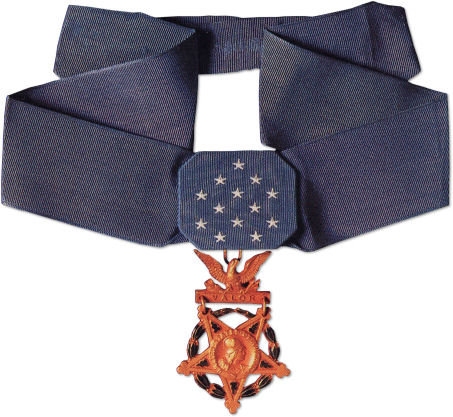 Citation: For conspicuous gallantry and intrepidity at risk of life above and beyond the call of duty in action on 22 September 1943, at Oliveto, Italy. Although 2d Lt. Childers previously had just suffered a fractured instep he, with 8 enlisted men, advanced up a hill toward enemy machinegun nests. The group advanced to a rock wall overlooking a cornfield and 2d Lt. Childers ordered a base of fire laid across the field so that he could advance. When he was fired upon by 2 enemy snipers from a nearby house he killed both of them. He moved behind the machinegun nests and killed all occupants of the nearer one. He continued toward the second one and threw rocks into it. When the 2 occupants of the nest raised up, he shot 1. The other was killed by 1 of the 8 enlisted men. 2d Lt. Childers continued his advance toward a house farther up the hill, and single-handed, captured an enemy mortar observer. The exceptional leadership, initiative, calmness under fire, and conspicuous gallantry displayed by 2d Lt. Childers were an inspiration to his men.
Citation: For the conspicuous bravery displayed by him in defence of one of the guns of the Naval Brigade, at the battle of Tamai, on 13th March, 1884.Citation: For conspicuous gallantry and intrepidity in action above and beyond the call of duty in the Southwest Pacific area from 10 October to 15 November 1944. Though assigned to duty as gunnery instructor and neither required nor expected to perform combat duty, Maj. Bong voluntarily and at his own urgent request engaged in repeated combat missions, including unusually hazardous sorties over Balikpapan, Borneo, and in the Leyte area of the Philippines. His aggressiveness and daring resulted in his shooting down 8 enemy airplanes during this period.
Citation: For conspicuous gallantry and intrepidity at risk of life above and beyond the call of duty in action on 22 September 1943, at Oliveto, Italy. Although 2d Lt. Childers previously had just suffered a fractured instep he, with 8 enlisted men, advanced up a hill toward enemy machinegun nests. The group advanced to a rock wall overlooking a cornfield and 2d Lt. Childers ordered a base of fire laid across the field so that he could advance. When he was fired upon by 2 enemy snipers from a nearby house he killed both of them. He moved behind the machinegun nests and killed all occupants of the nearer one. He continued toward the second one and threw rocks into it. When the 2 occupants of the nest raised up, he shot 1. The other was killed by 1 of the 8 enlisted men. 2d Lt. Childers continued his advance toward a house farther up the hill, and single-handed, captured an enemy mortar observer. The exceptional leadership, initiative, calmness under fire, and conspicuous gallantry displayed by 2d Lt. Childers were an inspiration to his men.
Citation: For the conspicuous bravery displayed by him in defence of one of the guns of the Naval Brigade, at the battle of Tamai, on 13th March, 1884.Citation: For conspicuous gallantry and intrepidity in action above and beyond the call of duty in the Southwest Pacific area from 10 October to 15 November 1944. Though assigned to duty as gunnery instructor and neither required nor expected to perform combat duty, Maj. Bong voluntarily and at his own urgent request engaged in repeated combat missions, including unusually hazardous sorties over Balikpapan, Borneo, and in the Leyte area of the Philippines. His aggressiveness and daring resulted in his shooting down 8 enemy airplanes during this period.Elementary & Middle Grade Fiction
Picture Books
Interrupting Chicken, by David Ezra Stein
Nonfiction Picture Books
The Extraordinary Life of Mark Twain (According to Susy), by Barbara Kerley
Easy Readers
We Are in a Book!, by Mo Willems
Short Chapter Books
Zapato Power: Freddie Ramos Takes Off, written by Jacqueline Jules and illustrated by Miguel Benitez
Poetry
Mirror Mirror: A Book of Reversible Verse, written by Marilyn Singer and illustrated by Josée Masse
Graphic Novels
Meanwhile: Pick Any Path. 3856 Story Possibilities, by Jason Shiga
Fantasy & Science Fiction
The Shadows (The Books of Elsewhere, Vol 1), by Jacqueline West
Middle Grade Fiction
The Strange Case of Origami Yoda, by Tom Angleberger
Young Adult
Non-fiction
The Secret of the Yellow Death: A True Story of Medical Sleuthing, by Suzanne Jurmain
Graphic Novels
Yummy: The Last Days of a Southside Shorty, written by G Neri and illustrated by Randy duBurke
Fantasy & Science Fiction
Rot & Ruin, by Jonathan Maberry
Young Adult Fiction
Split, by Swati Avasthi
Citation: Lieutenant Maxwell was one of three Officers not belonging to "Q" Battery, Royal Horse Artillery, specially mentioned by Lord Roberts as having shown the greatest gallantry, and disregard of danger, in carrying out the self-imposed duty of saving the guns of that Battery during the affair at Korn Spruit on 31st March, 1900. This Officer went out on five different occasions and assisted to bring in two guns and three limbers, one of which he, Captain Humphreys, and some Gunners, dragged in by hand. Citation: Served with Company D during the capture of the Korean forts [on the Han River], 9 and 10 June 1871. Fighting the enemy inside the fort, Lukes received a severe cut over the head.Citation: Landsman and member of Company D during the capture of the Korean forts [on the Han River], 9 and 10 June 1871, Merton was severely wounded in the arm while trying to force his way into the fort.Citation: The KING has been graciously pleased to approve the posthumous award of the GEORGE CROSS, in recognition of most conspicuous gallantry in carrying out hazardous work in a very brave manner, to: —