06 May 2007

Medal of Honor: L. K. Thorsness

LEO K THORSNESS

Lieutenant Colonel (then Major), US Air Force; 357th Tactical Fighter Squadron

Born: 14 February 1932, Walnut Grove, Minnesota
Died: TBD

Citation: For conspicuous gallantry and intrepidity in action at the risk of his life above and beyond the call of duty. As pilot of an F- 105 aircraft, Lt. Col. Thorsness was on a surface-to-air missile suppression mission over North Vietnam [on 19 April 1967]. Lt. Col. Thorsness and his wingman attacked and silenced a surface-to-air missile site with air-to-ground missiles, and then destroyed a second surface-to-air missile site with bombs. In tile attack on the second missile site, Lt. Col. Thorsness' wingman was shot down by intensive antiaircraft fire, and the 2 crewmembers abandoned their aircraft. Lt. Col. Thorsness circled the descending parachutes to keep the crewmembers in sight and relay their position to the Search and Rescue Center. During this maneuver, a MIG-17 was sighted in the area. Lt. Col. Thorsness immediately initiated an attack and destroyed the MIG. Because his aircraft was low on fuel, he was forced to depart the area in search of a tanker. Upon being advised that 2 helicopters were orbiting over the downed crew's position and that there were hostile MIGs in the area posing a serious threat to the helicopters, Lt. Col. Thorsness, despite his low fuel condition, decided to return alone through a hostile environment of surface-to-air missile and antiaircraft defenses to the downed crew's position. As he approached the area, he spotted 4 MIG-17 aircraft and immediately initiated an attack on the MIGs, damaging 1 and driving the others away from the rescue scene. When it became apparent that an aircraft in the area was critically low on fuel and the crew would have to abandon the aircraft unless they could reach a tanker, Lt. Col. Thorsness, although critically short on fuel himself, helped to avert further possible loss of life and a friendly aircraft by recovering at a forward operating base, thus allowing the aircraft in emergency fuel condition to refuel safely. Lt. Col. Thorsness' extraordinary heroism, self-sacrifice, and personal bravery involving conspicuous risk of life were in the highest traditions of the military service, and have reflected great credit upon himself and the U.S. Air Force.


Note: Thorsness is one of seven Eagle Scouts who have been awarded the Medal of Honor.

04 May 2007

"The Ballad of East and West"

I said once that Rudyard Kipling was my favourite poet. And here's my favourite, by far, of his poems. It's a bit long, perhaps, but I'm going to give you the entire thing, not just bits and bobs.

"The Ballad of East and West"

Oh, East is East, and West is West, and never the twain shall meet,
Till Earth and Sky stand presently at God's great Judgment Seat;
But there is neither East nor West, Border, nor Breed, nor Birth,
When two strong men stand face to face, tho' they come from the ends of the earth!

Kamal is out with twenty men to raise the Border-side,
And he has lifted the Colonel's mare that is the Colonel's pride:
He has lifted her out of the stable-door between the dawn and the day,
And turned the calkins upon her feet, and ridden her far away.
Then up and spoke the Colonel's son that led a troop of the Guides:
"Is there never a man of all my men can say where Kamal hides?"
Then up and spoke Mahommed Khan, the son of the Ressaldar:
"If ye know the track of the morning-mist, ye know where his pickets are.
At dusk he harries the Abazai -- at dawn he is into Bonair,
But he must go by Fort Bukloh to his own place to fare,
So if ye gallop to Fort Bukloh as fast as a bird can fly,
By the favour of God ye may cut him off ere he win to the Tongue of Jagai.
But if he be past the Tongue of Jagai, right swiftly turn ye then,
For the length and the breadth of that grisly plain is sown with Kamal's men.
There is rock to the left, and rock to the right, and low lean thorn between,
And ye may hear a breech-bolt snick where never a man is seen."
The Colonel's son has taken a horse, and a raw rough dun was he,
With the mouth of a bell and the heart of Hell and the head of the gallows-tree.
The Colonel's son to the Fort has won, they bid him stay to eat --
Who rides at the tail of a Border thief, he sits not long at his meat.
He's up and away from Fort Bukloh as fast as he can fly,
Till he was aware of his father's mare in the gut of the Tongue of Jagai,
Till he was aware of his father's mare with Kamal upon her back,
And when he could spy the white of her eye, he made the pistol crack.
He has fired once, he has fired twice, but the whistling ball went wide.
"Ye shoot like a soldier," Kamal said. "Show now if ye can ride."
It's up and over the Tongue of Jagai, as blown dustdevils go,
The dun he fled like a stag of ten, but the mare like a barren doe.
The dun he leaned against the bit and slugged his head above,
But the red mare played with the snaffle-bars, as a maiden plays with a glove.
There was rock to the left and rock to the right, and low lean thorn between,
And thrice he heard a breech-bolt snick tho' never a man was seen.
They have ridden the low moon out of the sky, their hoofs drum up the dawn,
The dun he went like a wounded bull, but the mare like a new-roused fawn.
The dun he fell at a water-course -- in a woeful heap fell he,
And Kamal has turned the red mare back, and pulled the rider free.
He has knocked the pistol out of his hand -- small room was there to strive,
"'Twas only by favour of mine," quoth he, "ye rode so long alive:
There was not a rock for twenty mile, there was not a clump of tree,
But covered a man of my own men with his rifle cocked on his knee.
If I had raised my bridle-hand, as I have held it low,
The little jackals that flee so fast were feasting all in a row:
If I had bowed my head on my breast, as I have held it high,
The kite that whistles above us now were gorged till she could not fly."
Lightly answered the Colonel's son: "Do good to bird and beast,
But count who come for the broken meats before thou makest a feast.
If there should follow a thousand swords to carry my bones away,
Belike the price of a jackal's meal were more than a thief could pay.
They will feed their horse on the standing crop, their men on the garnered grain,
The thatch of the byres will serve their fires when all the cattle are slain.
But if thou thinkest the price be fair, -- thy brethren wait to sup,
The hound is kin to the jackal-spawn, -- howl, dog, and call them up!
And if thou thinkest the price be high, in steer and gear and stack,
Give me my father's mare again, and I'll fight my own way back!"
Kamal has gripped him by the hand and set him upon his feet.
"No talk shall be of dogs," said he, "when wolf and gray wolf meet.
May I eat dirt if thou hast hurt of me in deed or breath;
What dam of lances brought thee forth to jest at the dawn with Death?"
Lightly answered the Colonel's son: "I hold by the blood of my clan:
Take up the mare for my father's gift -- by God, she has carried a man!"
The red mare ran to the Colonel's son, and nuzzled against his breast;
"We be two strong men," said Kamal then, "but she loveth the younger best.
So she shall go with a lifter's dower, my turquoise-studded rein,
My broidered saddle and saddle-cloth, and silver stirrups twain."
The Colonel's son a pistol drew and held it muzzle-end,
"Ye have taken the one from a foe," said he; "will ye take the mate from a friend?"
"A gift for a gift," said Kamal straight; "a limb for the risk of a limb.
Thy father has sent his son to me, I'll send my son to him!"
With that he whistled his only son, that dropped from a mountain-crest --
He trod the ling like a buck in spring, and he looked like a lance in rest.
"Now here is thy master," Kamal said, "who leads a troop of the Guides,
And thou must ride at his left side as shield on shoulder rides.
Till Death or I cut loose the tie, at camp and board and bed,
Thy life is his -- thy fate it is to guard him with thy head.
So, thou must eat the White Queen's meat, and all her foes are thine,
And thou must harry thy father's hold for the peace of the Border-line,
And thou must make a trooper tough and hack thy way to power --
Belike they will raise thee to Ressaldar when I am hanged in Peshawur."

They have looked each other between the eyes, and there they found no fault,
They have taken the Oath of the Brother-in-Blood on leavened bread and salt:
They have taken the Oath of the Brother-in-Blood on fire and fresh-cut sod,
On the hilt and the haft of the Khyber knife, and the Wondrous Names of God.
The Colonel's son he rides the mare and Kamal's boy the dun,
And two have come back to Fort Bukloh where there went forth but one.
And when they drew to the Quarter-Guard, full twenty swords flew clear --
There was not a man but carried his feud with the blood of the mountaineer.
"Ha' done! ha' done!" said the Colonel's son. "Put up the steel at your sides!
Last night ye had struck at a Border thief -- to-night 'tis a man of the Guides!"

Oh, East is East, and West is West, and never the twain shall meet,
Till Earth and Sky stand presently at God's great Judgment Seat;
But there is neither East nor West, Border, nor Breed, nor Birth,
When two strong men stand face to face, tho' they come from the ends of the earth!


Originally published December, 1889, in MacMillan's Magazine.

RIP: Capt Walter M Schirra Jr, USN (ret)


Schirra (suited up for his Mercury flight) talking with fellow astronaut Deke Slayton


ZUI this article from the Tampa Tribune:
Walter M. "Wally" Schirra Jr., who followed his barnstorming parents into the sky as a Navy combat pilot and was the only astronaut to fly in the Mercury, Gemini and Apollo space programs, died Thursday of a heart attack in La Jolla, Calif. He was 84.

"With the passing of Wally Schirra, we at NASA note with sorrow the loss of yet another of the pioneers of human spaceflight," NASA Administrator Michael Griffin said in a statement.

A Naval Academy graduate credited with shooting down at least one enemy jet during the Korean War, Schirra was chosen as one of America's seven original Project Mercury astronauts.

On Oct. 3, 1962, he lifted off from Cape Canaveral in the Sigma 7 space capsule for America's fifth manned space mission and third orbital flight.

The Detroit News says:
His family said he died of natural causes, David Mould, NASA press secretary in Washington, said Thursday. Mould said he had been suffering from cancer but didn't know if that contributed to the death.

In October 1962, Schirra became the third American to orbit the Earth, encircling the globe six times in a flight that lasted more than nine hours. Americans in space before him were Alan Shepard and Virgil "Gus" Grissom, who flew suborbital flights in 1961, and John Glenn and Scott Carpenter, who orbited Earth earlier in 1962.

Schirra returned to space three years later as commander of Gemini 6 and guided his two-man capsule toward Gemini 7, already in orbit. On Dec. 15, 1965, the two ships came within a few feet of each other as they shot through space, some 185 miles above the Earth. It was the first rendezvous of two spacecraft in orbit.

His third and final space flight in 1968 inaugurated the Apollo program that the following year put men on the moon.

-------

A native of Hackensack, N.J., Schirra developed an early interest in flight. His father was a fighter pilot during World War I and later barnstormed at county fairs with Schirra's mother, who sometimes stood of the wing of a biplane during flights.

Wally, as he liked to be called, took his first flight with his father at age 13 and already knew how to fly when he left home for the U.S. Naval Academy in Annapolis, Md.

After graduation in 1945, Schirra served in the Seventh Fleet and flew 90 combat missions during the Korean War. He was credited with shooting down one Soviet MiG-15 and possibly a second. He received the Distinguished Flying Cross and two Air Medals.

His official NASA biography page is here. Another biography page is here.


Lieutenant Schirra in Korea

03 May 2007

Driving in Sacramento

Bothenook has a marvelous set of photos of the traffic signs and signals at an intersection in Sacramento. The green lights alone are priceless....

This day in history: 3 May

1942: Light cruiser HMS Edinburgh, which had been damaged on 30 April by torpedoes from U-456 whilst escorting Convoy QP11, and her escorts were attacked by three German destroyers. Herrmann Schoemann (Z7) was damaged and was scuttled the next day, but Edinburgh was torpedoed again and was also scuttled.
On the same day, Japanese troops invaded Tulagi Island in the Solomon Islands.

1943: Twelve Lockheed Ventura light bombers from 487 (New Zealand) Squadron, Bomber Command, departed on a daylight raid against a target in Amsterdam. One aircraft turned back due to mechanical problems, nine were shot down by German fighters, and the tenth was crippled but managed to make it back to England. Only the formation leader, Squadron Leader L H Trent, made his bombing run, and he was shot down immediately afterwards and taken prisoner. Trent was awarded the Victoria Cross after the war, when the details of the raid were made known.

1945: Liner Cap Arcona and freighter Thielbek, loaded with approximately 7500 concentration-camp prisoners, and hospital ship (former liner) Deutschland were sunk by the RAF in Lübeck Bay.

1946: The International Military Tribunal for the Far East was convened in Tokyo against 28 Japanese military and government officials accused of "crimes against peace, conventional war crimes, and crimes against humanity."

1952 - USAF Lieutenant Colonels Joseph O Fletcher and William P Benedict landed a plane at the North Pole.

1973: The Sears Tower, in Chicago, was topped out as the world's tallest building. (The title was lost in 1996 to the Petronas Towers, in Kuala Lumpur, Malaysia.)

2003: The Old Man of the Mountain, a rock formation on Cannon Mountain, in New Hampshire, collapsed.


Mehmed II the Conqueror (1432–1481), Anna Guarini (1563–1598) and Milt Caniff (1907-1988) died on this date.


And happy birthday to Nicolò Machiavelli (1469–1527), Richard D'Oyly Carte (1844–1901), Emmett Dalton (1861–1937), Ernest Alvia Smith VC CM OBC CD (1914-2005), Pete Seeger (1919-TBD), Dave Dudley (1928-2003), Frankie Valli (1934/7-TBD) and Doug Henning (1947-2000).

01 May 2007

This day in history: 1 May

1707: The Act of Union, which had been ratified by the Scottish parliament in January and by the English in March, joined England and Scotland to form the Kingdom of Great Britain.*

1786: The opera Le nozze di Figaro (The Marriage of Figaro), by Wolfgang Amadeus Mozart, premiered at the Burgtheater in Vienna.

1851: The Great Exhibition was opened in London by Queen Victoria.

1857: William Walker surrendered to Commander Charles H Davis, United States Navy, and was repatriated from Nicaragua to the United States.

1863: The Battle of Chancellorsville, between Robert E Lee's Army of Northern Virginia and Joseph Hooker's Army of the Potomac, began. The battle ended in a Confederate victory when Hooker retreated back across the Rappahannock River, though Lieutenant General "Stonewall" Jackson was shot by his own men during the night of 2/3 May and died on the 10th.
Also on this date, the "Stainless Banner" replaced the "Stars and Bars" as the national flag of the Confederate States of America.

1893: The World's Columbian Exposition (aka the Chicago World's Fair) opened in Chicago.

1898: The US Navy destroyed the Spanish Pacific fleet in the Battle of Manila Bay.

1930: The dwarf planet Pluto, discovered on 18 Feb 1930 by astronomer Clyde Tombaugh, was officially named.

1931: The Empire State Building was dedicated in New York City.

1943: Sergeant Maynard H Smith, USAAC, was flying his first combat mission, as ball turret gunner aboard a B-17, when his plane was severely damaged by anti-aircraft fire and enemy fighters. Three of the crew baled out when an intense fire broke out in the centre section of the aircraft. Smith fought the fire by himself, administered first aid to the tail gunner, manned the waist guns, and fought the fire. When ammunition stowed in the radio compartment began to explode, Smith threw the exploding ammunition overboard, continued fighting the fire until all the firefighting aids were exhausted, manned the workable guns until the enemy fighters were driven away, further administered first aid to the tail gunner, and then completely extinguished the fire by hand. Smith was awarded the Medal of Honor.

1960: Captain Francis Gary Powers, USAF, flying a Lockheed U-2 spyplane, was shot down over the Soviet Union.

1978: Naomi Uemura, travelling by dog sled, became the first person to reach the North Pole alone.

2001: Thomas Blanton Jr became the second ex-Ku Klux Klansman to be convicted in the bombing of the 16th Street Baptist Church in Birmingham, Alabama, in 1963.

2004: Cyprus, the Czech Republic, Estonia, Hungary, Latvia, Lithuania, Malta, Poland, Slovakia, and Slovenia joined the European Union.

2004: Private Johnson Beharry, Princess of Wales’s Royal Regiment, was driving a Warrior armoured vehicle through Al Amarah, Iraq, when it was hit by several rocket-propelled grenades. Showing initiative and great courage, Beharry drove through the ambush, taking his own crew and leading five other Warriors to safety. For this, and for his actions during a second ambush on 11 June 2004, Beharry was awarded the Victoria Cross.

Jean Baptiste Bessières, Duke of Istria (1768-1813), David Livingstone (1813–1873), Antonín Dvořák (1841–1904), Joseph Goebbels (1897–1945), Spike Jones (1911–1965), Eldridge Cleaver (1935–1998) and Steve Reeves (1926–2000) died on this date.


And happy birthday to Martha Jane Canary (1855–1903), Fr Pierre Teilhard de Chardin, SJ (1881–1955), Sir Alan Cunningham GCMG KCB DSO MC (1887-1983), Mark Wayne Clark (1896–1984), Otto Kretschmer (1912-1998), Krystyna Skarbek GM OBE (1915-1952), Glenn Ford (1916–2006), Jack Paar (1918–2004), Scott Carpenter (1925-TBD), Judy Collins (1939-TBD), Lady Sarah Chatto (1964-TBD) and Tim McGraw (1967-TBD).


* This year being the 300th anniversary of the Act of Union, the Royal Mint will be producing a special £2 coin to commemmorate the event.

Book list - Apr 07

Client Privilege - mystery, by William G Tapply
The Spotted Cats - mystery, by William G Tapply
The Seventh Enemy - mystery, by William G Tapply
The Stars Are Ours - SF, by Andre Norton
The Witch of Blackbird Pond - children's historical novel, by Elizabeth George Speare (Newbery Medal, 1959)
Thimble Summer - children's, by Elizabeth Enright (Newbery Medal, 1939)
Number the Stars - children's WWII novel, by Lois Lowry (Newbery Medal, 1990)
Dear Mr Henshaw - children's, by Beverly Cleary (Newbery Medal, 1984)
The Dark Frigate - children's historical novel, by Charles Boardman Hawes (Newbery Medal, 1924)
The Time Traders - SF, by Andre Norton
Galactic Derelict - SF, by Andre Norton
Secret of the Andes - children's, by Ann Nolan Clark (Newbery Medal, 1953)
The Trumpeter of Krakow - children's historical novel, by Eric P Kelly (Newbery Medal, 1929)
Tales from the "White Hart" - SF (short stories), by Arthur C Clarke
Sarah, Plain and Tall - children's historical novel, by Patricia MacLachlan (Newbery Medal, 1986)
For Love and Glory - SF, by Poul Anderson
Lone Wolf: The Life and Death of U-Boat Ace Werner Henke - WW II, by Timothy P Mulligan
Adam of the Road - children's historical novel, by Elizabeth Janet Gray (Newbery Medal, 1943)
Star Born - SF, by Andre Norton
Amelia Earhart's Daughters - aviation history, by Leslie Haynsworth and David Toomey

Twenty books this month. (Having a week off work helped.) Clarke and the four Norton books were the only rereads; all the others were new to me.

Up to seventeen (of 86) Newbery Medal books now. Just for the record, the eight I had already read are:
The Voyages of Doctor Dolittle, by Hugh Lofting (1923)
Rabbit Hill, by Robert Lawson (1945)
Strawberry Girl, by Lois Lenski (1946)
The Twenty-One Balloons, by William Pène du Bois (1948)
Ginger Pye, by Eleanor Estes (1952)
A Wrinkle in Time, by Madeleine L'Engle (1963)
It's Like This, Cat, by Emily Neville (1964)
From the Mixed-Up Files of Mrs. Basil E. Frankweiler, by E L Konigsburg (1968)
(At least, I'm pretty sure I've read Ginger Pye - I remember reading other books by Estes, though not that one specifically. Maybe I'll just go ahead and reread those eight while I'm at it....)

29 April 2007

Victoria Cross: M. E. Nasmith

MARTIN ERIC NASMITH

Lieutenant Commander, Royal Navy; commanding HM Submarine E11

Born: 1 April 1883, East Barnes, London

Citation: For most conspicuous bravery in command of one of His Majesty's Submarines, while operating in the Sea of Marmora [during the period 20 May-8 Jun 1915]. In the face of great danger he succeeded in destroying one large Turkish gunboat, two transports, one ammunition ship and three storeships, in addition to driving one storeship ashore. When he had safely passed the most difficult part of his homeward journey he returned again to torpedo a Turkish transport.

(London Gazette Issue 29206 dated 25 Jun 1915, published 25 Jun 1915.)


Note: Lieutenant Guy D'Oyly Hughes RN and Acting Lieutenant Robert Brown RNR were awarded the Distinguished Service Cross, and the remaining members of the crew received the Distinguished Service Medal, for this combat patrol.

Medal of Honor: J. Parrott

JACOB PARROTT

Private, Company K, 33d Ohio Infantry

Born: 17 July 1843, Fairfield County, Ohio
Died: 22 December 1908, Kenton, Ohio


Citation: One of the 19 of 22 men (including 2 civilians) who [in April, 1862], by direction of Gen. Mitchell (or Buell) penetrated nearly 200 miles south into enemy territory and captured a railroad train at Big Shanty, Ga., in an attempt to destroy the bridges and tracks between Chattanooga and Atlanta.


Note: This was the first Medal of Honor presented.

28 April 2007

George Cross: O. M. C. Sansom

MRS ODETTE MARIE CELINE (BRAILLY) SANSOM, MBE

Women's Transport Service (First Aid Nursing Yeomanry); attached Special Operations Executive

Born: 28 April 1912, Amiens, Somme, France
Died: 13 March 1995, France

Citation: Mrs Sansom was infiltrated into enemy-occupied France and worked with great courage and distinction until April, 1943, when she was arrested with her Commanding Officer. Between Marseilles and Paris on the way to the prison at Fresnes, she succeeded in speaking to her Commanding Officer and for mutual protection they agreed to maintain that they were married. She adhered to this story and even succeeded in convincing her captors in spite of considerable contrary evidence and through at least fourteen interrogations. She also drew Gestapo attention from her Commanding Officer on to herself saying that he had only come to France on her insistence. She took full responsibility and agreed that it should be herself and not her Commanding Officer who should be shot. By this action she caused the Gestapo to cease paying attention to her Commanding Officer after only two interrogations. In addition the Gestapo were most determined to discover the whereabouts of a wireless operator and of another British officer whose lives were of the greatest value to the Resistance Organisation. Mrs Sansom was the only person who knew of their whereabouts. The Gestapo tortured her most brutally to try to make her give away this information. They seared her back with a red hot iron and, when that failed, they pulled out all her toe-nails. Mrs Sansom, however, continually refused to speak and by her bravery and determination, she not only saved the lives of the two officers but also enabled them to carry on their most valuable work.
During the period of over two years in which she was in enemy hands, she displayed courage, endurance and self-sacrifice of the highest possible order.

(London Gazette Issue 37693 dated 20 Aug 1946, published 16 Aug 1946.)

This day in history: 28 Apr

1192: Conrad of Montferrat, King of Jerusalem, was assassinated.

1788: Maryland became the seventh state to ratify the US Constitution.

1789: Mutineers led by Fletcher Christian took over HMAV Bounty; its captain, Lieutenant William Bligh, and 18 others were set adrift in a ship's longboat.*


1862: American forces commanded by Admiral David Farragut captured Forts Jackson and St Philip, south of New Orleans.

1917: Near St Quentin, France, CSM Edward Brooks, Ox & Bucks Light Infantry, rescued a British attack which had been pinned down by a German machine-gun. His single-handed attack succeeded in killing or driving away the gun's crew, after which he turned the captured weapon on the neighbouring German defences and secured the success of the British raid. Elsewhere on the Western Front, when the Germans launched heavy attacks on British troops in an exposed position, 20-year-old Second Lieutenant Reginald Haine, Honourable Artillery Company, organised a succession of counter-attacks on a German position; his efforts led to the capture of the German position, fifty prisoners and two machine guns. Brooks and Haine were both awarded the Victoria Cross.

1943: A Company, 6th Armored Infantry, 1st Armored Division, was advancing in the vicinity of MedjezelBab, Tunisia, when they were held up by flanking fire from an enemy machinegun nest. Pvt Nicholas Minue, acting alone, charged the enemy position with fixed bayonet, killing approximately 10 enemy machinegunners and riflemen. After destroying this position, Pvt Minue continued forward, routing enemy riflemen until he was fatally wounded. Minue was awarded the Medal of Honor.

1945: Benito Mussolini and his mistress, Clara Petacci, were executed by members of the Italian resistance movement.

1947: Thor Heyerdahl and five others set sail from Peru on the Kon-Tiki, bound for Polynesia.

1967: Expo 67 opened in Montreal, Quebec.

1986: USS Enterprise (CVN 65) became the first nuclear-powered aircraft carrier to transit the Suez Canal.

2001: Millionaire Dennis Tito became the world's first space tourist, launching from Baikonur on Soyuz TM-32.


2006: Olav Heyerdahl (Thor's grandson) and five others set sail from Peru on the Tangaroa, bound for Tahiti.


Besides Conrad (1140s–1192), Mussolini (1883-1945) and Petacci (1912-1945), Henry Percy, 4th Earl of Northumberland (c. 1449–1489), Prince Mikhail Illarionovich Golenishchev-Kutuzov (1745—1813) and Rory Calhoun (1922-1999) died on this date.

And happy birthday to King Edward IV (1442–1483), President James Monroe (1758–1831), Lionel Barrymore (1878–1954), Jan Oort (1900–1992), Kurt Gödel (1906–1978), Oskar Schindler (1908–1974), Odette Sansom GC MBE (1912-1995), Ferruccio Lamborghini (1916-1993), William J. Guarnere (1922-TBD), Ann-Margret (1941-TBD), Alice Waters (1944-TBD), Terence Pratchett OBE (1948-TBD) and Jay Leno (1950-TBD).


* The photo shows the replica built in 1978 for the Mel Gibson film The Bounty.

27 April 2007

RIP: Barry Nelson


ZUI this article from the Washington Post:
Barry Nelson, an MGM contract player during the 1940s who later had a prolific theater career and was the first actor to play James Bond on screen, has died. He was 89.

Nelson died on April 7 while traveling in Bucks County, Pa., his wife, Nansi Nelson, said Friday. The cause of death was not immediately known, she said.

After graduating from the University of California, Berkeley, in 1941, Nelson was signed to MGM after being spotted by a talent scout. He appeared in a number of films for the studio in 1942, including "Shadow of the Thin Man," "Johnny Eager" and "Dr. Kildare's Victory." He also landed the leading role in "A Yank on the Burma Road," playing a cab driver who decides to lead a convoy of trucks for the Chinese government.

The "first actor to play James Bond on screen"? Yep. Casino Royale, 1954 - eight years before Sean Connery's first Bond Movie, Dr No, and 13 years before David Niven's appearance in the better-known version of Casino Royale.

From the News-Tribune:
Barry Nelson, a Broadway leading man who launched his career at MGM in the 1940s and earned a niche in show business history as the first actor to play British secret agent James Bond – as an American named Jimmy Bond – in a live television production of “Casino Royale” in the 1950s, has died. He was 89.

-------

He later played opposite Debbie Reynolds in the 1963 movie comedy, “Mary, Mary,” a role he originated on Broadway with co-star Barbara Bel Geddes. He also appeared in the films “Airport,” “Pete ’n’ Tillie” and “The Shining.”

But Nelson had some of his greatest successes on Broadway, including appearing in “Light Up the Sky” and “The Moon Is Blue” in the 1940s, “Cactus Flower” opposite Lauren Bacall (in the ’60s) and “The Act” opposite Liza Minnelli (for which he received a Tony Award nomination as best actor in a musical in 1978).

“He was a charming light comedian with a wonderful boyish face and a lovely youthful quality,” Miles Kreuger, president of the Institute of the American Musical in Los Angeles, told the Los Angeles Times on Friday.

You can read more about his career at IMDb and at IBDB.

I know him primarily from Airport, in which he played Dean Martin's co- pilot, though the really memorable (for me, at least) roles in that film were played by Martin, Helen Hayes, Burt Lancaster and George Kennedy. But I see Amazon is offering Casino Royale - Nelson's version - on VHS. I may have to order a copy....

RIP: Mstislav Rostropovich

1965 photo


ZUI this article from the Scotsman:
The Russian cellist and conductor Mstislav Rostropovich, who became a symbol of the fight for artistic freedom under Soviet rule, died yesterday [27 April] aged 80.

Vladimir Putin, the president, who feted the maestro in the Kremlin last month when he made a frail appearance at his 80th birthday celebration, called his death a "huge loss".

"I want to tell [his] relatives and loved ones: 'Please accept my deepest condolences. This is a huge loss for Russian culture'," Mr Putin said.

Says the Herald:
Mstislav Rostropovich - the glorious Slava, as he was nicknamed - was the most exuberant and big-hearted of cellists, the obverse of the pensive, perhaps even greater, Pierre Fournier, and for the public at large he was the man who spectacularly bridged the gap between Pablo Casals and Yo-Yo Ma.

Although in modern times his outsized musical personality came to seem outmoded in the music of Bach, in which Pieter Wispelwey, Paulo Pandolfo and other members of the new school of playing have surpassed him, it was Rostropovich - who else could it have been? - who performed Bach's suites at the base of the Berlin Wall when it was dismantled.

-------

He had been ailing for some time and was no longer the figure he had once been, though Vladimir Putin honoured him last month with a birthday party at the Kremlin. Scotland, fortunately, had heard him in his heyday, playing Bach's complete suites at the 1962 Edinburgh Festival, an event for which he gave his services free.

That was the great Shostakovich year, presided over by Lord Harewood, in which Rostropovich partnered Benjamin Britten in Shostakovich's Sonata for cello and piano as well as in Britten's own Cello Sonata, specially written for him in 1961. Theirs was one of the great creative friendships, which resulted also in Britten's Cello Symphony, one of the masterpieces of modern cello music, and the three suites for solo cello, which today take their place alongside Bach's in the cello repertoire.

And from the North County (CA) Times:
Mstislav Rostropovich played the cello with grace and verve _ and lived his life offstage the same way. His death at age 80 takes away one of modern Russia's most compelling figures, admired both for his musical mastery and his defiance of Soviet repression.

Rostropovich stirred souls with playing that was both intense and seemingly effortless. He fought for the rights of Soviet-era dissidents and later triumphantly played Bach suites below the crumbling Berlin Wall.

In his last public appearance, at his birthday celebration in the Kremlin on March 27, Rostropovich was frail but still able to show his capacity for joy and generosity.

"I feel myself the happiest man in the world," he said. "I will be even more happy if this evening will be pleasant for you."

Spokeswoman Natalia Dollezhal confirmed Rostropovich's death, but would not immediately give details. The composer, who returned to Russia last month after years of living in Paris, had suffered from intestinal cancer.

And I thought I had it rough

ZUI this post of Tam's.

26 April 2007

Croix de Guerre: L. V. Rolfe

LILIAN VERA ROLFE

Assistant Section Officer, Women's Auxiliary Air Force; attached Special Operations Executive

Born: 26 April 1914, Paris, France

Citation: Jeune anglais volontaire pour remplir des missions en France fut déposée près d'Orléans par Lysander, le 5 mai 1944 pour assurer les liaisons radio d'un maquis avec l'E.M. F.F.I.
Bien qui la région fut très controlée par l'ennemi, elle parvint grâce à ses solides connaissances techniques et à son beau sangfroid à transmettre durant deux mois des messages réguliers qui permirent l'armement des maquis de la région, par parachutages; après l'arrestation de son chef, elle n'en continua pas moins courageusement son travail au milieu du danger croissant.
Fut elle-même arrêtée le 3 juillet 1944, renvoyée à Fresnes puis déportée en Allemagne.
Reste un vivant symbole de l'amitié Franco-Britannique.


"A young Englishwoman who volunteered to undertake missions in France and was dropped near Orleans from a Lysander on 5 May 1944 to secure radio links between the maquis and the E.M. F.F.I.
Although the region was fully controlled by the enemy, she succeeded, thanks to her good technical knowledge and presence of mind, in transmitting regular messages for two months, which led to the arming of the maquis of the region by parachute drops; after the arrest of her superior officer she courageously continued her work in the midst of increasing danger.
She was herself arrested on 3rd July 1944, sent to Fresnes and then deported to Germany.
She remains a living symbol of Franco-British friendship."

This day in history: 26 Apr

1607: English colonists, en route to found the Jamestown settlement, made landfall at Cape Henry, Virginia.

1805: Meriwether Lewis and William Clark reached the mouth of the Yellowstone River, in what is now western North Dakota.

1865: John Wilkes Booth was killed by Union soldiers led by Lieutenant Edward Doherty, 16th New York Cavalry Regiment.

1915: Second Lieutenant William Rhodes-Moorhouse, 2 Squadron Royal Flying Corps, set off on a bombing mission against the German-held rail junction at Courtrai, Belgium. His approach took him through heavy ground-fire; his aircraft was badly damaged, and he suffered a severe wound in the thigh, but made a successful bombing run. He managed to fly back to base and insisted on making his report before receiving medical treatment. He died of his wounds the next day. His posthumous Victoria Cross was the first VC awarded for air action. Five other men - two in Belgium, three at Gallipoli - also were awarded the VC for their actions that day.

1933: The Geheime Staatspolizei (Gestapo) was established.


1937: Guernica, Spain was bombed by the German Luftwaffe.


1962: Ranger 4, which had been launched from Cape Canaveral on 23 April, crash-landed on the Moon.

1964: The nations of Tanganyika and Zanzibar merged to form Tanzania.

1986: A nuclear reactor accident occurred at the Chernobyl Nuclear Power Plant, in the Ukraine*.

In addition to Booth (1838-1865), Ludwig Freiherr von der Tann (1815-1881), Gypsy Rose Lee (1911/1914–1970), Irene Ryan (1902–1973), "Count" Basie (1904–1984), Broderick Crawford (1911-1986), Lucille Ball (1911–1989) and Maria Schell (1926-2005) died on this date.


And happy birthday to Marie de' Medici (1573–1642), Esek Hopkins (1718–1802), Emma, Lady Hamilton (1765–1815), John James Audubon (1785–1851), Frederick Law Olmsted (1822–1903), Rudolf Hess (1894–1987), Ernst Udet (1896–1941), A E van Vogt (1912–2000), Lilian Rolfe (1914-1945), Carol Burnett (1933-TBD), Jet Li (1963-TBD) and Jessica Lynch (1983-TBD).


* Yes, I know - it's officially "Ukraine," not "the Ukraine." So sue me.

22 April 2007

Victoria Cross: L. A. Trigg

LLOYD ALLAN TRIGG, DFC

Flying Officer, Royal New Zealand Air Force; 200 Squadron, Royal Air Force

Born: 5 June 1914, Houhora, New Zealand

Citation: Flying Officer Trigg had rendered outstanding service on convoy escort and anti-submarine duties. He had completed 46 operational sorties and had invariably displayed skill and courage of a very high order.
One day in August, 1943, Flying Officer Trigg undertook, as captain and pilot, a patrol in a Liberator although he had not previously made any operational sorties in that type of aircraft. After searching for 8 hours, a surfaced U-boat was sighted.
Flying Officer Trigg immediately prepared to attack. During the approach the aircraft received many hits from the submarine's anti-aircraft guns and burst into flames, which quickly enveloped the tail.
The moment was critical. Flying Officer Trigg could have broken off the engagement and made a forced landing in the sea. But if he continued the attack the aircraft would present a "no deflection" target to deadly accurate anti-aircraft fire, and every second spent in the air would increase the extent and intensity of the flames and diminish his chances of survival.
There could have been no hesitation or doubt in his mind. He maintained his course in spite of the already precarious condition of his aircraft and executed a masterly attack. Skimming over the U-boat at less than 50 feet, with anti-aircraft fire entering his opened bomb doors, Flying Officer Trigg dropped his bombs on and around the U-boat where they exploded with devastating effect. A short distance further on the Liberator dived into the sea with her gallant captain and crew.
The U-boat sank within 20 minutes and some of the crew were picked up later in a rubber dinghy that had broken loose from the Liberator.
The Battle of the Atlantic has yielded many fine stories of air attacks on underwater craft, but Flying Officer Trigg's exploit stands out as an epic of grim determination and high courage. His was the path of duty that leads to glory.

(London Gazette Issue 36230 dated 2 Nov 1943, published 29 Oct 1943.)


Note: Since Trigg's aircrew were all killed, there were no friendly witnesses to this action. There were seven survivors from the submarine (U-468), however, including its CO, Oblt z S Klemens Schamong, and Trigg's award was based on their testimony. His was the only Victoria Cross awarded to an Allied serviceman in either World War I or II solely on the recommendation by the enemy.

Medal of Honor: F. T. Fisher

FREDERICK THOMAS FISHER

Gunner's Mate First Class, US Navy; USS Philadelphia (C 4)

Born: 3 Jun 1872, England
Died: Unknown

Citation: On board the U.S.S. Philadelphia, Samoa, 1 April 1899. Serving in the presence of the enemy on this date, Fisher distinguished himself by his conduct.

21 April 2007

Little old beauty queens with guns

Only one actually, but.... ZUI this article from Yahoo! News:
Venus Ramey, 82, confronted a man on her farm in south-central Kentucky last week after she saw her dog run into a storage building where thieves had previously made off with old farm equipment.

Ramey said the man told her he would leave. "I said, 'Oh, no you won't,' and I shot their tires so they couldn't leave," Ramey said.

She had to balance on her walker as she pulled out a snub-nosed .38-caliber handgun.

"I didn't even think twice. I just went and did it," she said. "If they'd even dared come close to me, they'd be 6 feet under by now."

Miss Ramey, born in Kentucky but representing the District of Columbia, was chosen as Miss America in 1944 - the first redhead to win the title.

20 April 2007

"Paul Revere's Ride"

Wednesday was 18 April, and I'm sure everyone remembers what happened 132 years ago on that date. I'm probably not the only one who's thinking about the following poem today, but here it is anyway:

Paul Revere's Ride

Listen my children and you shall hear
Of the midnight ride of Paul Revere,
On the eighteenth of April, in Seventy-five;
Hardly a man is now alive
Who remembers that famous day and year.


He said to his friend, "If the British march
By land or sea from the town to-night,
Hang a lantern aloft in the belfry arch
Of the North Church tower as a signal light,--
One if by land, and two if by sea;
And I on the opposite shore will be,
Ready to ride and spread the alarm
Through every Middlesex village and farm,
For the country folk to be up and to arm."


Then he said "Good-night!" and with muffled oar
Silently rowed to the Charlestown shore,
Just as the moon rose over the bay,
Where swinging wide at her moorings lay
The Somerset, British man-of-war;
A phantom ship, with each mast and spar
Across the moon like a prison bar,
And a huge black hulk, that was magnified
By its own reflection in the tide.


Meanwhile, his friend through alley and street
Wanders and watches, with eager ears,
Till in the silence around him he hears
The muster of men at the barrack door,
The sound of arms, and the tramp of feet,
And the measured tread of the grenadiers,
Marching down to their boats on the shore.


Then he climbed the tower of the Old North Church,
By the wooden stairs, with stealthy tread,
To the belfry chamber overhead,
And startled the pigeons from their perch
On the sombre rafters, that round him made
Masses and moving shapes of shade,--
By the trembling ladder, steep and tall,
To the highest window in the wall,
Where he paused to listen and look down
A moment on the roofs of the town
And the moonlight flowing over all.


Beneath, in the churchyard, lay the dead,
In their night encampment on the hill,
Wrapped in silence so deep and still
That he could hear, like a sentinel's tread,
The watchful night-wind, as it went
Creeping along from tent to tent,
And seeming to whisper, "All is well!"
A moment only he feels the spell
Of the place and the hour, and the secret dread
Of the lonely belfry and the dead;
For suddenly all his thoughts are bent
On a shadowy something far away,
Where the river widens to meet the bay,--
A line of black that bends and floats
On the rising tide like a bridge of boats.


Meanwhile, impatient to mount and ride,
Booted and spurred, with a heavy stride
On the opposite shore walked Paul Revere.
Now he patted his horse's side,
Now he gazed at the landscape far and near,
Then, impetuous, stamped the earth,
And turned and tightened his saddle girth;
But mostly he watched with eager search
The belfry tower of the Old North Church,
As it rose above the graves on the hill,
Lonely and spectral and sombre and still.
And lo! as he looks, on the belfry's height
A glimmer, and then a gleam of light!
He springs to the saddle, the bridle he turns,
But lingers and gazes, till full on his sight
A second lamp in the belfry burns.


A hurry of hoofs in a village street,
A shape in the moonlight, a bulk in the dark,
And beneath, from the pebbles, in passing, a spark
Struck out by a steed flying fearless and fleet;
That was all! And yet, through the gloom and the light,
The fate of a nation was riding that night;
And the spark struck out by that steed, in his flight,
Kindled the land into flame with its heat.
He has left the village and mounted the steep,
And beneath him, tranquil and broad and deep,
Is the Mystic, meeting the ocean tides;
And under the alders that skirt its edge,
Now soft on the sand, now loud on the ledge,
Is heard the tramp of his steed as he rides.


It was twelve by the village clock
When he crossed the bridge into Medford town.
He heard the crowing of the cock,
And the barking of the farmer's dog,
And felt the damp of the river fog,
That rises after the sun goes down.


It was one by the village clock,
When he galloped into Lexington.
He saw the gilded weathercock
Swim in the moonlight as he passed,
And the meeting-house windows, black and bare,
Gaze at him with a spectral glare,
As if they already stood aghast
At the bloody work they would look upon.


It was two by the village clock,
When he came to the bridge in Concord town.
He heard the bleating of the flock,
And the twitter of birds among the trees,
And felt the breath of the morning breeze
Blowing over the meadow brown.
And one was safe and asleep in his bed
Who at the bridge would be first to fall,
Who that day would be lying dead,
Pierced by a British musket ball.


You know the rest. In the books you have read
How the British Regulars fired and fled,---
How the farmers gave them ball for ball,
From behind each fence and farmyard wall,
Chasing the redcoats down the lane,
Then crossing the fields to emerge again
Under the trees at the turn of the road,
And only pausing to fire and load.


So through the night rode Paul Revere;
And so through the night went his cry of alarm
To every Middlesex village and farm,---
A cry of defiance, and not of fear,
A voice in the darkness, a knock at the door,
And a word that shall echo for evermore!
For, borne on the night-wind of the Past,
Through all our history, to the last,
In the hour of darkness and peril and need,
The people will waken and listen to hear
The hurrying hoof-beats of that steed,
And the midnight message of Paul Revere.

Henry Wadsworth Longfellow (1807-1882)


Tourists, arriving

Back in the days before pier security was tightened up, we used to get the occasional person (or few) dropping by and asking for a tour of the boat. Sometimes it would be a fellow submariner, from a different class of boat; other times it would be a skimmer, or perhaps a member of one of the other services. In Groton, SubScol students were fairly common.

The POOD would call below to get permission from the SDO, and the SDO would usually say yes, provided a tour guide could be found. I was almost always willing to volunteer; in part because I was proud of my boat and of what I did, and in part because I remembered two young men who were willing to take the time to give me the same courtesy. (One was on a diesel boat - Blueback, I think - when I was going through RM 'A' school in San Diego; the other was on HMS Spartan, which spent a week or so in Groton when I was in SubScol.)

I'd usually take 45 minutes to an hour to give a tour. I'd start out topside, talking about the ship's size and pointing out whatever masts and antennas* happened to be raised. Then we'd go below and I'd show them the CO's stateroom, Control and the Nav Centre, and let them look through the deadlight into the fan room. Down to middle level for the crew's mess and galley, Countermeasures (where I'd talk about the doc), berthing (where if possible I'd open a convenient bunkpan to show how much storage room we didn't have for personal effects), the weirdroom and officers' staterooms, and the goat locker. Then down to lower level for the machinery room and the torpedo room. And somewhere along the way I'd pause to talk about the EAB system and how it worked, and about other DC gear.

Skimmers often have (or at least use to have) open house, where they'll throw the boat open for the general public to come aboard and look around. I've only seen a submarine do that once.

We were doing our homeport shift from Norfolk to Pearl, and along the way we stopped off for a namesake-city visit to Olympia, Washington. Just getting there was a trip in itself. On Thursday we transited the Strait of Juan de Fuca, mooring for the night in Seattle. (Cinderella liberty!) We got under way early the next day for a full-day transit of Puget Sound, arriving in Olympia early in the evening.

Back in those days the city of Olympia loved us.** Official (and unofficial) representatives of the city had been at the commissioning ceremony, and when we pulled in to Roosevelt Roads and St Croix during our first underway as USS (vice PCU) Olympia, there were Olympia citizens waiting on the piers.

To start with, they had arranged a big party for us in a warehouse not far from our berth, though I was unable to attend as I had duty the first night in.

There were a few dozen protesters on the pier when we pulled in, waving signs and chanting ("Take the toys away from the boys!"). I had the first watch up in the bridge, with an M-16, and I sat up there and chanted along with them ("More nukes, less kooks!") Besides the protesters and the party-goers, there were also quite a few people who just came down to the pier to have a look at the boat.

The next morning I went up topside to have a look around in the daylight. The protesters were gone, but they'd left some of their signs propped up to remind us of their displeasure. One of these signs caught my eye, and I wasted no time in going below and dragging a couple of my nuke buddies up to see it: WE WELCOME THE PEOPLE BUT NOT THE NUKES. ("See, Joel? Even the damn' hippies know the difference between nukes and real people!")

After duty-section turnover I went out with a handful of others (all nukes, as I recall), looking for breakfast. We found it in a hotel restaurant, and after eating, we went next door to the hotel bar. There were seven or eight of us, and we hadn't gotten three steps inside the door when a man seated at the bar looked up at us and announced, "I'm buying these boys a drink." The bartender bought the second round, and I never did see who paid for the third round; the bartender just came over and started setting glasses in front of us again. I figured if I wanted to see much of the town, I'd better get out of there quickly, so I drank the third one and left.

It was like that the entire time we were there - almost impossible for us to buy our own drinks. I don't think many people wore civvies the entire time we were there; most of us wore our dress blues whenever we went out into town. And the response was amazing: People driving by would honk and wave. Or they'd pull over and ask if we knew where we were going. If not, did we want directions? If we did know, did we want a ride? If we didn't care, would we like to go with them? There were reports of crewmembers being taken out to people's cabins, deep-sea fishing, up for rides in private planes.

And the party the first night wasn't all. Sunday afternoon there was a parade, followed by a reception at the governor's mansion. And Monday was brewery day. The Olympia brewery loved us, too; during new construction they'd shipped us several cases of beer mugs, enough for every man in the crew to get one, and they'd provided some nice glasses for the commissioning banquet, too. When we went out to tour the brewery, we discovered that they had some keychains for us, engraved with with out names and ranks, and the date. And it wasn't a matter of telling them your name, and then waiting while they did the engraving. No, someone had sent them a copy of the sailing list, and the keychains were all ready and waiting; all we had to do was dig through the bowl to find the right one.

And then there were the tourists. The decision had been made to throw the boat open to the public. Members of the duty section would be posted at various locations throughout the forward compartment, and the visitors would come below and be directed along a set route. At each stop, the tour guide posted there would give a brief talk, and then the people would be given a chance to buy something from the ship's store before being escorted off the boat. Officially, the tours ran from 0800 until 1700, but....

To begin with, any time you went up topside, day or night, you'd find people - plural - standing there, just looking at the boat. By the time duty-section turnover started (0700, if I recall correctly), they'd be queued up a block long. So the duty officer would sigh, and as soon as turnover was complete, say, "Okay - take stations and start bringing them down."

By 0900, the queue was a good two blocks long. And it stayed that way. All day. Around 1645 we'd send some poor sap from the duty section out to the end of the queue to start turning people away. "We're sorry. We know you've been waiting a long time, but we have to stop the tours for the night. Maybe you can come back tomorrow...."

And still they'd keep coming. The official tours stopped, but crewmembers would be bringing folks down for private tours. Finally, about 2200, the SDO would put his foot down and say, "That's it - no more tours." And the last tour would finally go down about midnight.

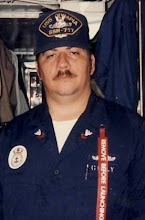
I was responsible for a few of those private tours, too. I was sitting up in the bridge with my M-16, mostly watching the water for swimmers or other threats, but also keeping an eye on the crowd on the pier, and I noticed a cute young lady sitting on a bollard looking at the boat. She sat there for what must have been two hours, just looking, and just before I was due to get relieved, she stood up and started to walk away. So I called out, "Miss!" She looked back, and I asked, "Would you like a tour?" She nodded, so I told her to wait, I'd be getting relieved in fiteen minutes or so and would be happy to provide. So she did, and I did. (Her name was Tina, and I got several letters from her over the next few years; in fact, I believe she was the one who sent me the teddy bear you can see in the picture here.)

As far as I know, I was the one to give the final tour during that visit - at 0200 Wednesday morning, to two young ladies who I'm pretty sure had been amongst the protesters the night we pulled in. They asked a few leading questions ("Is the crew politically aware?"), but they seemed to be genuinely interested in what I was showing them. Though I'm not quite sure how interesting they would have found it if I hadn't been standing right in front of the 21-Man door when a certain ET2 started to walk out, stark naked, on his way to the head....

Wednesday morning we were up early to repeat the trip in reverse, stopping for another night in Seattle before continuing on up to spend a few days in Nanoose Bay, BC.

The semi-official estimate I heard was that we put around 5000 people through the boat during that port call. And I've never seen anything like it since.


* According to the book we used when I was learning antenna theory in SETTS, radios have antennas; insects have antennae.

** Though it seems they have undergone a somewhat drastic change of opinion since then.

19 April 2007

Wonder of wonders, Carnegie of Carnegies

I've mentioned the Newbery Medal a time or two. It's awarded annually to the author of "the most distinguished contribution to American literature for children," as chosen by the Association for Library Service to Children (a division of the American Library Association). The first medal was presented in 1922, for The Story of Mankind, by Hendrik Willem van Loon; this year's winner was The Higher Power of Lucky, by Susan Patron.

The Brits have a similar award: The Carnegie Medal, which is presented annually by The Chartered Institute of Library and Information Professionals (CILIP) "for an outstanding book for children and young people." It was first awarded in 1937 for Pigeon Post, by Arthur Ransome; last year's winner was Tamar, by Mal Peet. (The shortlist for this year's award was announced recently, and the winner will presumably be announced sometime soon.)

(Incidentally, both medals are presented for the best children's book of the previous year. However, the American medals are referred to by the year they were awarded; thus, the book which was written last year and received the medal is referred to as the 2007 winner. The Brits, however, seem to refer to them by the year of publication, so the book which was written last year and will receive the medal is referred to as the 2006 winner.)

This year is the 70th anniversary of the Carnegie Medal, and CILIP are selecting a "Carnegie of Carnegies" - the best book of the 70 best books. A panel of judges have selected a shortlist of ten books from amongst the medal winners, and are asking the public to vote for their choice. ZUI this article from The Independent:


One is a cosy bedtime read about a family of tiny people who live beneath the floor; another takes you into the world of a 14-year-old heroin user; and a third enacts an elaborate fantasy of demons and witch-clans.

They are among 10 books today nominated as the most important children's novels of the past 70 years, and encompass gritty themes of murder, war and illness as well as the deeds of fairies, angels and strange beings.

Philip Pullman's Northern Lights was chosen alongside classics such as Mary Norton's The Borrowers and Alan Garner's The Owl Service by judges of the CILIP Carnegie Medal for children's literature, as a kind of "Carnegie of Carnegies" to celebrate its 70th anniversary.

The list includes Melvin Burgess's Junk, about young heroin users who run away to live in a squat, which won the Carnegie Medal in 1996.

Other groundbreaking novels include Eve Garnett's 1937 novel The Family From One End Street, the first book of its kind to portray a working-class family.

The complete list can be found here in the CILIP press release. I'm still trying to figure out how to actually vote, though.... (Just for the record, I've read six of the 67*, and two of the 10.)

Incidentally, there are parallel awards for the best picture book published each year. The American award is the Caldecott Medal, first given in 1938 for Animals of the Bible, A Picture Book, illustrated by Dorothy P. Lathrop with text selected by Helen Dean Fish.

The British Kate Greenaway Medal was first presented in 1957 for Tim All Alone, by Edward Ardizzone.


H/T to Big A little a.


* There have been three years - 1943, 1945 and 1966 - when no prize was given, because "no book was considered suitable."