26 April 2011

More Australian VCs to be awarded?

ZUI this article from the Sydney Morning Herald:

John Simpson is among 13 servicemen in contention for a Victoria Cross, write Mike Carlton and Dylan Welch.

HE IS a legendary Australian figure - a man who dodged shrapnel and snipers' bullets to ferry casualties of the Gallipoli campaign on the back of his donkey to the safety of Anzac Cove.

Now John Simpson Kirkpatrick, who enlisted as John Simpson to avoid being revealed as a deserter, is finally to receive the official recognition he deserves.

*******


Today, the government will name him as one of 13 long-dead members of the navy and army to be considered for Victoria Crosses.

Australians have won 98 VCs since 1899, two since 1969. The most recent recipient was the SAS Corporal Benjamin Roberts-Smith this year.

Those being considered served in both World Wars and in Vietnam. Ten are from the navy and two, including Kirkpatrick, from the army.

No sailor of the Royal Australian Navy has been awarded the VC.

*******

The standout navy candidate for a posthumous medal is Hector "Hardover Hec" Waller, a seaman born in rural Victoria and generally recognised to have been our finest fighting captain.

He led the five Australian destroyers of the Scrap Iron Flotilla in the Mediterranean in 1940-41, in the thick of the naval war against the Italians and Germans. Twice he won the Distinguished Service Order there, the second time for extraordinary seamanship in the Royal Navy's last great fleet action, the Battle of Matapan in March 1941.

ZUI also this announcement from the Australian Department of Defence.

The complete list is as follows:

Gunner Albert Neil Cleary - Royal Australian Artillery, 1945
Midshipman Robert Ian Davies - HMS Repulse, 1942
Leading Cook Francis Bassett Emms - HMAS Kara Kara, 1942
Lieutenant David John Hamer - HMAS Australia, 1945
Private John Simpson Kirkpatrick - Australian Imperial Force, 1915
Lt Cdr Robert William Rankin - HMAS Yarra, 1942
Able Seaman Dalmorton Joseph Owendale Rudd - HMAS Australia (attached HMS Vindictive), 1918
Ordinary Seaman Edward Sheean - HMAS Armidale, 1942
Leading Aircrewman Noel Ervin Shipp - Royal Australian Navy Helicopter Flight Vietnam, 1969
Lieutenant Commander Francis Edward Smith - HMAS Yarra, 1942
Lieutenant Commander Henry Hugh Gordon Dacre Stoker - HMAS AE2, 1915
Leading Seaman Ronald Taylor - HMAS Yarra, 1942
Captain Hector Macdonald Laws Waller - HMAS Perth, 1942

Update 1148 24 Jan 12: The Canberra Times have announced the addition of Warrant Officer Jack Kirby (Viet Nam, 1966) to this list.

RIP: Tul Bahadur Pun VC

Tul Bahadur Pun VC
23 Mar 1923 - 20 Apr 2011


ZUI this article from The Telegraph:
Lieutenant Tul Bahadur Pun, who died on April 20 aged 88, won the Victoria Cross while serving with the Second Chindit Expedition in Burma in 1944.

Early in March that year the Second Chindit Expedition, a force of six brigades comprising some 9,000 men together with stores, was air-landed in Burma. The main objectives of the Expedition were twofold: first, to support the advance on Myitkyina by the American-led Chinese troops and to establish a strong position astride the Japanese lines of communication; and secondly, to impede the build-up of Japanese forces for an invasion of India by harassing them in the Mogaung area.

The Chindits were supplied by establishing a number of fortified bases with airstrips south of Myitkyina. These strongholds provoked a strong reaction from the Japanese, and some of them subsequently proved indefensible and had to be abandoned.

On May 27 the 77th Indian Brigade was ordered to capture the Japanese supply centre of Mogaung. After almost a month of savage fighting which had greatly depleted the brigade’s numbers, the 3rd Battalion 6th Gurkha Rifles was ordered to attack the railway bridge at Mogaung on June 23.

*******

Tul Bahadur Pun was born on March 23 1923 at Banduk village in the Myagdit district of west Nepal. He enlisted in the Gurkha Brigade in west Nepal and, after completing his basic training, joined the 3rd Battalion 6th Gurkha Rifles for the Chindit Expedition.

After Independence in 1947, he transferred to the British Army and joined the 2nd/6th Gurkha Rifles, seeing action in Malaya and Hong Kong. He rose to be regimental sergeant major of his battalion and retired from the Army in May 1959 in the rank of honorary lieutenant.

*******

He was twice married, and is survived by his second wife, Punisara, and by his two sons and eight daughters.

ZUI also this article from the BBC.

There are now eight surviving VC holders, including two recipients of the Victoria Cross for Australia and one recipient of the Victoria Cross for New Zealand:
Flt Lt John A Cruickshank VC, RAFVR - North Atlantic, 1944
Sgt William Speakman VC, The Black Watch - Korea, 1951
Capt Ram Bahadur Limbu VC MVO, 10th Gurkha Rifles - Borneo, 1965
WO Keith Payne VC OAM, Australian Army - Vietnam, 1969
Pte Johnson G Beharry VC, Princess of Wales's Royal Regiment - Iraq, 2004
Cpl Bill H Apiata VC, New Zealand SAS - Afghanistan, 2004
Tpr Mark G S Donaldson VC, Australian SAS - Afghanistan, 2008
Cpl Ben Roberts-Smith VC, Australian SAS - Afghanistan, 2010

************* *** *************

TUL BAHADUR PUN

Rifleman, 6th Gurkha Rifles

Born: 23 March 1923, Banduk, Nepal
Died: 20 April 2011, Banduk, Nepal

Citation: In Burma on June 23rd, 1944, a Battalion of the 6th Gurkha Rifles was ordered to attack the Railway Bridge at Mogaung. Immediately the attack developed the enemy opened concentrated and sustained cross fire at close range from a position known as the Red House and from a strong bunker position two hundred yards to the left of it.
So intense was this cross fire that both the leading platoons of "B" Company, one of which was Rifleman Tulbahadur Pun's, were pinned to the ground and the whole of his Section was wiped out with the exception of himself, the Section Commander and one other man. The Section Commander immediately led the remaining two men in a charge on the Red House but was at once badly wounded. Rifleman Tulbahadur Pun and his remaining companion continued the charge, but the latter too was immediately badly wounded.
Rifleman Tulbahadur Pun then seized the Bren Gun, and firing from the hip as he went, continued the charge on this heavily bunkered position alone, in the face of the most shattering concentration of automatic fire, directed straight at him. With the dawn coming up behind him, he presented a perfect target to the Japanese. He had to move for thirty yards over open ground, ankle deep in mud, through shell holes and over fallen trees.
Despite these overwhelming odds, he reached the Red House and closed with the Japanese occupants. He killed three and put five more to flight and captured two light machine guns and much ammunition. He then gave accurate supporting fire from the bunker to the remainder of his platoon which enabled them to reach their objective.
His outstanding courage and superb gallantry in the face of odds which meant almost certain death were most inspiring to all ranks and were beyond praise.

[London Gazette issue 36785 dated 9 Nov 1944, published 7 Nov 1944.]

24 April 2011

Victoria Cross: A. P. Sullivan

ARTHUR PERCY SULLIVAN

Corporal, 45th Battalion, Royal Fusiliers

Born: 27 November 1896, Crystal Brook, South Australia
Died: 9 April 1937, Birdcage Walk, London

Citation: For most conspicuous bravery and devotion to duty on the 10th August, 1919, at the Sheika River, North Russia.
The platoon to which he belonged, after fighting a rearguard covering action, had to cross the river by means of a narrow plank, and during the passage an officer and three men fell into a deep swamp.
Without hesitation, under intense fire, Corporal Sullivan jumped into the river and rescued all four, bringing them out singly. But for this gallant action his comrades would undoubtedly have been drowned. It was a splendid example of heroism as all ranks were on the point of exhaustion and the enemy less than 100 yards distant.

[London Gazette issue 31572 dated 29 Sep 1919, published 26 Sep 1919.]

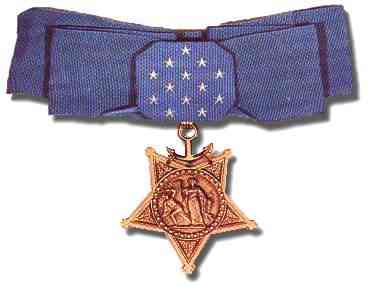
Medal of Honor: R. E. O'Malley

ROBERT EMMETT O'MALLEY

Sergeant (then Corporal), US Marine Corps; Company I, 3d Battalion, 3d Marine Regiment, 3d Marine Division (Reinforced)

Born: 3 June 1943, New York City, New York
Died: TBD

Citation: For conspicuous gallantry and intrepidity in action against the communist (Viet Cong) forces at the risk of his life above and beyond the call of duty. While leading his squad in the assault against a strongly entrenched enemy force [near An Cu'ong 2, South Vietnam, on 18 August 1965], his unit came under intense small-arms fire. With complete disregard for his personal safety, Sgt. O'Malley raced across an open rice paddy to a trench line where the enemy forces were located. Jumping into the trench, he attacked the Viet Cong with his rifle and grenades, and singly killed 8 of the enemy. He then led his squad to the assistance of an adjacent marine unit which was suffering heavy casualties. Continuing to press forward, he reloaded his weapon and fired with telling effect into the enemy emplacement. He personally assisted in the evacuation of several wounded marines, and again regrouping the remnants of his squad, he returned to the point of the heaviest fighting. Ordered to an evacuation point by an officer, Sgt. O'Malley gathered his besieged and badly wounded squad, and boldly led them under fire to a helicopter for withdrawal. Although 3 times wounded in this encounter, and facing imminent death from a fanatic and determined enemy, he steadfastly refused evacuation and continued to cover his squad's boarding of the helicopters while, from an exposed position, he delivered fire against the enemy until his wounded men were evacuated. Only then, with his last mission accomplished, did he permit himself to be removed from the battlefield. By his valor, leadership, and courageous efforts in behalf of his comrades, he served as an inspiration to all who observed him, and reflected the highest credit upon the Marine Corps and the U.S. Naval Service.

17 April 2011

Victoria Cross: G. R. D. Moor

GEORGE RAYMOND DALLAS MOOR

Second Lieutenant, 3rd Battalion The Hampshire Regiment.

Born: 22 October 1896, St Kilda, Victoria, Australia
Died: 3 November 1918, Mouveaux, France

Citation: For most conspicuous bravery and resource on 5th June, 1915, during operations south of Krithia, Dardanelles. When a detachment of a battalion on his left, which had lost all its officers, was rapidly retiring before a heavy Turkish attack, Second Lieutenant Moor, immediately grasping the danger to the remainder of the line, dashed back some 200 yards, stemmed the retirement, led back the men, and recaptured the lost trench.
This young officer, who only joined the Army in October, 1914, by his personal bravery and presence of mind, saved a dangerous situation.

[London Gazette issue 29240 dated 24 Jul 1915, published 23 Jul 1915.]

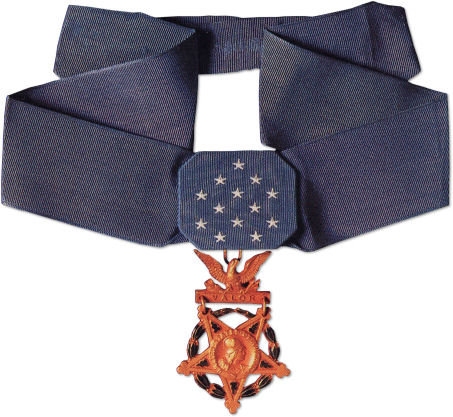
Medal of Honor: R. T. Emmet

ROBERT TEMPLE EMMET

Second Lieutenant, 9th US Cavalry.

Born: 13 December 1854, New York City, New York
Died: 25 October 1936

Citation: Lt. Emmet was in G Troop which was sent to relieve a detachment of soldiers under attack by hostile Apaches. During a flank attack on the Indian camp [at Las Animas Canyon, New Mexico, on 18 September 1879], made to divert the hostiles Lt. Emmet and 5 of his men became surrounded when the Indians returned to defend their camp. Finding that the Indians were making for a position from which they could direct their fire on the retreating troop, the Lieutenant held his point with his party until the soldiers reached the safety of a canyon. Lt. Emmet then continued to hold his position while his party recovered their horses. The enemy force consisted of approximately 200.

14 April 2011

Operational Honours List

Light blogging lately whilst dealing with the aftermath of the move. It's amazing what goes on in the world when you're not keeping track of your usual news sources....

ZUI this article (dated 25 Mar 11) from the MOD Defence News:
A total of 136 members of the Armed Forces have received honours and awards in the Operational Honours List dated today, 25 March 2011.

ZUI also this article:
Any one of the stories these brave servicemen and women have to tell is humbling. It seems invidious to single any out for special attention. The ones here give just a flavour of the calibre of not just the recipients of these awards, but of all our Armed Forces.

Ninety-three gallantry awards were made, including three Conspicuous Gallantry Crosses, five Distinguished Service Orders, 14 Military Crosses and a Distinguished Flying Cross. In addition to these, 43 meritorious awards were made, including three CBEs and four OBEs.

Members of the Royal Navy, the Royal Marines, the British Army and the Royal Air Force were all included on the list. (The complete list is given in the first article linked to above.)

Amongst those honoured:

Corporal Isobel Ann Henderson, Royal Army Medical Corps, was appointed a Member of the Order of the British Empire (MBE).


Corporal Dipprasad Pun, The Royal Gurkha Rifles, received the Conspicuous Gallantry Cross (CGC).


Acting Lance Corporal Kylie Elizabeth Watson, Royal Army Medical Corps, became the fourth woman to be awarded the Military Cross (MC).*


Squadron Leader Matthew David Roberts, Royal Air Force, received the Distinguished Flying Cross (DFC).

(The above awards were all earned in Afghanistan.)


* The other three were also medics, two from the RAMC and one from the Royal Navy.

Photographs © Crown Copyright/MOD 2011.

12 April 2011

Carnegie and Greenaway short lists announced

CILIP - the Chartered Institute of Library and Information Professionals - have released the short lists for this year's Carnegie Medal and Kate Greenaway Medal. The Andrew Carnegie Medal, named for the Scottish philanthropist, has been awarded annually since 1937 to the writer of "an outstanding book for children." In addition to the gold medal, the winner receives £500 worth of books to donate to a library of his/her choice.

This year's short list consists of:
Prisoner Of The Inquisition, by Theresa Breslin
Doubleday (Ages 12+)

The Death Defying Pepper Roux, by Geraldine McCaughrean
Oxford Children's Books (Ages 10+)

Monsters of Men, by Patrick Ness
Walker (Ages 14+)

The Bride's Farewell, by Meg Rosoff
Puffin (Ages 12+)

White Crow, by Marcus Sedgwick
Orion (Ages 12+)

Out Of Shadows, by Jason Wallace Andersen Press (Ages 14+)

I haven't read any of these yet. Three of the authors listed have already received the Carnegie Medal: McCaughrean for A Pack of Lies (1988), Breslin for Whispers in the Graveyard (1994) and Sosoff for Just in Case (2007). I haven't read the first two of these books either, but Just in Case is one of my least-favourite Carnegie books. YMMV.

The Kate Greenaway Medal, named for the nineteenth-century artist, has been awarded annually since 1957 to the illustrator of "an outstanding book in terms of illustration for children and young people." As with the Carnegie Medal, the winner receives a golden medal and £500 worth of books to donate to a library of his/her choice; since 2000, the winner has also been awarded the £5000 Colin Mears Award.

This year's short list consists of:
FArTHER, by Grahame Baker-Smith
Templar (Ages 8+)

Me And You, by Anthony Browne
Doubleday (Ages 4+)

April Underhill, Tooth Fairy, by Bob Graham
Walker (Ages 5+)

Jim, written by Hilaire Belloc and illustrated by Mini Grey
Jonathan Cape (Ages 6+)

The Heart And The Bottle, by Oliver Jeffers
HarperCollins (Ages 5+)

Big Bear, Little Brother, written by Carl Norac and illustrated by Kristin Oftedal
Macmillan (Age range: 3+)

Ernest, by Catherine Rayner
Macmillan (Age range: 3+)

Cloud Tea Monkeys, written by Mal Peet and Elspeth Graham, and illustrated by Juan Wijngaard Walker (Age range: 8+)

Browne has already received the Greenaway Medal twice, for Gorilla (1983) and Zoo (1992). Four of the others have also received it: Wijngaard for Sir Gawain and the Loathly Lady (1985), Graham for Jethro Byrde - Fairy Child (2002), Mini Grey for The Adventures of the Dish and the Spoon (2007) and Rayner for Harris Finds His Feet (2009).

(Amazon UK links provided for reference. Most, if not all, are probably also available from Amazon US. Supporting independent booksellers, as always, is recommended.)

The winners will be announced on 27 June.

10 April 2011

Victoria Cross: A. G. Hore-Ruthven

ALEXANDER GORE HORE-RUTHVEN

Captain, 3rd Battalion the Highland Light Infantry

Born: 6 July 1872, Windsor, Berkshire
Died: 2 May 1955, Shipton Moyne, Gloucestershire

Citation: On the 22nd September, 1898, during the action of Gedarif, Captain Hore-Ruthven, seeing an Egyptian officer lying wounded within 50 yards of the advancing Dervishes, who were firing and charging, picked him up and carried him towards the 16th Egyptian Battalion. He dropped the wounded officer two or three times, and fired upon the Dervishes, who were following, to check their advance. Had the officer been left where he first dropped, he must have been killed.

[London Gazette issue 27057 dated 28 Feb 1899, published 28 Feb 1899.]


Note: At the time of his death he was Brigadier General the Earl of Gowrie VC GCMG CB DSO** PC.
Gedarif (Al Qadarif) is in the Sudan, not far from the Ethiopian border.

Medal of Honor: J. T. O'Callahan and D. A. Gary

JOSEPH TIMOTHY O'CALLAHAN

Commander, Chaplain Corps, US Naval Reserve; USS Franklin (CV 13)

Born: 14 May 1904, Boston, Massachusetts
Died: 18 March 1964, Worcester, Massachusetts

Citation: For conspicuous gallantry and intrepidity at the risk of his life above and beyond the call of duty while serving as chaplain on board the U.S.S. Franklin when that vessel was fiercely attacked by enemy Japanese aircraft during offensive operations near Kobe, Japan, on 19 March 1945. A valiant and forceful leader, calmly braving the perilous barriers of flame and twisted metal to aid his men and his ship, Lt. Comdr. O'Callahan groped his way through smoke-filled corridors to the open flight deck and into the midst of violently exploding bombs, shells, rockets, and other armament. With the ship rocked by incessant explosions, with debris and fragments raining down and fires raging in ever-increasing fury, he ministered to the wounded and dying, comforting and encouraging men of all faiths; he organized and led firefighting crews into the blazing inferno on the flight deck; he directed the jettisoning of live ammunition and the flooding of the magazine; he manned a hose to cool hot, armed bombs rolling dangerously on the listing deck, continuing his efforts, despite searing, suffocating smoke which forced men to fall back gasping and imperiled others who replaced them. Serving with courage, fortitude, and deep spiritual strength, Lt. Comdr. O'Callahan inspired the gallant officers and men of the Franklin to fight heroically and with profound faith in the face of almost certain death and to return their stricken ship to port.


Notes: USS O'Callahan (DE 1051/FF 1051) was named in his honour.
O'Callahan, a Jesuit priest, was a maths professor at Holy Cross before the war. One of his students there was John V Power, who received a posthumous Medal of Honor for his actions as a Marine Corps first lieutenant at Kwajalein in 1944.


DONALD ARTHUR GARY

Lieutenant, Junior Grade, US Navy; USS Franklin (CV 13)

Born: 23 July 1903, Findlay, Ohio
Died: 9 April 1977

Citation: For conspicuous gallantry and intrepidity at the risk of his life above and beyond the call of duty as an engineering officer attached to the U.S.S. Franklin when that vessel was fiercely attacked by enemy aircraft during the operations against the Japanese Home Islands near Kobe, Japan, 19 March 1945. Stationed on the third deck when the ship was rocked by a series of violent explosions set off in her own ready bombs, rockets, and ammunition by the hostile attack, Lt. (j.g.) Gary unhesitatingly risked his life to assist several hundred men trapped in a messing compartment filled with smoke, and with no apparent egress. As the imperiled men below decks became increasingly panic stricken under the raging fury of incessant explosions, he confidently assured them he would find a means of effecting their release and, groping through the dark, debris-filled corridors, ultimately discovered an escapeway. Stanchly determined, he struggled back to the messing compartment 3 times despite menacing flames, flooding water, and the ominous threat of sudden additional explosions, on each occasion calmly leading his men through the blanketing pall of smoke until the last one had been saved. Selfless in his concern for his ship and his fellows, he constantly rallied others about him, repeatedly organized and led fire-fighting parties into the blazing inferno on the flight deck and, when firerooms 1 and 2 were found to be inoperable, entered the No. 3 fireroom and directed the raising of steam in 1 boiler in the face of extreme difficulty and hazard. An inspiring and courageous leader, Lt. (j.g.) Gary rendered self-sacrificing service under the most perilous conditions and, by his heroic initiative, fortitude, and valor, was responsible for the saving of several hundred lives. His conduct throughout reflects the highest credit upon himself and upon the U.S. Naval Service.


Note: USS Gary (FFG 51) was named in his honour.

03 April 2011

George Cross: B. Johnson

BARRY JOHNSON

Warrant Officer Class 1 (Staff Sergeant Major), Royal Army Ordnance Corps

Born: 25 January 1952, London
Died: TBD

Citation: WO1 B. Johnson, R.A.O.C. serving as an E.O.D. operator in N. Ireland completed 25 E.O.D. tasks, including the safe neutralization of 9 live devices. The most significant incident occurred [in Derry on 7 October 1989,] when W.0.1 Johnson was tasked to a vehicle which, it was suspected, contained mortars designed to be fired at a nearby Security Forces base. The vehicle had been abandoned in the middle of a housing estate and beside a hospital.
WO1 Johnson immediately realized that civilian lives would be put at risk if any of the mortar bombs were inadvertently launched during his disposal action. The normal procedure would have been to deal with the mortars by using a remotely controlled vehicle to disrupt the device. He decided that this posed too great a risk to civilian lives and that he would have to remove the bombs from their firing tubes and dismantle them by hand.
With the help of his assistant, the firing tubes were carefully moved from the back of the vehicle and placed on the ground. As the next stage was extremely hazardous, due to the delicate nature of the bombs, WO1 Johnson sent his assistant back behind cover and continued the render-safe procedure alone. He placed the firing tubes so that if they fired or exploded, the patients in the hospital would not have been in danger. In the dark, and in a bitterly cold drizzle, which made the handling of metal objects more hazardous, he proceeded to remove the bombs, dismantling each in turn. While he was dismantling the last bomb, there was an explosion, causing him very serious injury to his face, eyes and legs. Completely blinded by high velocity fragments, he was thrown across the road by the force of the blast, suffering multiple injuries to his legs.
Such was his courage and determination to ensure that the task was completed safely that, although in great pain, he refused to be evacuated until he had carefully briefed his assistant on the precise details of the device so that the operation could be safely completed by a replacement operator.

[London Gazette issue 52324 dated 5 Nov 1990, published 5 Nov 1990.]

Victoria Cross: P. Mahoney

PATRICK MAHONEY

Serjeant, 1st Madras Fusiliers

Born: 1827, Waterford, County Waterford, Ireland
Died: 30 October 1857, Lucknow, India

Citation: For distinguished gallantry (whilst doing duty with the Volunteer Cavalry) in aiding in the capture of the Regimental Colour of the 1st Regiment Native Infantry, at Mungulwar, on the 21st of September, 1857. (Extract from Field Force Orders of the late Major-General Havelock, dated 17th October, 1857.)

[London Gazette issue 22154 dated 18 Jun 1858, published 18 Jun 1858.]

Medal of Honor: N. E. Kearby

NEEL ERNEST KEARBY

Colonel, US Army Air Corps; commanding 348th Fighter Group

Born: 5 June 1911, Wichita Falls, Texas
Died: 5 March 1944, near Wewak, New Guinea

Citation: For conspicuous gallantry and intrepidity above and beyond the call of duty in action with the enemy, Col. Kearby volunteered to lead a flight of 4 fighters to reconnoiter the strongly defended enemy base at Wewak [on 11 October 1943]. Having observed enemy installations and reinforcements at 4 airfields, and secured important tactical information, he saw an enemy fighter below him, made a diving attack and shot it down in flames. The small formation then sighted approximately 12 enemy bombers accompanied by 36 fighters. Although his mission had been completed, his fuel was running low, and the numerical odds were 12 to 1, he gave the signal to attack. Diving into the midst of the enemy airplanes he shot down 3 in quick succession. Observing 1 of his comrades with 2 enemy fighters in pursuit, he destroyed both enemy aircraft. The enemy broke off in large numbers to make a multiple attack on his airplane but despite his peril he made one more pass before seeking cloud protection. Coming into the clear, he called his flight together and led them to a friendly base. Col. Kearby brought down 6 enemy aircraft in this action, undertaken with superb daring after his mission was completed.

01 April 2011

Carnegie Medal books

Having finished reading the Newbery Medal winners in August of '09, I'm continuing with the books which have been awarded the Andrew Carnegie Medal - the British equivalent of the Newbery Medal, now awarded by the Chartered Institute of Library and Information Professionals (CILIP).

The medal was first awarded in 1937, for the best children's book of 1936, but there have been three years when no book was considered suitable, so there are only 71 winners thus far. In addition to the gold medal, the winner receives £500 worth of books to donate to a library of his/her/their choice.

Here's the list. (Dates marked in red indicate the six books I had already read before last year; dates in purple indicate the ones I've read since.)

1936: Pigeon Post, by Arthur Ransome
1937: The Family from One End Street, by Eve Garnett
1938: The Circus is Coming (aka Circus Shoes), by Noel Streatfield
1939: Radium Woman, by Eleanor Doorly
1940: Visitors from London, by Kitty Barne
1941: We Couldn't Leave Dinah, by Mary Treadgold
1942: The Little Grey Men, by 'BB' (D J Watkins-Pitchford)
1943: Prize withheld as no book was considered suitable
1944: The Wind on the Moon, by Eric Linklater
1945: Prize withheld as no book was considered suitable
1946: The Little White Horse, by Elizabeth Goudge
1947: Collected Stories for Children, Walter De La Mare
1948: Sea Change, by Richard Armstrong
1949: The Story of Your Home, by Agnes Allen
1950: The Lark on the Wing, by Elfrida Vipont
1951: The Wool-pack, by Cynthia Harnett
1952: The Borrowers, by Mary Norton
1953: A Valley Grows Up, by Edward Osmond
1954: Knight Crusader, by Ronald Welch (Felton Ronald Oliver)
1955: The Little Bookroom, by Eleanor Farjeon
1956: The Last Battle, by C S Lewis
1957: A Grass Rope, by William Mayne
1958: Tom's Midnight Garden, by Philipa Pearce
1959: The Lantern Bearers, by Rosemary Sutcliff
1960: The Making of Man, by Dr I W Cornwall
1961: A Stranger at Green Knowe, by Lucy M Boston
1962: The Twelve and the Genii, by Pauline Clarke
1963: Time of Trial, by Hester Burton
1964: Nordy Bank, by Sheena Porter
1965: The Grange at High Force, by Philip Turner
1966: Prize withheld as no book was considered suitable
1967: The Owl Service, by Alan Garner
1968: The Moon in the Cloud, by Rosemary Harris
1969: The Edge of the Cloud, by Kathleen Peyton
1970: The God Beneath the Sea, by Leon Garfield and Edward Blishen
1971: Josh, by Ivan Southall
1972: Watership Down, by Richard Adams
1973: The Ghost of Thomas Kempe, by Penelope Lively
1974: The Stronghold, by Mollie Hunter
1975: The Machine Gunners, by Robert Westall
1976: Thunder and Lightnings, by Jan Mark
1977: The Turbulent Term of Tyke Tiler, by Gene Kemp
1978: The Exeter Blitz, by David Rees
1979: Tulku, by Peter Dickinson
1980: City of Gold and Other Stories from the Old Testament, by Peter Dickinson
1981: The Scarecrows, by Robert Westall
1982: The Haunting, by Margaret Mahy
1983: Handles, by Jan Mark
1984: The Changeover, by Margaret Mahy
1985: Storm, by Kevin Crossley-Holland
1986: Granny was a Buffer Girl, by Berlie Doherty
1987: The Ghost Drum, by Susan Price
1988: A Pack of Lies, by Geraldine McCaughrean
1989: Goggle-eyes, by Anne Fine
1990: Wolf, by Gillian Cross
1991: Dear Nobody, by Berlie Doherty
1992: Flour Babies, by Anne Fine
1993: Stone Cold, by Robert Swindells
1994: Whispers in the Graveyard, by Theresa Breslin
1995: Northern Lights, by Philip Pullman*
1996: Junk, by Melvin Burgess
1997: River Boy, by Tim Bowler
1998: Skellig, by David Almond
1999: Postcards From No Man's Land, by Aidan Chambers
2000: The Other Side of Truth, by Beverley Naidoo
2001: The Amazing Maurice and his Educated Rodents, by Terry Pratchett
2002: Ruby Holler, by Sharon Creech
2003: A Gathering Light, by Jennifer Donnelly**
2004: Millions, by Frank Cottrell Boyce
2005: Tamar, by Mal Peet
2006: ***
2007: Just in Case, by Meg Rosoff
2008: Here Lies Arthur, by Philip Reeve
2009: Bog Child, by Siobhan Dowd
2010: The Graveyard Book, by Neil Gaiman
2011: To be announced....

So the count now is 49 down, 22 to go, with the short list for this year's winner to be announced later this month. The ILLs are still coming in, but I forgot to note what library I should thank for the latest book.


* His Dark Materials, Book 1. Published in the US as The Golden Compass.

** Published in the US as A Northern Light.

*** Up through the award for 2005, the winners were referred to by the year of publication. Beginning in 2007, the winners were referred to by the year the award was given, as with the American Newbery Medal. Thus there is no "2006 winner" of the Carnegie Medal. Tamar, the 2005 winner, was published in '05, and received the medal in '06. Just in Case, the 2007 winner, was published in '06 and received the award in '07.

Book list - Mar 11

The Tick of Death (aka Invitation to a Dynamite Party) - historical mystery, by Peter Lovesey
Revenge of the Wrought-Iron Flamingos - mystery, by Donna Andrews
Time for the Stars - SF, by Robert A Heinlein *
The Shadows - children's fantasy, by Jacqueline West
Dragonsinger - SF, by Anne McCaffrey *
The Skies of Pern - SF, by Anne McCaffrey *
We'll Always Have Parrots - mystery, by Donna Andrews
A Great Big Ugly Man Came up and Tied His Horse to Me: A Book of Nonsense Verse - children's poetry, compiled and illustrated by Wallace Tripp *
Dragonsong - SF, by Anne McCaffrey *
Rose's Are Red, Violet's Are Blue and Other Silly Poems - children's poetry, compiled and illustrated by Wallace Tripp
Atlantis and Other Places: Stories of Alternate History - AH (short stories), by Harry Turtledove
The Stronghold - children's historical fiction, by Mollie Hunter (Carnegie Medal, 1974)
Dragondrums - SF, by Anne McCaffrey *
Rough Cider - mystery, by Peter Lovesey

14 books last month, with six rereads (marked by asterisks). I'm not setting an official goal this year, though I do expect to read around 200 books.

The one Carnegie Medal winner brings me up to 49 of 71, though I'm afraid I forgot to note what library supplied the ILL.

30 March 2011

Smoking may be hazardous to your health

ZUI this article from WFAA TV (Dallas):
A Dallas physician is accused of trying to run over someone he allegedly saw smoking near his car.

H/T to Dr Grumpy.

27 March 2011

Victoria Cross: C. C. Teesdale

CHRISTOPHER CHARLES TEESDALE, CB

Lieutenant, Royal Artillery

Born: 1 June 1833, Grahamstown, Cape of Good Hope, South Africa
Died: 1 December 1893, South Bersted, Sussex

Citation: For gallant conduct, in having, while acting as Aide-de-Camp to Major-General Sir William Fenwick Williams, Bart., K.C.B., at Kars, volunteered [on 29 September 1855] to take command of the force engaged in the defence of the most advanced part of the works, — the key of the position — against the attack of the Russian Army; when, by throwing himself into the midst of the enemy, who had penetrated into the above redoubt, he encouraged the garrison to make an attack, so vigorous, as to drive out the Russians therefrom, and prevent its capture; also for having, during the hottest part of the action, when the enemy's fire had driven the Turkish Artillerymen from their guns, rallied the latter, and by his intrepid example induced them to return to their post; and further, after having led the final charge which completed the victory of the day, for having, at the greatest personal risk, saved from the fury of the Turks, a considerable number of the disabled among the enemy, who were lying wounded outside the works, — an action witnessed, and acknowledged gratefully before the Russian Staff, by General Mouravieff.

[London Gazette issue 22043 dated 25 Sep 1857, published 25 Sep 1857.]


Note: Teesdale, the first VC recipient born in South Africa, was awarded the Legion d'honneur and made a Companion of the Order of the Bath in 1856. At the time of his death he was Major-General Sir Christopher Teesdale, VC KCMG CB.
Kars, part of the mediaeval kingdom of Armenia, is now in Turkey.

Medal of Honor: F. H. Furness

FRANK HEYLING FURNESS

Captain, Company F, 6th Pennsylvania Cavalry

Born: 12 November 1839, Philadelphia, Pennsylvania
Died: 27 June 1912

Citation: Voluntarily carried a box of ammunition across an open space swept by the enemy's fire [at Trevilian Station, Virginia, on 12 June 1864] to the relief of an outpost whose ammunition had become almost exhausted, but which was thus enabled to hold its important position.

20 March 2011

Victoria Cross: T. J. Crean

THOMAS JOSEPH CREAN

Surgeon-Captain, 1st Imperial Light Horse

Born: 19 April 1873, Dublin, Ireland
Died: 25 March 1923, Mayfair, Central London

Citation: During the action with De Wet at Tygerskloof, on the 18th December, 1901, this Officer continued to attend to the wounded in the firing line, under a heavy fire at only 150 yards range, after he had himself been wounded, and only desisted when he was hit a second time, and, as it was at first thought, mortally wounded.

[London Gazette issue 27405 dated 11 Feb 1902, published 11 Feb 1902.]

Medal of Honor: W. E. Osborne

WEEDON EDWARD OSBORNE

Lieutenant, Junior Grade, Dental Corps, US Navy; attached 6th Regiment, US Marines

Born: 13 November 1892, Chicago, Illinois
Died: 6 June 1918, near Château-Thierry, France

Citation: For extraordinary heroism while attached to the 6th Regiment, U.S. Marines, in actual conflict with the enemy and under fire during the advance on Bouresche, France, on 6 June 1918. In the hottest of the fighting when the marines made their famous advance on Bouresche at the southern edge of Belleau Wood, Lt (j.g.). Osborne threw himself zealously into the work of rescuing the wounded. Extremely courageous in the performance of this perilous task, he was killed while carrying a wounded officer to a place of safety.

13 March 2011

Victoria Cross; A. L. Aaron

ARTHUR LOUIS AARON, DFM

Acting Flight Sergeant, Royal Air Force Volunteer Reserve; 218 Squadron

Born: 5 March 1922, Leeds, Yorkshire
Died: 13 August 1943, Bone Hospital, Algeria

Citation: On the night of I2th August, 1943, Flight Sergeant Aaron was captain and pilot of a Stirling aircraft detailed to attack Turin. When approaching to attack, the bomber received devastating bursts of fire from an enemy fighter. Three engines were hit, the windscreen shattered, the front and rear turrets put out of action and the elevator control damaged, causing the aircraft to become unstable and difficult to control. The navigator was killed and other members of the crew were wounded.
A bullet struck Flight Sergeant Aaron in the face, breaking his jaw and tearing away part of his face. He was also wounded in the lung and his right arm was rendered useless. As he fell forward over the control column, the aircraft dived several thousand feet. Control was regained by the flight engineer at 3,000 feet. Unable to speak, Flight Sergeant Aaron urged the bomb aimer by signs to take over the controls. Course was then set southwards in an endeavour to fly the crippled bomber, with one engine out of action, to Sicily or North Africa.
Flight Sergeant Aaron was assisted to the rear of the aircraft and treated with morphia. After resting for some time he rallied and, mindful of his responsibility as captain of aircraft, insisted on returning to the pilot's cockpit, where he was lifted into his seat and had his feet placed on the rudder bar. Twice he made determined attempts to take control and hold the aircraft to its course but his weakness was evident and with difficulty he was persuaded to desist. Though in great pain and suffering from exhaustion, he continued to help by writing directions with his left hand.
Five hours after leaving the target the petrol began to run low, but soon afterwards the flare path at Bone airfield was sighted. Flight Sergeant Aaron summoned his failing strength to direct the bomb aimer in the hazardous task of landing the damaged aircraft in the darkness with undercarriage retracted. Four attempts were made under his direction; at the fifth Flight Sergeant Aaron was so near to collapsing that he had to be restrained by the crew and the landing was completed by the bomb aimer.
Nine hours after landing, Flight Sergeant Aaron died from exhaustion. Had he been content, when grievously wounded, to lie still and conserve his failing strength, he would probably have recovered, but he saw it as his duty to exert himself to the utmost, if necessary with his last breath, to ensure that his aircraft and crew did not fall into enemy hands. In appalling conditions he showed the greatest qualities of courage, determination and leadership and, though wounded and dying, he set an example of devotion to duty which has seldom been equalled and never surpassed.

[London Gazette issue 36235 dated 5 Nov 1943, published 2 Nov 1943.]

Medal of Honor: F. W. Stockham

FRED WILLIAM STOCKHAM (Army Medal)

Gunnery Sergeant, US Marine Corps; 96th Company, 2d Battalion, 6th Regiment

Born: 16 March 1881, Detroit, Michigan
Died: 22 June 1918, France

Citation: During an intense enemy bombardment with high explosive and gas shells which wounded or killed many members of the company [in the Bois-de-Belleau, France, on 13-14 June 1918], G/Sgt. Stockham, upon noticing that the gas mask of a wounded comrade was shot away, without hesitation, removed his own gas mask and insisted upon giving it to the wounded man, well knowing that the effects of the gas would be fatal to himself. He continued with undaunted courage and valor to direct and assist in the evacuation of the wounded, until he himself collapsed from the effects of gas, dying as a result thereof a few days later. His courageous conduct undoubtedly saved the lives of many of his wounded comrades and his conspicuous gallantry and spirit of self-sacrifice were a source of great inspiration to all who served with him.


Note: USS Stockham (DD 683) and USNS GYSGT Fred W Stockham (T-AK 3017) were named in his honour.

06 March 2011

George Cross: W. R. Mosedale

WILLIAM RADENHURST MOSEDALE

Station Officer and Rescue Officer, Birmingham Fire Brigade

Born: 29 March 1894, Highgate, Birmingham, Warwickshire
Died: 27 March 1971, Nailsea, Somerset

Citation: An Auxiliary Fire Station was completely demolished by a very large high explosive bomb [on 11 December 1940]. A number of Auxiliary Firemen were trapped in the station and civilians were buried in an adjoining house which had also been demolished.
Station Officer Mosedale immediately began tunnelling and propping operations. Hundreds of tons of debris covered the site and Mosedale fully realised that at any moment he might be buried by a further collapse.
When the first tunnel was completed and the Control Room reached, he found that there were still men whom he could not extricate. He carried out another tunnelling operation from a different direction and again entered the Control Room. Five men were found, one dead, the others injured.
The Station Officer crawled through and administered oxygen to the injured men and they were then taken out through the tunnel.
The entrance to the cellar of the private house was full of debris. Station Officer Mosedale directed operations for removing this, only to find that the cellar itself had collapsed. He nevertheless persevered and, after a time, reached seven people who were trapped. Three had been killed outright when the roof collapsed. He gave oxygen to the remaining four and succeeded in extricating them.
To reach other victims it was again necessary to tunnel, and Mosedale immediately commenced this work. The dangers to be faced were similar to those which he had found in reaching the Control Room. He nevertheless completed the tunnel and entered the cellar under the Fire Station. Four men who were alive were given oxygen and, despite their injuries, were safely removed.
Tunnelling through such difficult material had necessarily been extremely hazardous, and the cellar collapsed completely, shortly after the removal of the last victim.
These operations, which lasted more than twelve hours, were carried out under a most intense bombardment. Twelve lives were saved by Station Officer Mosedale who showed outstanding gallantry and resource. In effecting the rescues he repeatedly risked his own life.

[London Gazette issue 35117 dated 28 Mar 1941, published 25 Mar 1941.]

Victoria Cross: J. Travers

JAMES TRAVERS

Colonel, 2nd Bengal Native Infantry

Born: 6 October 1821, Cork, County Cork, Ireland
Died: 1 April 1884, Pallanza, Italy

Citation: For a daring act of bravery, in July, 1857, when the Indore Presidency was suddenly attacked by Holkar's Troops, in having charged the guns with only five men to support him, and driven the Gunners from the guns, thereby creating a favourable diversion, which saved the lives of many persons, fugitives to the Residency.
It is stated that Officers who were present considered that the effect of the charge was to enable many Europeans to escape from actual slaughter, and time was gained which enabled the faithful Bhopal Artillery to man their guns. Colonel Travers's horse was shot in three places, and his accoutrements were shot through in various parts. He commanded the Bhopal Levy.

[London Gazette issue 22485 dated 1 Mar 1861, published 1 Mar 1861.]

Medal of Honor: A. Paine

ADAM PAINE

Private, Indian Scouts

Born: 1843, Florida
Died: 1877

Citation: Rendered invaluable service to Col. R. S. Mackenzie, 4th U.S. Cavalry, during this engagement [at the Canyon Blanco tributary of the Red River, Texas, on 26-27 September 1874].

01 March 2011

Book list - Feb 11

Please Ignore Vera Dietz - YA, by A S King
Moon Over Manifest - children's historical fiction, by Claire Vanderpool (Newbery Medal, 2011)
Cowboy Angels - SF, by Paul McAuley
Murder with Puffins - mystery, by Donna Andrews
Dragonseye (aka Red Star Rising) - SF, by Anne McCaffrey *
All the Weyrs of Pern - SF, by Anne McCaffrey *
Abracadaver - historical mystery, by Peter Lovesey
Here Abide Monsters - fantasy, by Andre Norton *
Elsie and Mairi Go to War: Two Extraordinary Women on the Western Front - WW I, by Diane Atkinson


Nine books last month, with three rereads (marked by asterisks). I'm not setting an official goal this year, though I do expect to read around 200 books.

No Carnegie Medal winners, so I'm still at 48 of 71.

Onward....

28 February 2011

RIP: Frank Buckles

Frank Woodruff Buckles
1 Feb 1901 – 27 Feb 2011


The last surviving US veteran of World War I has died. ZUI this article from Fox News:
He was repeatedly rejected by military recruiters and got into uniform at 16 after lying about his age. But Frank Buckles would later become the last surviving U.S. veteran of World War I.

Buckles, who also survived being a civilian POW in the Philippines in World War II, died of natural causes Sunday at his home in Charles Town, biographer and family spokesman David DeJonge said in a statement. He was 110.

*******

More than 4.7 million people joined the U.S. military from 1917-18. As of spring 2007, only three were still alive, according to a tally by the Department of Veterans Affairs: Buckles, J. Russell Coffey of Ohio and Harry Richard Landis of Florida.

*******

Coffey died Dec. 20, 2007, at age 109, while Landis died Feb. 4, 2008, at 108. Unlike Buckles, those two men were still in basic training in the United States when the war ended and did not make it overseas.

The last known Canadian veteran of the war, John Babcock of Spokane, Wash., died in February 2010.

There are no French or German veterans of the war left alive.

Buckles served in England and France, working mainly as a driver and a warehouse clerk. The fact he did not see combat didn't diminish his service, he said: "Didn't I make every effort?"

*******

He married in 1946 and moved to his farm in West Virginia's Eastern Panhandle in 1954, where he and wife Audrey raised their daughter, Susannah Flanagan. Audrey Buckles died in 1999.

ZUI also this article from Voice of America News:
Buckles wanted to serve when World War I broke out, and his lie to the recruiter made it possible. Shortly afterward, at age 16, he deployed to Europe as an ambulance driver. He saw the horror of war close up, ferrying the wounded from the trenches to primitive field hospitals. Later, he drove German prisoners back to Germany.

Buckles left the army in 1920 and years later he went to work for a shipping company in the Philippines. When World War II broke out, he and other Americans there were put in prison camps by the occupying Japanese forces. Although he was not a soldier at that time, he spent more than three years in the notorious Los Baňos prison.

According to Wikipedia, there are now only two surviving WWI veterans: Claude Choules, in Australia, who served with the Royal Navy,* and Women's Royal Air Force veteran Florence Green. The last Italian veteran, Delfino Borroni, died on 26 Oct 08; the last Australian, John Campbell Ross, on 3 Jun 09; the last French veteran, Pierre Picault, on 20 Nov 08, and the last Canadian, John Babcock, on 18 Feb 2010. On the other side, the last German veteran, Erich Kästner, died on 1 Jan 08; the last Turkish veteran, Yakup Satar, on 2 Apr 2008; and the last Austro-Hungarian veteran, Franz Künstler, on 27 May 2008. (Künstler was born in Hungary; the last Austrian-born survivor was August Bischof, who died on 4 March 2006.)


* Choules also served in World War II, with the Royal Australian Navy.

27 February 2011

Victoria Cross: Lindsay, M'Kechnie and Reynolds

ROBERT JAMES LINDSAY

Brevet Major, Scots Fusilier Guards

Born: 17 April 1832, Balcarres, Fife, Scotland
Died: 10 June 1901, Wantage, Berkshire

Citation: When the formation of the line of the Regiment was disordered at Alma [on 20 Sep 1854], Captain Lindsay stood firm with the Colours, and by his example and energy, greatly tended to restore order.
At Inkerman [on 5 November 1854], at a most trying moment, he, with a few men, charged a party of Russians, driving them back, and running one through the body himself.

[London Gazette issue 21971 dated 24 Feb 1857, published 24 Feb 1857.]


JAMES M'KECHNIE

Serjeant, Scots Fusilier Guards

Born: June 1826, Paisley, Renfrewshire, Scotland
Died: 5 July 1886, Glasgow, Scotland

Citation: When the formation of the Regiment was disordered at Alma [on 20 Sep 1854], for having behaved gallantly, and rallied the men round the Colours.

[London Gazette issue 21971 dated 24 Feb 1857, published 24 Feb 1857.]


WILLIAM REYNOLDS

Private, Scots Fusilier Guards

Born: 1827, Edinburgh, Scotland
Died: 20 October 1869, Strand, Centre London

Citation: When the formation of the line was disordered at Alma [on 20 Sep 1854], for having behaved in a conspicuous manner in rallying the men round the Colours.

[London Gazette issue 21971 dated 24 Feb 1857, published 24 Feb 1857.]

Medal of Honor: E. Childers

ERNEST CHILDERS

Second Lieutenant, US Army; 45th Infantry Division

Born: 1 February 1918, Broken Arrow, Oklahoma
Died: 17 March 2005

Citation: For conspicuous gallantry and intrepidity at risk of life above and beyond the call of duty in action on 22 September 1943, at Oliveto, Italy. Although 2d Lt. Childers previously had just suffered a fractured instep he, with 8 enlisted men, advanced up a hill toward enemy machinegun nests. The group advanced to a rock wall overlooking a cornfield and 2d Lt. Childers ordered a base of fire laid across the field so that he could advance. When he was fired upon by 2 enemy snipers from a nearby house he killed both of them. He moved behind the machinegun nests and killed all occupants of the nearer one. He continued toward the second one and threw rocks into it. When the 2 occupants of the nest raised up, he shot 1. The other was killed by 1 of the 8 enlisted men. 2d Lt. Childers continued his advance toward a house farther up the hill, and single-handed, captured an enemy mortar observer. The exceptional leadership, initiative, calmness under fire, and conspicuous gallantry displayed by 2d Lt. Childers were an inspiration to his men.

20 February 2011

Victoria Cross: T. Edwards

THOMAS EDWARDS

Private, 1st Battalion, Royal Highlanders

Born: 19 April 1863, Brill, Buckinghamshire
Died: 27 March 1952, Woodford Bridge, London

Citation: For the conspicuous bravery displayed by him in defence of one of the guns of the Naval Brigade, at the battle of Tamai, on 13th March, 1884.
This man (who was attached to the Naval Brigade as Mule Driver) was beside the gun with Lieutenant Almack, R.N., and a blue jacket. Both the latter were killed, and Edwards, after bayonetting two Arabs, and himself receiving a wound with a spear, rejoined the ranks with his mules, and subsequently did good service in remaining by his gun throughout the action.

[London Gazette issue 25356 dated 21 May 1884, published 21 May 1884.]

Medal of Honor: R. I. Bong

RICHARD IRA BONG

Major, US Army Air Corps; V Fighter Command

Born: 24 September 1920, Poplar, Wisconsin
Died: 6 August 1945, North Hollywood, California

Citation: For conspicuous gallantry and intrepidity in action above and beyond the call of duty in the Southwest Pacific area from 10 October to 15 November 1944. Though assigned to duty as gunnery instructor and neither required nor expected to perform combat duty, Maj. Bong voluntarily and at his own urgent request engaged in repeated combat missions, including unusually hazardous sorties over Balikpapan, Borneo, and in the Leyte area of the Philippines. His aggressiveness and daring resulted in his shooting down 8 enemy airplanes during this period.


Note: Major Bong was killed when the Lockheed P-80 Shooting Star he was flying crashed following a fuel-pump malfunction.

Richard I Bong AFB, Wisconsin, was named in his honour. The uncompleted base was closed in 1960, and is now the Richard Bong State Recreation Area.

15 February 2011

The Cybils: 2010 winners

The winners of the 2010 Cybils (Children's and Young Adult Bloggers' Literary Awards) were announced yesterday:
Elementary & Middle Grade Fiction

Picture Books
Interrupting Chicken, by David Ezra Stein

Nonfiction Picture Books
The Extraordinary Life of Mark Twain (According to Susy), by Barbara Kerley

Easy Readers
We Are in a Book!, by Mo Willems

Short Chapter Books
Zapato Power: Freddie Ramos Takes Off, written by Jacqueline Jules and illustrated by Miguel Benitez

Poetry
Mirror Mirror: A Book of Reversible Verse, written by Marilyn Singer and illustrated by Josée Masse

Graphic Novels
Meanwhile: Pick Any Path. 3856 Story Possibilities, by Jason Shiga

Fantasy & Science Fiction
The Shadows (The Books of Elsewhere, Vol 1), by Jacqueline West

Middle Grade Fiction
The Strange Case of Origami Yoda, by Tom Angleberger


Young Adult

Non-fiction
The Secret of the Yellow Death: A True Story of Medical Sleuthing, by Suzanne Jurmain

Graphic Novels
Yummy: The Last Days of a Southside Shorty, written by G Neri and illustrated by Randy duBurke

Fantasy & Science Fiction
Rot & Ruin, by Jonathan Maberry

Young Adult Fiction
Split, by Swati Avasthi

Congratulations to all the winners! Not sure about the others, but I'm definitely going to be checking our public library for The Shadows.

The post linked to above includes comments on each book. Links to the complete list of finalists (by category) can be found here, and a sidebar there links to complete lists of nominees.

13 February 2011

Victoria Cross: F. A. Maxwell

FRANCIS AYLMER MAXWELL, DSO

Lieutenant, Indian Staff Corps, attached Roberts's Light Horse

Born: 7 September 1871, Guildford, Surrey
Died: 21 September 1917, Ypres, Belgium

Citation: Lieutenant Maxwell was one of three Officers not belonging to "Q" Battery, Royal Horse Artillery, specially mentioned by Lord Roberts as having shown the greatest gallantry, and disregard of danger, in carrying out the self-imposed duty of saving the guns of that Battery during the affair at Korn Spruit on 31st March, 1900. This Officer went out on five different occasions and assisted to bring in two guns and three limbers, one of which he, Captain Humphreys, and some Gunners, dragged in by hand.
He also went out with Captain Humphreys and Lieutenant Stirling to try to get the last gun in, and remained there till the attempt was abandoned.
During a previous Campaign (the Chitral Expedition of 1895) Lieutenant Maxwell displayed gallantry in the removal of the body of Lieutenant-Colonel F. D. Battye, Corps of Guides, under fire, for which, though recommended, he received no reward.

[London Gazette issue 27292 dated 8 Mar 1901, published 8 Mar 1901.]


Note: Major E J Phipps-Hornby, Sergeant C E H Parker, Gunner I Lodge and Driver H H Glasock, all of Q Battery, RHA, also received the Victoria Cross for this action.

Medal of Honor: W. F. Lukes and J. F. Merton

WILLIAM F LUKES

Landsman, US Navy; USS Colorado

Born: 18 February 1847, Niderbergdorf, Bohemia
Died: 13 December 1923, Los Angeles, California

Citation: Served with Company D during the capture of the Korean forts [on the Han River], 9 and 10 June 1871. Fighting the enemy inside the fort, Lukes received a severe cut over the head.


JAMES F MERTON

Landsman, US Navy; USS Colorado

Born: 1843, Cheshire, England
Died: unknown

Citation: Landsman and member of Company D during the capture of the Korean forts [on the Han River], 9 and 10 June 1871, Merton was severely wounded in the arm while trying to force his way into the fort.


Note: This action was a result of an attack by Korean shore batteries on two American warships in the Ganghwa Straits on 1 June 1871.

06 February 2011

George Cross: J. R. O. Thompson

JENKIN ROBERT OSWALD THOMPSON

Captain, Royal Army Medical Corps

Born: 13 July 1911
Died: 24 January 1944, Anzio, Italy

Citation: The KING has been graciously pleased to approve the posthumous award of the GEORGE CROSS, in recognition of most conspicuous gallantry in carrying out hazardous work in a very brave manner, to: —
Captain Jenkin Robert Oswald Thompson (115213), Royal Army Medical Corps (Claygate, Surrey).

[London Gazette issue 36918 dated 2 Feb 1945, published 30 Jan 1945.]


Note: Captain Thompson was serving aboard HM Hospital Ship St David when that vessel was attacked by enemy dive bombers off Anzio. With the ship rapidly sinking, Thompson organised parties to remove the wounded to safety in nearby boats. One patient in Thompson's ward remained trapped belowdecks when the order was given for all to save themselves. Thompson returned alone to attempt to save this man. Unable to do so, he remained with him, and both men died when the ship went down.

Victoria Cross: Unwin, Malleson, Drewry, Williams, Samson and Tisdall

EDWARD UNWIN
Commander, Royal Navy; commanding SS River Clyde

Born: 17 March 1864, Fawley
Died: 19 April 1950, Hindhead, Surrey

WILFRED ST AUBYN MALLESON

Midshipman, Royal Navy; SS River Clyde

Born: 17 September 1896, Kirkee, India
Died: 21 July 1975, St Clement, Cornwall

GEORGE LESLIE DREWRY

Midshipman, Royal Naval Reserve; SS River Clyde

Born: 3 November 1894, Forest Gate
Died: 3 August 1918, Scapa Flow, Orkneys

WILLIAM CHARLES WILLIAMS

Able Seaman, Royal Navy; SS River Clyde

Born: 15 September 1880, Stanton Lacy, Shropshire
Died: 25 April 1915, 'V' Beach, Gallipoli, Turkey

GEORGE McKENZIE SAMSON

Seaman, Royal Naval Reserve; SS River Clyde

Born: 7 January 1889, Carnoustie, Angus, Scotland
Died: 23 February 1923, Bermuda

Joint Citation: The KING has been graciously pleased to approve of the grant of the Victoria Cross to the undermentioned Officers and men for the conspicuous acts, of bravery mentioned in the foregoing despatch: —
Commander Edward Unwin, R.N.
Midshipman Wilfred St. Aubyn Malleson, R.N.
Midshipman George Leslie Drewry, R.N.R.
Able Seaman William Chas. Williams, O.N. 186774 (R.F.R. B.3766) (since killed).
Seaman R.N.R. George McKenzie Samson, O.N. 2408A.

[London Gazette issue 29264 dated 16 Aug 1915, published 13 Aug 1915.]


Williams's medals


ARTHUR WALDERNE ST CLAIR TISDALL

Sub-Lieutenant, Royal Naval Volunteer Reserve; Anson Battalion, Royal Naval Division

Born: 21 July 1890, Bombay, India,
Died: 6 May 1915, Achi Baba, Gallipoli, Turkey

Citation: The KING has been graciously pleased to approve of the grant of the Victoria Cross to the undermentioned Officer in recognition of his most conspicuous bravery and devotion to duty:—
Sub-Lieutenant Arthur Waldene St. Clair Tisdall, R.N.V.R. (killed in action).
During the landing from the S.S. "River Clyde" at V Beach in the Gallipoli Peninsula on the 25th April, 1915, Sub-Lieutenant Tisdall, hearing wounded men on the beach calling for assistance, jumped into the water and, pushing a boat in front of him, went to their rescue. He was, however, obliged to obtain help, and took with him on two trips Leading Seaman Malia and on other trips Chief Petty Officer Perring and Leading Seamen Curtiss and Parkinson. In all Sub-Lieutenant Tisdall made four or five trips between the ship and the shore, and was thus responsible for rescuing several wounded men under heavy and accurate fire.
Owing to the fact that Sub-Lieutenant Tisdall and the platoon under his orders were on detached service at the time, and that this Officer was killed in action on the 6th May, it has only now been possible to obtain complete information as to the individuals who took part in this gallant act. Of these, Leading Seaman Fred Curtiss, O.N. Dev. 1899, has been missing since the 4th June, 1915.

[London Gazette issue 29530 dated 31 Mar 1916, published 31 Mar 1916.]


The despatch mentioned in the citation for Unwin, et al, included the following:
SPECIAL RECOMMENDATIONS.
Commander Edward Unwin, R.N.
While in "River Clyde," observing that the lighters which were to form the bridge to the shore had broken adrift, Commander Unwin left the ship and under a murderous fire attempted to get the lighters into position. He worked on until, suffering from the effects of cold and immersion, he was obliged to return to the ship, where he was wrapped up in blankets. Having in some degree recovered, he returned to his work against the doctor's order and completed it. He was later again attended by the doctor for three abrasions caused by bullets, after which he once more left the ship, this time in a lifeboat, to save some wounded men who were lying in shallow water near the beach. He continued at this heroic labour under continuous fire, until forced to stop through pure physical exhaustion.
Midshipman George L. Drewry, R.N.R.
Assisted Commander Unwin at the work of securing the lighters under heavy rifle and maxim fire. He was wounded in the head, but continued his work and twice subsequently attempted to swim from lighter to lighter with a line.
Midshipman Wilfred St. A. Malleson, R.N.
Also assisted Commander Unwin, and after Midshipman Drewry had failed from exhaustion to get a line from lighter to lighter, he swam with it himself and succeeded. The line subsequently broke, and he afterwards made two further but unsuccessful attempts at his self-imposed task.
Able Seaman William Chas. Williams, O.N. 186774 (R.F.R. B.3766).
Held on to a line in the water for over an hour under heavy fire, until killed.
Seaman R.N.R. George McKenzie Samson, O.N. 2408A.
Worked on a lighter all day under fire, attending wounded and getting out lines; he was eventually dangerously wounded by maxim fire.


Notes: River Clyde was a 4000-ton collier used as a transport to land some 2000 men of the 1st Battalion, Royal Munster Fusiliers, at Cape Helles on 25 April 1915, during the Battle of Gallipoli.
Tisdall's middle name is spelt "Waldene" in the Gazette, but most sources give it as "Walderne."

Medal of Honor: A. W. Knappenberger

ALTON W KNAPPENBERGER

Private First Class, US Army; 3d Infantry Division

Born: 31 December 1923, Cooperstown, Pennsylvania
Died: 9 June 2008

Citation: For conspicuous gallantry and intrepidity at the risk of his life above and beyond the call of duty in action involving actual conflict with the enemy, on 1 February 1944 near Cisterna di Littoria, Italy. When a heavy German counterattack was launched against his battalion, Pfc. Knappenberger crawled to an exposed knoll and went into position with his automatic rifle. An enemy machinegun 85 yards away opened fire, and bullets struck within 6 inches of him. Rising to a kneeling position, Pfc. Knappenberger opened fire on the hostile crew, knocked out the gun, killed 2 members of the crew, and wounded the third. While he fired at this hostile position, 2 Germans crawled to a point within 20 yards of the knoll and threw potato-masher grenades at him, but Pfc. Knappenberger killed them both with 1 burst from his automatic rifle. Later, a second machinegun opened fire upon his exposed position from a distance of 100 yards, and this weapon also was silenced by his well-aimed shots. Shortly thereafter, an enemy 20mm. antiaircraft gun directed fire at him, and again Pfc. Knappenberger returned fire to wound 1 member of the hostile crew. Under tank and artillery shellfire, with shells bursting within 15 yards of him, he held his precarious position and fired at all enemy infantrymen armed with machine pistols and machineguns which he could locate. When his ammunition supply became exhausted, he crawled 15 yards forward through steady machinegun fire, removed rifle clips from the belt of a casualty, returned to his position and resumed firing to repel an assaulting German platoon armed with automatic weapons. Finally, his ammunition supply being completely exhausted, he rejoined his company. Pfc. Knappenberger's intrepid action disrupted the enemy attack for over 2 hours.

03 February 2011

Book list - Jan 11

Elleander Morning - AH, by Jerry Yulsman *
Caesars' Wives: Sex, Power, and Politics in the Roman Empire - ancient history, by Annelise Freisenbruch
Six Geese A-Slaying - mystery, by Donna Andrews
Murder with Peacocks - mystery, by Donna Andrews
Crouching Buzzard, Leaping Loon - mystery, by Donna Andrews
Discord's Apple - modern fantasy, by Carrie Vaughn
Firestorm! - children's historical fiction, by Joan Hiatt Harlow
Dreadnought - AH, by Cherie Priest
Maria: My Own Story - memoirs, by Maria von Trapp
The Masterharper of Pern - SF, by Anne McCaffrey


Ten books last month, with only one reread (marked by an asterisk). I haven't set an official goal this year, though I do expect to read around 200 books.

No Carnegie Medal winners this time round, so I'm still at 48 of 71. But I've started reading this year's Newbery Medal winner, Moon Over Manifest....